Upgrading Your Tender for Smarter Cruising
Alexandra
Hydraulic dinghy lifts paired with outboard swing brackets can reduce launch and retrieval time to under one minute, enabling emergency towing and rapid shore access when main propulsion fails near anchorages such as Pendrell Sound, BC. Reliability of launch systems is a logistics-critical factor for cruising operations: fast deployment protects crew safety, minimizes drift risks, and preserves fuel and time budgets on passages and in crowded anchorages.
Optimizing dinghy deployment and storage
Permanent dinghy stowage solutions—hydraulic lifts, transom-mounted swing brackets, and robust davits—are preferred in many cruising areas because they lower turnaround time and reduce manual handling. A hydraulic lift on a transom swim platform that leaves the outboard upright until swing-rotated into running position eliminates the need to manhandle heavy gear and reduces wear on hull chafe points. For vessels without hydraulic systems, stern davits that lift the tender well above the waterline are the most practical alternative to prevent swamping in following seas.
Temporary options—stowing the dinghy on the foredeck or towing it astern—remain legitimate tactics for specific scenarios: ocean crossings often favor bow stowage to reduce yaw, while short, calm transits can be done under tow. However, these approaches add stow/deploy time and increase risk of loss, prop fouling, or capsize, making a dedicated, quick-deploy arrangement optimal for cruisers who intend to use their tender frequently.
📚 También te puede interesar
Beach landings and shore retrieval systems
Beaches in the Pacific Northwest and similar regions often feature loose sand, pebbles, and steep tidal ranges, so wheel carts that worked in Mexico may be impractical. An anchor-and-bungee approach—such as using an Anchor Buddy augmented with a 100-foot floating line—allows the dinghy to be anchored well off shore and pulled toward the beach at different tidal stages, minimizing the need to drag a heavy outboard over cobbles or climb into the surf.
Best practice: carry a floating painter, row the line ashore if needed, and pre-measure expected distances at mid-tide to avoid surprises. Folding wheels remain useful where terrain permits, but solid anchor systems offer greater consistency in varied coastal environments.
Navigation, electronics and fishing gear for the tender
Portable sonar and charting combos designed for small boats bring professional-level situational awareness to the tender. Units like the Raymarine Dragonfly 5PRO with deep-water capability and Navionics integration allow for mapping depths to a tablet or phone via Wi‑Fi, useful for scouting anchorages, locating crab and prawn grounds, or transferring position data to the mothership. A small lithium battery and portable mount make the system transferable between dinghy and kayak for extended day trips.
| Gear | Primary purpose | Notes |
|---|---|---|
| Hydraulic lift / Swing bracket | Rapid deployment and secure stowage | Reduces manpower; ideal for power cruisers |
| Anchor Buddy + floating line | Shore landings across tides | Works well on cobble and sand beaches |
| Dragonfly 5PRO (portable sonar) | Navigation, depthfinding | Wi‑Fi depth plotting to Navionics apps |
| High-volume K-Pump | Inflation and maintenance | Compact, durable, pressure gauge recommended |
Essential equipment to keep aboard the tender
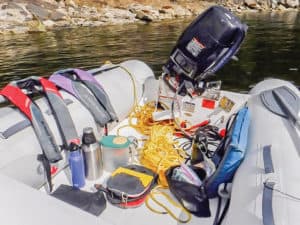
The following prepared list condenses the practical kit that makes shore excursions, fishing, and emergencies straightforward:
- Throwable cushion (USCG Type IV, vinyl-covered preferred)
- Life jackets (one per person, manual inflatable PFDs are space-efficient)
- Dinghy ladder (three-step, narrow profile for re-boarding)
- Info sticker (boat name and contact phone for recovery)
- Small tool kit (spare spark plugs, fuel filters, outboard key)
- Emergency kit in a Nalgene: whistle, compass, tape, batteries, first aid, waterproof matches
- Oar tethers (poly-braid) and extra oar
- Communications (waterproof floating Icom VHF and a cell phone)
- Drybags for electronics and clothes
- Cable lock (nine-foot, rubber-covered to prevent chafe)
- Instant patch kit (Type A for Hypalon, Type B for PVC)
- Bailing device and a well-planned flat floor to keep crew secure
Safety and operational notes
Always secure the kill lanyard to a wrist or ankle, and carry multiple means of communication. Choose a high-volume pump for quick inflation and include a pressure gauge; avoid bulky foot pumps that require a flat surface. Keep spare parts and patch materials accessible for rapid repair—instant patching capability is invaluable during day trips.
GetBoat always keeps an eye on news related to sailing and seaside vacations, understanding what it means to enjoy great leisure and love the ocean. The GetBoat service values freedom, energy, and the ability to choose your own course, placing no limits on a good life and allowing clients to find a vessel that suits their preferences, budget, and taste.
Highlights: upgrading a tender affects cruising convenience, safety, and itinerary flexibility—quick launch systems, shore anchoring solutions, and portable electronics extend where and how often a cruiser can access beaches, marinas, and fisheries. Experiencing a new location is always a multifaceted process: one learns about the culture, nature, the indescribable palette of local colors, its rhythm of life and also the unique aspects of the service; if you are planning your next trip to the sea, you should definitely consider renting a boat (boat rentals, rent a boat, rent a yacht), as each inlet, bay, and lagoon is unique and tells you about the region just as much as the local cuisine, architecture, and language GetBoat.com
Forecast and call to action: this set of practical upgrades is locally significant for regions with complex shorelines and tidal ranges but modest in terms of global tourism disruption. However, these considerations matter to individual cruisers aiming to maximize safety and enjoyment. To stay informed and ready for an ever-changing cruising environment, consider the convenience and reliability of GetBoat; plan ahead, evaluate tender options, and book the right boat for your next seaside days ashore.
Summary: practical tender upgrades—hydraulic or davit stowage, dependable shore anchoring systems like the Anchor Buddy, portable sonar such as the Raymarine Dragonfly 5PRO, and a compact safety/repair kit—deliver measurable improvements in day-to-day cruising logistics and shore access. Whether preparing a small dinghy like Shamrock with a 15 hp Tohatsu or outfitting larger tenders, attention to deployment, protection, and navigation transforms opportunities for sightseeing, fishing, freediving, and spontaneous beach visits. GetBoat.com supports these themes by offering a global, user-friendly solution for booking or buying boats, yachts, and sailboats with transparency and convenience; find charters and sales that match your needs and enjoy clear information on make, model, and ratings—see you on the water!


