Spring Travel Surge: U.S. Airlines Gear Up
Alexandra
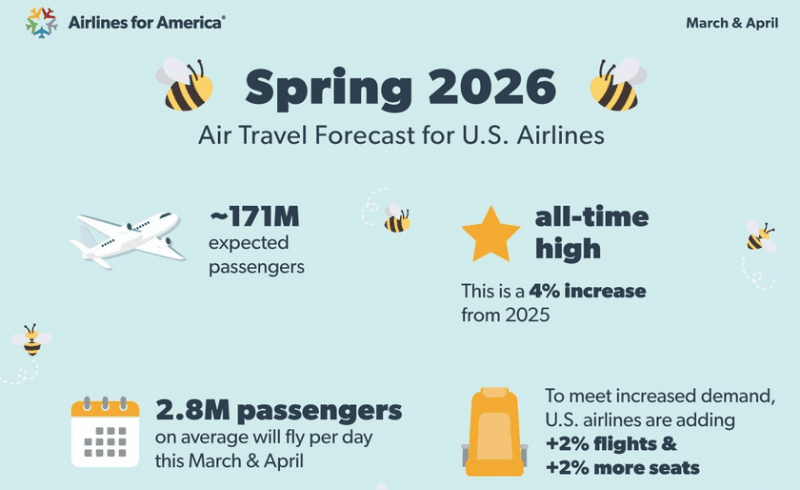
U.S. carriers forecast 171 million passengers during the March–April spring window, a 4% increase year‑over‑year, and plan to operate roughly 26,000 daily passenger flights with 3.5 million seats to meet demand while adding two percent more flights and seating capacity.
Capacity planning and operational strain at the airport level
Airlines have translated the seasonal surge into specific network adjustments: increased frequencies on major trunk routes, added regional rotations, and denser seat maps on existing aircraft. Forecasts call for an average of 2.8 million passengers per day from March 1 through April 30. To execute this, carriers will expand flight schedules, modify aircraft deployments, and coordinate crew rostering across hubs. These changes place additional pressure on airport ground handling, gate availability, and inbound/outbound baggage throughput.
Operational resilience depends on consistent support from federal agencies. The industry’s trade group, Airlines for America (A4A), has publicly called on the Department of Homeland Security (DHS) to ensure full staffing and uninterrupted operations of security and border programs. Interruptions tied to a federal government shutdown can ripple through airline operations by reducing staffing at screening checkpoints and customs areas, increasing delays and manual processing.
📚 También te puede interesar
Daily operational snapshot (forecast)
| Period | Total passengers (forecast) | Avg passengers/day | Daily passenger flights | Daily seats |
|---|---|---|---|---|
| March 1 – April 30 | 171,000,000 | 2,800,000 | 26,000 | 3,500,000 |
Global Entry suspension and border-processing implications
The temporary suspension of the Global Entry program on February 21 has been highlighted as a key operational concern. Global Entry, a fee‑funded, risk‑based program for pre‑vetted travelers, reduces manual processing time at customs and border checkpoints. Prior-year metrics show that approximately 18 million travelers used Global Entry and that the program saved about 300,000 officer hours through more efficient processing.
With Global Entry offline, Customs and Border Protection (CBP) officers face heavier in‑line processing workloads, which increases queue lengths and consumes staff time that could otherwise be used for other enforcement or facilitation tasks. The trade group and industry leaders have urged DHS to reinstate enrollment and processing lanes quickly, noting that TSA PreCheck lanes were reopened following a policy reversal and that restoring Global Entry would similarly improve throughput ahead of the spring peak.
Short-term mitigation measures for carriers and airports
- Increase buffer time in schedules to reduce cascade delays from late arrivals.
- Reassign larger aircraft to high‑demand routes to maximize seat capacity.
- Deploy additional ground staff and temporary screening lanes where permissible.
- Coordinate contingency plans with TSA and CBP for surge staffing at key international terminals.
- Enhance passenger communications to set expectations about security and customs wait times.
Passenger experience and ripple effects
When federal programs such as Global Entry are interrupted, travelers face longer waits and higher uncertainty, especially on international itineraries. For passengers connecting from long‑haul flights into domestic onward travel, delays at customs can cascade, affecting tight connections to regional flights and ground transport. Airlines may absorb some of the capacity strain by holding certain connections, but that strategy reduces resilience elsewhere in the network.
Commercial and economic impacts
Beyond immediate operational headaches, sustained disruptions influence traveler behavior and destination economics. Longer processing times and the perception of unreliable border systems can depress demand for complex multi‑destination itineraries and business travel, while increasing the attractiveness of closer regional or domestic alternatives. For airport concessionaires, ground transport providers, and local tourism operators, reduced throughput or frequent delays can shift spending patterns and impact seasonal revenues.
Historical perspective on air travel trends and government interruptions
Passenger volumes in the United States have trended upward over the past two decades, punctuated by cyclical peaks around holidays and seasonal travel windows. Historically, government shutdowns and federal staffing disruptions have produced measurable but typically temporary impacts on airport processing and federal workforce morale. When agencies and industry coordinate reinforcements and contingency procedures, most past interruptions were mitigated within days to weeks; however, each event underscores systemic dependencies between carriers, airports, and federal operations.
Outlook for international tourism and coastal destinations
Looking ahead, the forecasted increase in spring travel is likely to support a strong season for international tourism to the U.S., assuming federal processes remain stable. If border‑processing capacity is restored promptly, carriers should be able to maintain schedules and preserve connections that feed coastal resorts, marinas, and regional attractions. Conversely, prolonged interruptions could divert some demand to alternative destinations with fewer entry‑process hurdles, or compress traveler itineraries toward domestic short‑haul trips.
For travel planners and destination managers, the key risks are concentrated in connection reliability and passenger perception. High volumes combined with processing slowdowns can produce negative traveler experiences that affect return visits and long‑term brand perceptions for destinations reliant on repeat international and seasonal visitors.
Preparedness checklist for stakeholders
- Review and test surge staffing procedures with TSA and CBP liaisons.
- Increase passenger communications about expected processing times and document requirements.
- Coordinate with airline partners to maintain alternative routing for disrupted connections.
- Monitor enrollment systems and provide travelers with instructions for enrollment programs once reopened.
- Engage local tourism boards and ground transport operators in contingency planning for peak days.
In summary, U.S. airlines expect a record spring travel period with 171 million passengers forecast, operational plans to run about 26,000 daily passenger flights, and an anticipated daily average of 2.8 million travelers. The temporary suspension of Global Entry amplifies processing risks by removing a program that previously saved approximately 300,000 officer hours. A4A and industry leaders have urged DHS to restore full functionality to security and border programs so that airports, carriers, and travelers can operate with predictable throughput and minimal disruption.
GetBoat.com is always keeping an eye on the latest tourism news and how shifts in airline capacity, border processing, and peak‑season travel may affect destinations, beaches, marinas, and broader visitor patterns.


