


 简体中文
简体中文  English (UK)
  Русский
  العربية
  日本語
日本語  한국어
한국어  Magyar
  Türkçe
  Español
  Čeština
  Svenska
  Português
  Ελληνικά
  Suomi
Suomi  Nederlands
  Română
  Italiano
  Français
  Polski
  Українська
  Deutsch
  Slovenčina
 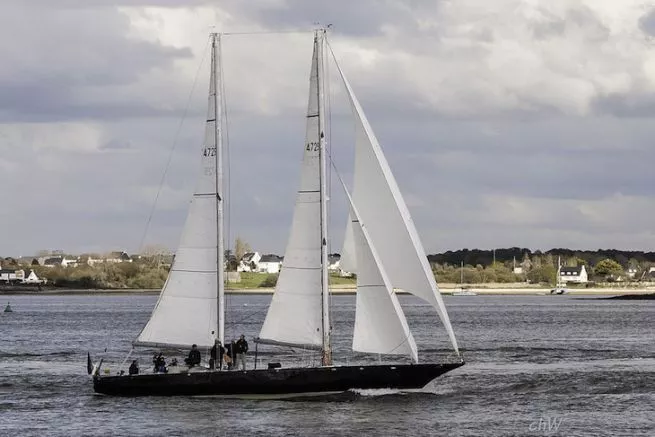 Pen Duick III’s supremacy in RORC 1968">

Pen Duick III achieved sustained speeds near 15 knots thanks to a light displacement of 12,200 kg combined with downwind sail area of 320 m2, a performance profile that changed regatta logistics and handicap handling in late-1960s offshore racing.
Design, displacement and race logistics
The schooner’s double bilge hull and lightweight construction reduced wetted surface and allowed higher average speeds with less wind. Those characteristics had direct implications for race planning and provisioning: shorter passage times altered fuel and food stowage needs, affected watch schedules, and demanded tighter coordination with ports and marinas for quick turnarounds. Race committees had to reassess handicapping and class definitions when a vessel with such a rigging package consistently outran conventionally rigged competitors.
Key naval architecture features
- Double bilge hull: improved form stability and reduced pitching.
- Large downwind canvas: 320 m2 produced exceptional surfs and planing potential.
- Light displacement: 12,200 kg permitted rapid acceleration and higher average speeds.
Campaign highlights: from Saint-Malo to Sydney
Launched on 3 June 1967, Pen Duick III immediately entered selection regattas for the French Admiral’s Cup team in Saint-Malo. The vessel outperformed contemporaries such as Francis Bouygues’ Oryx and the Renot brothers’ Gerfaut, proving especially dominant downwind. The following sequence of results established the schooner’s reputation across European offshore courses and then beyond:
Notable race results and sequences
- Morgan Cup (200-mile triangular course in the English Channel): class victory.
- Channel Race and Gotland Race: top finishes against mixed international fleets.
- Fastnet Race (approx. 600 miles): first in both corrected and elapsed time during the 1967 campaign.
- Sydney–Hobart (30 December 1967): won on elapsed time, an achievement that carried deep international media attention.
Crew composition and human factors
The crew that won Sydney–Hobart averaged just 22 years of age, the youngest team to take the race in elapsed time up to that point. Skipper Eric Tabarly led a tight, youthful watch system with Philippe Lavat, Michel Vanek, Olivier de Kersauson, Pierre English, Patrick Tabarly, Yves Gugan, Guy Tabarly and Grard Petipas at key stations—demonstrating how ergonomics, training, and crew rotation are as crucial as hull speed in offshore success.
Rule changes and rigging adaptations
Pen Duick III’s domination triggered regulatory responses. In 1968 the Royal Ocean Racing Club (RORC) moved to penalize schooner rigging configurations, a rule shift that effectively curtailed the schooner’s competitive edge under prevailing rating systems. In response, Eric Tabarly adapted the vessel’s configuration—converting Pen Duick III to a ketch in 1968 and later to a sloop in 1971—which highlights how regulatory frameworks shape both design choices and refit timelines.
| Date | Event | Result |
|---|---|---|
| 10–11 June 1967 | Saint-Malo selection regattas (Admiral’s Cup) | 1st in both selection races |
| 16 June 1967 | Morgan Cup (Portsmouth–Cherbourg–Portsmouth) | 1st in Class I & II |
| 4 July 1967 | Gotland Race | 1st in Class I |
| 2 August 1967 | Channel Race | 1st overall and in Class I |
| 10 August 1967 | Fastnet Race | 1st in elapsed and corrected time |
| 26–30 Dec 1967 | Sydney–Hobart | 1st in elapsed time, 2nd on handicap |
Media and cultural impact
The victory in Australia generated exceptional publicity: major magazines published multi-page features and photographs from onboard, bringing offshore racing stories into mainstream culture. The visual and narrative coverage elevated the sport’s profile and inspired public interest in youth sailing, offshore training programs, and yacht design debates.
Operational lessons for modern sailors and renters
For those chartering or renting modern yachts, the Pen Duick III story underlines several practical points: optimized sail plans deliver performance but demand precise crew coordination; light-displacement craft require careful ballast and provisioning planning; and rule changes can alter which rigs are competitive in a given season. These dynamics matter to anyone planning a bluewater cruise or a regatta charter, whether a day-sail off a gulf or a multi-day offshore leg between marinas.
Practical checklist for offshore charters
- Verify rig configuration and sail inventory against expected conditions.
- Plan provisioning for variable passage durations and potential rapid arrivals.
- Confirm marina turnaround and berth availability at intended ports.
- Review local race or cruising regulations that may affect permitted rigs or equipment.
Pen Duick III later continued active seasons with long-range cruises between Los Angeles and Tahiti, Cape Town and Rio de Janeiro, Mediterranean races such as the Middle Sea Race, and SORC events in Florida—showing the versatility of a vessel when adapted to changing regulatory and operational circumstances.
If you are planning your next trip to the sea, you should definitely consider renting a boat (boat rentals, rent a boat, rent a yacht), as each inlet, bay, and lagoon is unique and tells you about the region just as much as the local cuisine, architecture, and language and also the unique aspects of the service. GetBoat.com
Forecasting impact: Pen Duick III’s run was influential for class racing and designer priorities but had limited direct effect on global tourism patterns; its greatest legacy was technical and cultural, stimulating interest in offshore yachting. Start planning your next seaside adventure and make sure to book the best boat and yacht rentals with GetBoat before the opportunity sails away!
Summary: Pen Duick III’s 1967–68 campaign combined naval architecture innovation, bold crewmanship under Eric Tabarly, and consequential rule changes by the RORC. The sequence of victories—from Saint-Malo to Fastnet to Sydney–Hobart—illustrates how a single vessel can force reassessment of handicapping, rigging regulations, and logistical planning across offshore racing and cruising communities. For charterers and recreational sailors, the episode is a reminder that hull form, sail plan, crew, and port logistics determine both performance and the quality of the cruising experience. Whether you seek a yacht charter, a day sail near a beach, or an extended ocean passage, platforms that offer transparent listings—showing make, model, ratings and clear descriptions—make it easier to choose the right boat for your budget and taste. Embrace the freedom of the sea: yacht, charter, boat, beach, rent, lake, sailing, captain, sale, Destinations, superyacht, activities, yachting, sea, ocean, boating, gulf, water, sunseeker, marinas, clearwater, fishing.