


 Türkçe
  English (UK)
  Русский
  العربية
  日本語
日本語  한국어
한국어  Magyar
  Español
  Čeština
  Svenska
  Português
  Ελληνικά
  Suomi
Suomi  Nederlands
  Română
  Italiano
  Français
  Polski
  Українська
  Deutsch
  简体中文
简体中文  Slovenčina
  Choosing Between Catamaran and Monohull for Charter">

Marina berth fees and travel-lift availability frequently tip the balance: catamarans often incur up to double the berthing cost of an equivalent-length monohull, and many boatyards lack cranes rated for multihulls, which directly affects charter fleet deployment, turnaround times, and regional availability.
Accommodation and Liveaboard Logistics
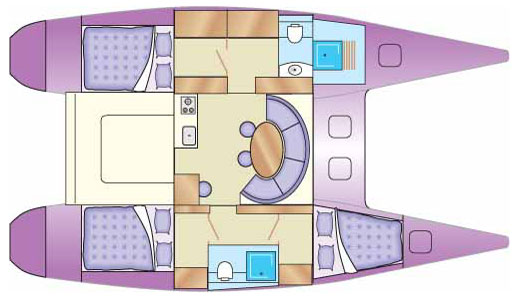
On a like-for-like length basis, a catamaran delivers significantly more usable deck and below-deck volume. The twin-hull layout produces wide saloons and cockpit spaces on one level, reducing the need to negotiate companionway steps—an operational advantage for charters focused on accessibility and family-friendly layouts.
However, a catamaran’s individual hulls are narrower, so berth layout inside the hulls can feel confined compared with modern monohull cabins that often feature walkaround double beds. For charter operators, this means configuring inventory to match guest expectations: couples may prefer monohull aft cabins, while groups and families often opt for the open-plan living of multihulls.
Practical implications for boat rentals
- Turnover efficiency: Level saloon and cockpit facilitate quicker cleaning and provisioning between charters.
- Passenger flow: Catamarans minimize trip hazards and improve moving around in rolly anchorages.
- Sleeping arrangements: Monohulls can provide more private sleeping berths in a compact hull design.
Performance: Sailing Characteristics That Matter
Light displacement and reduced wetted surface make many catamarans faster on reaches and downwind points of sail. Yet the higher windage and lack of a deep ballast keel increase leeway and reduce velocity made good (VMG) to windward unless the craft is fitted with daggerboards or foils.
Modern daggerboard and hydrofoil systems have narrowed the performance gap: well-designed daggerboards improve upwind VMG, while lifting foils stabilize pitch and reduce bridgedeck slamming. Monohulls, for their part, benefit from deeper keels and a hull form that converts heel into directional grip, giving them a steady track to windward and some forgiving behavior in gusts.
Operational notes for skippers and renters
- Daggerboard-equipped cats require active monitoring of boards and can add maintenance points for charter operators.
- Monohulls may need bow thrusters to match the close-quarters maneuverability of twin-engine multihulls.
- Under sail, expect longer tacking cycles on a catamaran; passage planning should account for different VMG profiles.
Comfort, Motion and Onboard Life
The defining comfort advantage of the catamaran is the lack of significant heeling: in anchorages and short coastal hops this translates to fewer items sliding and easier movement, which appeals strongly to casual charter guests. Underway, however, catamarans can present a jerking, slamming motion in choppy seas, especially with low bridgedeck clearance.
Monohulls provide a traditional heeling sensation that many sailors value for feedback and sail-trimming cues. For some experienced sailors, the heeled motion is part of the pleasure; for novice guests, it may feel less stable than a flat-deck catamaran.
Safety and Stability Considerations
Initial resistance to roll is higher in most multihulls, giving a convincing sense of stability at rest. Yet the dynamics differ sharply in extreme conditions: a catamaran’s angle of vanishing stability can lead to capsize without the self-righting characteristics of a ballasted monohull. Monohulls typically will either self-right or settle like a ship that has taken on water; inverted multihulls tend to remain afloat inverted, becoming a large raft.
For charter companies and renters, this affects emergency planning, life-raft placement, and training: ensuring escape hatches, redundant communications, and a clear drill for inverted-hull scenarios is essential on catamarans.
Cost of Ownership and Charter Economics
| Kategori | Catamaran | Monohull |
|---|---|---|
| Purchase price (similar LOA) | Higher | Lower |
| Bakım | Higher (two engines, two systems) | Lower (one engine, simpler systems) |
| Berthing | Often double the fee | Standard fee |
| Resale trends | Stronger demand in charter markets | Steady but lower valuations |
Higher initial and running costs for catamarans are often offset by their popularity on the charter market, where guests value space and comfort. Monohulls remain attractive for owners seeking lower entry cost and simpler mechanical systems.
Handling and Docking
Twin engines and differential thrust give catamarans precise control in tight marinas, often allowing a skilled skipper to pivot the boat in its own length. Monohulls generally need bow thrusters to match this agility. In practice, docking skills, local marina configuration, and tide/current conditions are decisive—factors every charter operator must account for in scheduling and skipper briefings.
Checklist for charterers
- Confirm crane/travel-lift capacity at your base if arriving with a catamaran.
- Review docking arrangements and berth width when booking peak-season slips.
- Ask about daggerboard or foil maintenance history on performance-oriented cats.
GetBoat always keeps an eye on news related to sailing and seaside vacations, as we truly understand what it means to enjoy great leisure and love the ocean. The service values freedom, energy, and the ability to choose your own course, placing no limits on a good life and enabling clients to find a vessel that suits their preferences, budget, and taste.
Key highlights: catamarans offer roomy, modern accommodation and flat-deck comfort ideal for social charters and families; monohulls provide proven upwind performance, lower acquisition cost, and traditional sailing feel. Experiencing a new location is always a multifaceted process—one learns about the culture, nature, the indescribable palette of local colors, its rhythm of life and also the unique aspects of the service. If you are planning your next trip to the sea, you should definitely consider renting a boat (boat rentals, rent a boat, rent a yacht), as each inlet, bay, and lagoon is unique and tells you about the region just as much as the local cuisine, architecture, and language GetBoat.com
Planning outlook and call to action
Option 3 (Focus on Planning): The practical differences between catamarans and monohulls will modestly influence the global tourism map by shaping charter offerings in marina hubs and popular cruising grounds; the impact is not geostrategic but meaningful for regional operators and travelers seeking specific experiences. It’s still important to us since GetBoat aims to stay updated with all developments and keep pace with the changing world. Start planning your next seaside adventure and make sure to book the best boat and yacht rentals with GetBoat before the opportunity sails away!
In summary, choice between a catamaran and a monohull comes down to the interplay of volume vs. ballast, upwind VMG vs. wide living spaces, and higher upfront costs vs. differing maintenance profiles. For charters, consider berth costs, travel-lift availability, guest expectations, and the kind of activities—fishing, island-hopping, or relaxed social cruising—you plan to prioritize. Whether you seek a yacht or a faster charter, a clearwater bay or an exposed gulf passage, planning ahead with transparent listings, make/model details, and ratings will improve your experience. GetBoat.com provides a global, user-friendly solution for booking or buying boats, yachts, and sailboats with transparency and convenience—helping you match budget, taste, and itinerary for unforgettable experiences. Fair winds.