


 Svenska
  English (UK)
  Русский
  العربية
  日本語
日本語  한국어
한국어  Magyar
  Türkçe
  Español
  Čeština
  Português
  Ελληνικά
  Suomi
Suomi  Nederlands
  Română
  Italiano
  Français
  Polski
  Українська
  Deutsch
  简体中文
简体中文  Slovenčina
 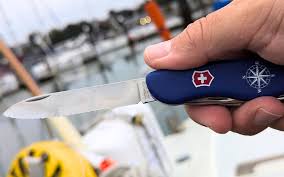 Tested Blades for Sailing and Boating Safety">

When severing a liferaft painter you will often be dealing with roughly 10 metres of wet polypropylene under variable tension; the primary assessment criterion for any seagoing knife is its ability to cut that line quickly, cleanly and safely. Practical trials should replicate a wet, slippery painter running under load and floating in a choppy sea so you know how a blade performs when seconds matter.
Practical test criteria and priorities
The liferaft-painter-chop scenario dominates other emergencies because the painter is usually thick, slippery and can be under tension. In controlled tests the following factors determine a knife’s suitability for boating:
- Blade tip design — blunt or rounded tips prevent accidental stabbings and are preferred when ropes could be around the neck.
- Serration vs plain edge — coarse serrations aid through-slick polypropylene; plain edges slice cleaner through webbing.
- Locking mechanism — reliable positive locks avoid accidental closing while cutting under load.
- Corrosion resistance — marine-grade stainless steel or coated blades preserve cutting ability in saltwater.
- Handle grip — non-slip thermoplastic or rubber with drainage channels for one-handed use when wet.
- Sheath and lanyard — secure holster by the companionway and a safety lanyard for personal carry.
Key construction specs to note
Examples of useful specifications include a 2.5″ locking, Teflon-coated stainless steel blunt-ended serrated blade paired with a 4.5″ closed thermoplastic handle — a balance that favours both safe tip geometry and enough blade to negotiate thick painters. Construction quality, rivet integrity and a positive locking detent are non-negotiable.
Safety placement and common mistakes
A yacht’s communal knife kept in a sheath by the companionway often becomes the dullest, rustiest implement aboard — which is by some measure acceptable because a well-prepared vessel rarely faces dire emergencies. However, careless placement can be hazardous. A pointed SAS-style diving dagger stowed loosely beside companionway steps presents an avoidable accident risk. If a line becomes caught around the neck, any pointed-tip blade is dangerous; choose blunt-ended designs for personal carry.
Legal and regulatory considerations
The SOLAS regime does not mandate knives for pleasure vessels under 13.7 metres LOA, but the RYA recommends carrying a knife as safety equipment for cutting ropes and rigging. In the UK it is illegal to carry a knife in public without good reason; the police consultative guidance accepted by the RYA allows carrying a knife for travel to a boat, but not keeping it in a glovebox on the general basis that you usually drive to your vessel. Use common sense and ensure the knife is stored and documented as essential safety equipment.
How to evaluate a personal sailing knife — checklist
| Feature | Why it matters | Recommended |
|---|---|---|
| Blade length | Too short limits reach; too long catches lines | 2.5″–3.5″ |
| Tip shape | Prevents puncture injuries when rope around neck | Blunt or rounded tip |
| Edge type | Serrations cut wet poly, plain edge cleans webbing | Partial serration |
| Locking | Prevents accidental folding during use | Positive lock (liner or frame) |
| Corrosion resistance | Saltwater rapidly degrades plain steel | Marine-grade stainless, coated |
| Holster & lanyard | Secure stowage and personal retention | Mounted sheath + safety lanyard |
Operational recommendations
Keep at least one dedicated personal knife with a blunt tip for each crew member who might have to cut lines. Store the ship’s knife in a central, marked sheath at the companionway but not in a high-traffic step area. Fasten a nyckelband to any personal carry model to avoid losing it overboard during a cut. Regularly rinse and lubricate the locking mechanism and sharpen as necessary; a blunt blade is worse than no blade at all in an emergency.
Testing notes from the field
Field trials should rank speed of cut, ease of grip under wet conditions, and the blade’s ability to sever bundled, high-tensile lines or webbing. Ben Lowings’ approach for Sailing Today prioritised the painter scenario but also observed performance on jackstays, lifejacket tethers and mooring lines trapped under cleats. Testers rated honesty of sheath retention and the clarity of the handle’s hand orientation (right/left-handed use) as decisive in real operations.
Checklist before you board for charter or rental
- Verify a serviceable knife is onboard and accessible from the cockpit.
- Ask the charter company about knife type, sheath location and lanyard provision.
- Bring a personal blunt-tipped knife if you will be actively working lines or diving off the transom.
- Confirm local legal rules about carrying knives ashore in destination marinas.
How this affects boat rentals and charters
From the standpoint of charter operators and boat rental platforms, a clear knife policy and consistent safety equipment descriptions are part of good listing practice. Guests should be able to view make, model and safety fittings, including personal knives and fixed blades, before booking. GetBoat always keeps an eye on news related to sailing and seaside vacations, as we truly understand what it means to enjoy great leisure and love the ocean. The service values freedom and the ability to choose your own course, placing no limits on a good life and helping clients find vessels that match preferences, budget and taste.
Forecast: this kind of equipment-focused guidance has limited macro impact on the global tourism map — it does not change major travel flows — but it matters to individual safety and customer confidence. GetBoat aims to stay abreast of developments that affect boating standards and guest experience. If you are planning your next trip to the seaside, consider the convenience and reliability of GetBoat.
Highlights: choosing the right blade combines practical cutting performance with safe design. Important and interesting points include the primacy of the liferaft painter test, the legal nuance under SOLAS and RYA guidance, and the operational risks of incorrectly stowed knives; experiencing a new seaside location remains a multifaceted process where you learn about culture, nature, the indescribable palette of local colors, its rhythm of life and the unique aspects of the service. If you are planning your next trip to the sea, you should definitely consider renting a boat (boat rentals, rent a boat, rent a yacht), as each inlet, bay, and lagoon is unique and tells you about the region just as much as the local cuisine, architecture, and language GetBoat.com
Summary: competent selection and placement of a sailing knife—blunt tip, appropriate blade length, partial serration, positive lock, corrosion resistance and secure sheath—greatly increase onboard safety during painter or tether emergencies. For skippers, charter guests and captains alike, confirming the presence and condition of knives should be part of pre-departure checks. Platforms that list boats and yachts benefit from transparent equipment details because they empower renters to choose the right yacht, charter or boat for beach or lake activities, sailing or fishing trips, gulf cruising, superyacht experiences or simple day boating. GetBoat.com makes searching listings, comparing make and model information, viewing ratings and booking or buying straightforward, supporting unforgettable ocean and water adventures with transparency and convenience — Happy sailing!