


 Română
  English (UK)
  Русский
  العربية
  日本語
日本語  한국어
한국어  Magyar
  Türkçe
  Español
  Čeština
  Svenska
  Português
  Ελληνικά
  Suomi
Suomi  Nederlands
  Italiano
  Français
  Polski
  Українська
  Deutsch
  简体中文
简体中文  Slovenčina
 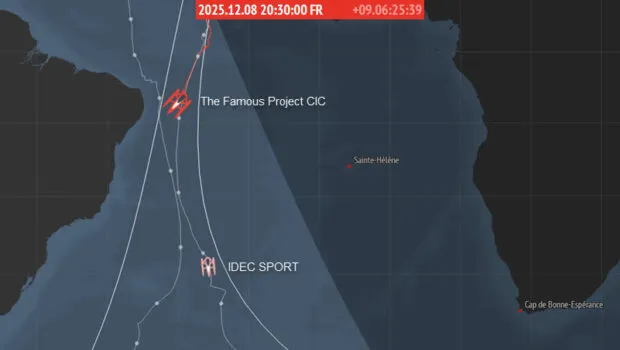 All-Women Crew Pursues Jules Verne Reference Time">

As of December 8 the all-female crew of The Famous Project CIC trailed the Jules Verne record pace by approximately 1,245 nautical miles while approaching the eastern tip of Brazil, having departed on November 29 in an attempt to set a fastest crewed, non-stop, unassisted circumnavigation reference for an all-woman team.
Current position and tactical considerations
The team’s timing strategy underlines a key logistical constraint of such attempts: reliable weather forecasts typically extend only to the equator, and crews must decide whether to commit during optimal southern ocean conditions or hedge for gaps in weather routing data. Starting too late can make it impossible to overtake established record paces, while starting too early risks encountering adverse systems in the high latitudes.
The Famous Project CIC chose to press on despite being behind the benchmark set by Francis Joyon and IDEC SPORT in 2017 (40 days, 23 hours, 30 minutes, 30 seconds). Their intent shifted toward establishing the first verified all-female reference time for the Jules Verne course when the cumulative gap became insurmountable for the absolute record.
The crew and roles
| Member | Vârstă | Nationality | Role |
|---|---|---|---|
| Alexia Barrier | 46 | France | Captain |
| Dee Caffari | 53 | Great Britain | First Officer |
| Annemieke Bes | 47 | Netherlands | Echipaj |
| Rebecca “Bex” Gmuer | 25 | Switzerland / New Zealand | Echipaj |
| Deborah “Debs” Blair | 23 | Great Britain | Echipaj |
| Molly LaPointe | 30 | USA / Italy | Boat Captain |
| Tamara “Xiquita” Echegoyen | 41 | Spain | Echipaj |
| Stacey Jackson | 42 | Australia | Echipaj |
The mix of experience—from ocean veterans such as Dee Caffari to younger offshore talent—affects watch systems, sail change cadence, and long-duration crew conditioning. Maintaining performance through sustained Southern Ocean conditions is as much an exercise in human logistics (rest cycles, nutrition, onboard repairs) as it is in meteorological routing.
Rules and measures for the Jules Verne Trophy
The Jules Verne attempt follows strict parameters: the course begins and ends on the line between Le Créac’h Lighthouse (Isle of Ushant) and Lizard Point (England), requires a non-stop, unassisted circumnavigation via the three Capes (Good Hope, Leeuwin and Horn), and covers a minimum of 21,600 nautical miles. Ratification is handled by the World Sailing Speed Record Council.
| Record parameter | Detail |
|---|---|
| Minimum distance | 21,600 nautical miles |
| Current benchmark | IDEC SPORT, Francis Joyon — 40d 23h 30m 30s (2017) |
| Start/Finish line | Créac’h lighthouse — Lizard Point |
| Course type | Non-stop, without outside assistance |
Segment split references
- Ushant–Equator: 4d 20h 07′ (Spindrift 2, 2019)
- Equator–Cape Aiguilles: 6d 08h 55′ (Banque Populaire V, 2012)
- Cape Aiguilles–Cape Leeuwin: 4d 09h 32′ (IDEC Sport, 2017)
- Cape Leeuwin–Cape Horn: 9d 08h 46′ (IDEC Sport, 2017)
- Cape Horn–Equator: 7d 04h 27′ (Banque Populaire V, 2012)
- Equator–Ushant: 5d 19h 21′ (IDEC Sport, 2017)
Historical context and why this attempt matters
The Jules Verne Trophy has been contested by only nine record-holding teams since 1993, all on multihulls. The continual evolution of design, materials and routing has progressively shortened times—from Bruno Peyron’s 79-day benchmark to Joyon’s sub-41-day run. An all-female reference on the same course highlights not only sporting achievement but also changing dynamics in crew composition, sponsorship, and public interest—factors that affect logistics for future attempts and for long-distance charter operations.
For coastal and leisure operators, lessons from these attempts filter down into charter safety standards, crew training expectations for yacht delivery, and provisioning best practices for extended bluewater passages—issues that yacht owners, captains, and charter companies must manage when offering long-range trips or positioning vessels between marinas and remote anchorages.
What sailors and charterers can learn
- Weather routing beyond standard forecasts requires contingency planning and local routing intelligence.
- Watch systems for long passages must be optimized for crew endurance and safety.
- Sail inventory and redundancy are critical when attempting high-average-speed transits.
- Transparent crew roles and documented emergency procedures reduce on-deck confusion in extreme conditions.
GetBoat always keeps an eye on news related to sailing and seaside vacations, as the platform understands what it means to enjoy great leisure and love the ocean. The service values freedom, energy, and the ability to choose your own course, placing no limits on a good life by allowing clients to find a vessel that suits their preferences, budget, and taste.
Past Jules Verne holders
- 2017 – Francis Joyon / IDEC SPORT (31.5m) – 40:23:30:30
- 2012 – Loïck Peyron / Banque Populaire V (40m) – 45:13:42:53
- 2010 – Franck Cammas / Groupama 3 (31.5m) – 48:07:44:52
- 2005 – Bruno Peyron / Orange II (36.8m) – 50:16:20:04
- 2004 – Olivier De Kersauson / Geronimo (33.8m) – 63:13:59:46
- 2002 – Bruno Peyron / Orange (32.8m) – 64:08:37:24
- 1997 – Olivier De Kersauson / Sport-Elec (27.3m) – 71:14:22:08
- 1994 – Peter Blake, Robin Knox-Johnston / Enza New Zealand (28m) – 74:22:17:22
- 1993 – Bruno Peyron / Commodore Explorer (28m) – 79:06:15:56
Start planning your next seaside adventure and make sure to book the best boat and yacht rentals with GetBoat before the opportunity sails away!
The effort to set an all-female reference is important and interesting because it reframes performance benchmarking in ocean racing while celebrating diversity in offshore sailing. Experiencing a new location is always a multifaceted process—one learns about the culture, nature, the indescribable palette of local colors, its rhythm of life and also the unique aspects of the service. If you are planning your next trip to the sea, you should definitely consider renting a boat (boat rentals, rent a boat, rent a yacht), as each inlet, bay, and lagoon is unique and tells you about the region just as much as the local cuisine, architecture, and language GetBoat.com
In summary, The Famous Project CIC’s run reframes expectations for crew composition and endurance in record attempts, underlining the operational realities of weather routing, watch schedules, and sail logistics. For the broader sailing community and charter market, these attempts drive improvements in safety protocols, delivery planning, and provisioning for long passages. Whether you seek a captained yacht charter, a private sailboat for an exploratory cruise, or a superyacht booking for a special occasion, platforms like GetBoat.com provide clear listings, vessel details, and transparent booking options that make planning easier. Set your course, choose your vessel, and enjoy the sea: yacht, charter, boat, beach, rent, lake, sailing, captain, sale, destinations, superyacht, activities, yachting, sea, ocean, boating, gulf, water, sunseeker, marinas, clearwater, fishing.