


 Română
  English (UK)
  Русский
  العربية
  日本語
日本語  한국어
한국어  Magyar
  Türkçe
  Español
  Čeština
  Svenska
  Português
  Ελληνικά
  Suomi
Suomi  Nederlands
  Italiano
  Français
  Polski
  Українська
  Deutsch
  简体中文
简体中文  Slovenčina
 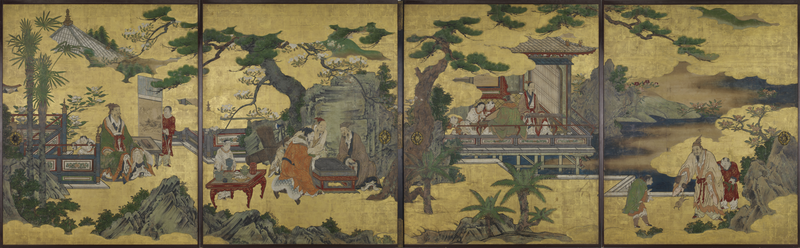 Remounting 17th‑Century Fusuma Across Institutions">

The Tateuchi Conservation Studio is preparing four 17th‑century fusuma sliding door panels for international shipment, requiring climate‑controlled crating, detailed customs documentation for cultural goods, and coordinated courier windows between Seattle, London, and Japan ahead of a summer 2026 exhibition loan.
Project overview and logistics
The set known as Kinkishoga, Sennin‑zu (The Four Accomplishments and Immortal) is undergoing complex remounting at the Seattle Art Museum (SAM) with conservation partners at the British Museum and Tohoku University of Arts and Sciences. The panels—ink, color, and gold on paper from the late Momoyama or early Edo period—were acquired by SAM in 1951 and are being treated for a loan to a Japanese exhibition next summer. Treatment logistics include staggered handling schedules to minimize exposure, cross‑institutional condition reporting, and insurance valuation updates reflecting recent attributions to the artist Kano Sogen Shigenobu.
Conservation leadership and institutional roles
Tanya Uyeda, Director of East Asian Paintings Conservation at SAM, leads the treatment of the four panels. Collaboration spans: SAM for core treatment and documentation; the British Museum for comparative material studies and object histories; Tohoku University of Arts and Sciences for technical input on Japanese mounting techniques; and the National Museum of Asian Art (Smithsonian) providing specialized facilities for large‑scale support work. Curatorial coordination is led by Aaron Rio, Tateuchi Foundation Curator of Japanese and Korean Art at SAM.
Materials, tools, and mounting specifics
Remounting fusuma requires attention to both the painted surface and the mounting system. Key materials and methods in current use include:
- Handmade Japanese papers prepared to rebuild support layers and linings.
- Animal glue for consolidating friable pigments and securing small areas of original media.
- Wheat starch paste used extensively for adhering support layers and mending tears.
- Precision tools—tweezers, soft brushes, bamboo folders, knives, and awls—to remove old linings and place new ones without stressing the paint film.
- A custom interior lattice and lacquer trim to match original mounting geometry; these components are being manufactured in Japan and fitted during final assembly.
Table: Key treatment stages and logistics
| Stage | Primary Actions | Tools & Materials | Institution/Notes |
|---|---|---|---|
| Assessment & Documentation | Condition reporting, photography, sampling | Multispectral imaging, written reports | SAM lead; shared with partners |
| Removal & Stabilization | Detach painting from old liners; surface consolidation | Tweezers, brushes, animal glue | SAM; Smithsonian assistance for large panels |
| Support Rebuild | Apply new handmade papers and linings | Wheat starch paste, bamboo folders | Collaborative methodology with British Museum |
| Lattice & Trim Integration | Fit custom lattice, reattach lacquer trim | Precision fitting tools; Japanese lacquerwork | Components made in Japan; installed at SAM |
| Crating & Export | Climate‑controlled crating; customs clearance | Shock mounts, silica gel control | Planned shipment windows to two venues in Japan |
What conservation revealed about provenance
Dismantling the panels produced documentary evidence embedded within support layers: recycled papers such as old account books, letters, and later newspapers reveal past interventions. Dates and place names on these underlayers confirmed that SAM’s fusuma were remounted at least twice since their 17th‑century shrine installation in the Nara region. Comparative study of paper sizes, fiber characteristics, and inscriptions helped link SAM’s panels with related works now in the British Museum and a set recently located in a private collection in Aomori.
Material signals and historical configurations
Sliding door paintings were traditionally double‑sided and often served as room dividers in temple guest quarters. Over centuries, fusuma could be reconfigured—split into folding screens, incorporated into handscrolls, or sectioned into hanging scrolls—so understanding the original mounting and subsequent treatments is central to reconstructing historical display practices and artistic intent.
Conservation challenges and collaborative solutions
Major technical and project management challenges include:
- Handling very large, flexible paper supports without inducing new mechanical stresses.
- Balancing historic materials conservation with reversible modern treatments.
- Coordinating treatment stages across institutions and time zones while maintaining a single object history record.
- Designing crating and courier plans that maintain strict RH and temperature tolerances during international transport.
Curatorial and scholarly outcomes
Conservation work has advanced attribution and scholarship: collaborative research led to the attribution of the SAM panels to Kano Sogen Shigenobu. Upcoming publications include an essay by Aaron Rio in the journal Kokka and contributions to the exhibition catalog. The forthcoming exhibition reunites long‑separated panels, providing public access to a dispersed suite and enriching comparative study.
Historical context and a cautious outlook
Fusuma painting has a documented history as an architectural and narrative medium in Japan, particularly during the late Momoyama and early Edo periods when large‑scale compositions adorned palaces and shrines. The conservation and reunion of dispersed panels is part of a larger trend in museum practice: material‑based scholarship that leverages technical analysis to trace object biographies. Such reunifications often reinvigorate interest in source regions—Nara and Aomori in this case—by spotlighting local heritage and prompting travel for exhibitions and related cultural events.
Implications for cultural tourism
Exhibitions that reunite dispersed works can spur destination visits and broader cultural programming. While primarily a museum initiative, the project may influence tourism flows to nearby cultural sites, beaches, lakes, and heritage routes, encouraging activities that intersect with regional hospitality, marinas, and coastal destinations. The scholarly and public visibility generated by conservation‑led attributions tends to deepen engagement among collectors, curators, and visitors alike.
In summary, the remounting of Kinkishoga, Sennin‑zu exemplifies how technical conservation, cross‑institutional logistics, and documentary research can reconstruct fragmented object histories, prepare large‑scale works for international loan, and enrich curatorial scholarship. The project required specialized materials and techniques—handmade papers, animal glue, wheat starch paste—and careful coordination among SAM, the British Museum, Tohoku University of Arts and Sciences, and the National Museum of Asian Art.
GetBoat is always keeping an eye on the latest tourism news; for those tracking cultural events that may influence destinations, yachts, beaches, lake excursions, sailing activities, and broader yachting or boating interest, this conservation and exhibition initiative highlights how museum loans and reunifications can shape attention to regions, marinas, clearwater sites, and local fishing and leisure offerings. For more on travel and cultural happenings, visit GetBoat.com.