Civilian Conservation Corps and Mt. Airy Forest
Alexandra
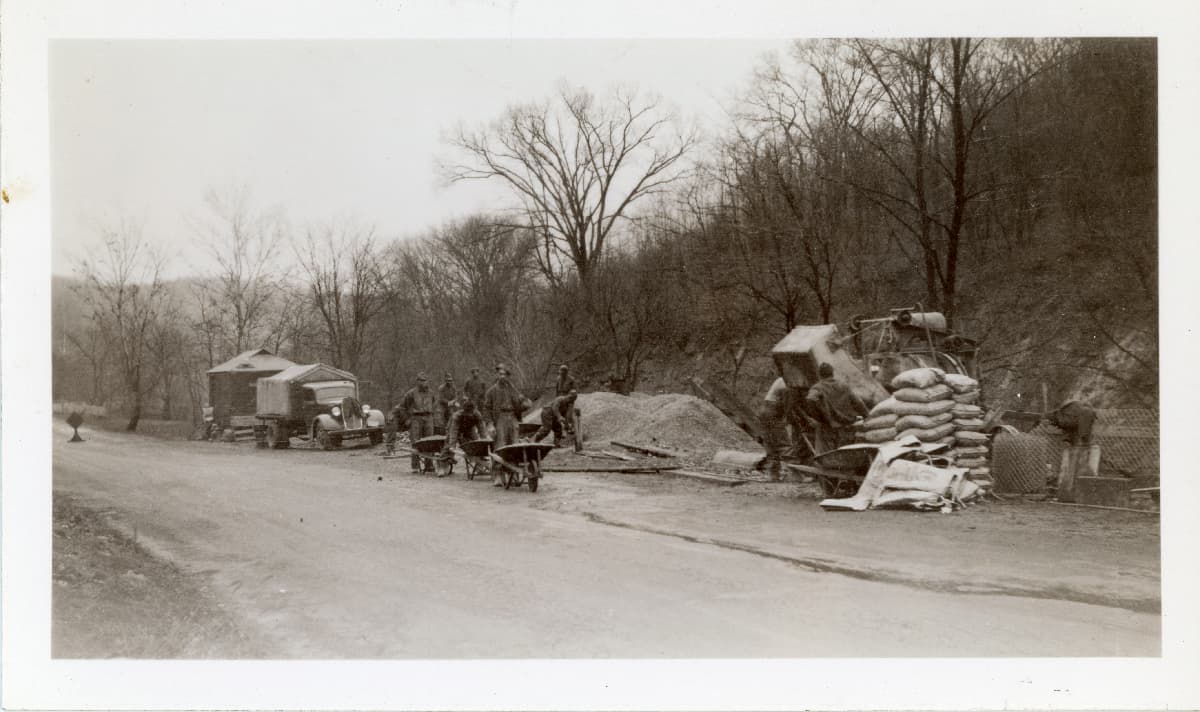
Between 1935 and 1937 the Civilian Conservation Corps (CCC) mobilized more than 200 men and logged roughly 51,414 hours of documented labor to build trails, dams, shelters, and landscape-retention structures across Cincinnati’s Mt. Airy Forest, creating an infrastructural imprint that still shapes park access and recreational logistics today.
Operational logistics and on-site infrastructure improvements
Group 1505-C, a segregated unit composed of Black enrollees, was established as the primary workforce for Mt. Airy Forest. Deployment required coordination of barracks, tools, food supplies, and transport routes to a then-remote municipal greenbelt. The CCC constructed on-site shelters for living quarters, comfort stations, and concession facilities that reduced daily transit needs and enabled continuous shifts of trail crews and tree-planting teams. Stone retention walls and small dam works improved stormwater management, stabilizing slopes and protecting downstream neighborhoods from erosion-related transport disruptions.
Key competencies applied by the crews
- Trail engineering and clearing for greater public access and emergency response routing.
- Construction of stone walls and dams to control runoff and stabilize paths.
- Planting and reforestation to restore watershed integrity and recreational landscape value.
- Building of comfort stations and concessions to support visitor services and reduce off-site logistic strain.
Projects and measurable outputs
The recorded outputs provide clear metrics for evaluating the CCC’s impact on the park’s infrastructure. Over a concentrated two-year period, the combined efforts of the CCC and supplemental Works Progress Administration (WPA) teams not only established permanent park features but also provided surge labor capacity during civic emergencies, notably the 1937 flood response in the Cincinnati area.
📚 Você também pode gostar
| Project type | Primary function | Approx. labor impact |
|---|---|---|
| Trail construction & clearing | Access, recreation, emergency routes | Thousands of man-hours |
| Stone-wall retention & dams | Runoff control, erosion prevention | Significant masonry & earth-moving time |
| Shelters and comfort stations | On-site housing; visitor services | Construction and maintenance shifts |
| Tree and field planting | Reforestation; ecosystem restoration | Continuous seasonal planting cycles |
Emergency response and cross-agency coordination
When the Ohio River flood of 1937 struck, the CCC and WPA labor pools provided critical manpower for cleanup, rescue assistance, and infrastructure stabilization. The park’s on-site facilities and nearby staging areas allowed for more rapid deployment of crews and materials, illustrating how publicly funded conservation labor can double as a logistics asset during regional disasters.
Social policy, segregation, and federal regulations
Although the CCC’s founding legislation included a non-discrimination clause authored by Representative Oscar DePriest—declaring that "no discrimination shall be made on account of race, color, and creed"—implementation varied regionally. In practice, many CCC camps were segregated to reflect prevailing local and state customs. Still, presence of Group 1505-C at Mt. Airy demonstrates a federal-level commitment to employing Black men in public-works projects, delivering tangible infrastructure benefits to Cincinnati while operating within the constraints of 1930s social policy.
Administration and workforce composition
Program administration was driven by Roosevelt-era New Deal priorities, with President Franklin Delano Roosevelt (FDR) and Secretary of Labor Frances Perkins establishing the CCC in 1933 to address both unemployment and environmental degradation. The CCC’s age-limited workforce (typically men 18–25) created a ready pool of physical laborers for civil engineering tasks that municipal agencies otherwise could not finance during the Depression.
Historical context and program evolution
Launched as part of the New Deal, the CCC formed an essential component of federal infrastructure and conservation policy in the 1930s. It built on earlier public-land management concepts while creating a new federal-local partnership model for park development and watershed protection. Over its first year and beyond, CCC camps prioritized reforestation, fire-fighting, erosion control, and the construction of public amenities—projects that shifted the balance between urban expansion and preserved green space. The CCC’s approach to labor-intensive conservation set precedents for later public-works programs, including the WPA, which provided complementary funding and personnel for larger civic undertakings.
Legacy in the urban park system
At Mt. Airy, many CCC-built features remain visible: trails used by hikers and cyclists, stone work that still performs drainage control, and park shelters that form the nucleus of contemporary visitor services. The CCC’s interventions turned a once-challenging topography into a managed landscape that supports both daily recreation and larger civic functions—storm mitigation, biodiversity corridors, and community health benefits.
Implications for contemporary tourism and recreation
Today’s park planners and tourism managers can draw lessons from the CCC’s combination of workforce mobilization and durable infrastructure investment. Well-designed trails and facilities increase accessibility, extend visitor seasonality, and can support diverse activities—walking, birdwatching, and fishing—that draw day-trippers and longer-stay visitors. Conserved urban forests also interact with regional destination networks: marinas, beaches, and lakeside areas depend on resilient watershed management upstream, while clear, well-maintained public lands contribute to broader destination appeal.
Practical takeaways for destination managers
- Investing in durable infrastructure (trails, retention walls, restrooms) reduces long-term maintenance costs and supports year-round access.
- Cross-agency labor agreements can provide surge capacity during emergencies.
- Interpretive programming that highlights historical labor projects can enhance visitor engagement and support for conservation funding.
In summary, the Civilian Conservation Corps’ work at Mt. Airy Forest represents a compact example of how targeted federal investment in conservation infrastructure can yield long-lived benefits for public access, environmental resilience, and local tourism. The deployment logistics, construction of durable park amenities, and the social dimensions of workforce policy combined to create a legacy still evident in trails, dams, shelters, and planted woodlands.
For readers tracking how historic infrastructure projects influence modern recreation and destinations, GetBoat is always keeping an eye on the latest tourism news. The Mt. Airy story ties into issues familiar to those working in coastal and inland destinations—how investments in trails, marinas, and waterfront access shape boating, sailing, beach use, fishing, and broader yachting and water activities—and underscores the value of durable infrastructure for attracting visitors to beaches, lakes, clearwater marinas, and gulf or oceanfront areas while supporting sustainable outdoor recreation.


