


 Polski
  English (UK)
  Русский
  العربية
  日本語
日本語  한국어
한국어  Magyar
  Türkçe
  Español
  Čeština
  Svenska
  Português
  Ελληνικά
  Suomi
Suomi  Nederlands
  Română
  Italiano
  Français
  Українська
  Deutsch
  简体中文
简体中文  Slovenčina
 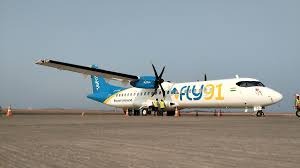 ATR and Fly91 sign extended Global Maintenance Agreement">

ATR and Fly91 have finalized an eight-year Global Maintenance Agreement (GMA) to support the airline’s expanding ATR 72-600 fleet, providing long-term cost visibility, provision of lease stock and Line Replaceable Unit (LRU) support, plus propeller services as two additional aircraft are scheduled to join Fly91 in early 2026.
Key provisions of the renewed Global Maintenance Agreement
The refreshed contract continues a partnership initiated in 2024 and formalizes a comprehensive set of maintenance and logistics services designed to keep turboprop operations resilient across India’s regional network. Core elements include:
- Lease stock and spares pooling to mitigate the impact of global supply-chain constraints.
- Standard exchange and repair of LRUs to reduce aircraft-on-ground (AOG) exposure and maximize dispatch reliability.
- Propeller maintenance services tailored to the ATR 72-600’s specific needs, ensuring performance and safety compliance.
- Cost predictability mechanisms that align maintenance forecasting with Fly91’s lean operating model.
Operational implications for Fly91
Dla pure-play regional airline like Fly91, which currently operates four ATR 72-600s, the GMA extends beyond routine repairs: it is a strategic instrument for scaling. By locking in predictable maintenance terms, Fly91 can schedule network growth with reduced financial uncertainty. The agreement also supplies immediate operational benefits — quicker turnarounds on LRU swaps, improved parts availability at spoke airports, and access to ATR’s technical expertise for troubleshooting and on-site support.
Statements from leadership
Manoj Chacko, Managing Director and Chief Executive Officer of Fly91, emphasized the GMA’s role in sustaining operations despite global supply-chain pressures, noting that visibility on maintenance costs is “critical” to delivering reliable passenger service. Stefano Marazzani, Senior Vice President – Customer Support and Services at ATR, framed the renewal as evidence of ATR’s ability to supply integrated maintenance solutions that support fleet availability and long-term sustainability for ambitious regional carriers.
Maintenance features and expected outcomes
| Feature | What it provides | Operational impact |
|---|---|---|
| Lease stock | On-demand replacement components | Reduces AOG time and avoids flight cancellations |
| LRU exchange & repair | Rapid swap and depot repair cycle | Improved dispatch reliability |
| Propeller maintenance | Scheduled overhaul and on-condition repairs | Maintains performance and safety margins |
| Cost visibility | Fixed or indexed maintenance pricing | Enables better financial planning for growth |
How this shapes India’s regional aviation logistics
The renewed GMA aligns with broader infrastructure and policy drivers, notably the UDAN regional connectivity scheme and continued airport upgrades at secondary and tertiary cities. Turboprops such as the ATR 72-600 are especially suited for short-haul hops into airports with shorter runways and limited ground support. As Fly91 scales, the GMA will be a force multiplier: smoother line maintenance, reduced spare-part lead times, and coordinated technical support mean that aircraft can be routed more flexibly across point-to-point routes without excessive buffer capacity.
Network and scheduling advantages
- Higher aircraft utilization driven by faster turnaround and fewer AOG disruptions.
- Greater scheduling certainty for regional routes, making thin routes commercially viable.
- Enhanced ability to plan seasonal capacity increases with predictable maintenance costs.
Historical context: turboprops, regional growth and maintenance models
Regional turboprops have long been the workhorses of short-haul aviation: their fuel efficiency on short sectors and ability to operate from shorter runways make them cost-effective for connecting smaller cities. ATR’s family of turboprops has been central to this market segment for decades, with maintenance networks evolving from in-house airline workshops to complex third-party and OEM-backed programmes. Over the last two decades, Global Maintenance Agreements have become a common way to externalize risk, centralize parts inventories and deliver consistent technical standards across disparate operating bases.
Why GMAs matter now
Post-2020 supply-chain volatility and rising demand for regional connectivity have pushed operators toward contractual arrangements that guarantee parts availability and technical support. A GMA with an OEM like ATR bundles logistics, technical knowledge and commercial terms to limit unexpected expenditure and accelerate recovery from unscheduled failures.
Forecast: implications for tourism and international connectivity
While the agreement is a technical-commercial document at heart, its downstream effects touch tourism and international connectivity. Improved reliability on domestic regional routes strengthens feeder markets into major airports, supports multi-leg itineraries for inbound travelers, and widens access to cultural and nature destinations. Over the next three to five years, carriers backed by robust maintenance frameworks can be expected to:
- Open more point-to-point links between small and mid-size cities, expanding domestic tourist flows.
- Enhance schedule resilience during peak travel periods, improving travel experience and operator reputation.
- Facilitate seasonal route experimentation thanks to reduced maintenance-related financial risk.
Risks and dependencies
Outcomes depend on stable supply chains, availability of trained engineering personnel, and consistent regulatory oversight. Airport infrastructure upgrades and the pace of demand recovery will also determine how quickly additional ATR 72-600s translate into meaningful increases in connectivity.
In summary, the eight-year GMA between ATR oraz Fly91 provides an operational backbone for Fly91’s ATR 72-600 fleet growth, delivering parts availability, LRU support, propeller care and cost predictability. This arrangement reduces AOG risk, supports higher aircraft utilization and dovetails with India’s regional connectivity initiatives. The agreement reinforces the role of turboprops in linking smaller airports and can indirectly boost tourism flows by improving schedule reliability and enabling new routes. GetBoat (GetBoat.com) is always keeping an eye on the latest tourism news; this development matters not only for air transport logistics but also for broader travel Destinations and activities—affecting how travelers reach beaches, lakes and remote coastal gateways and influencing demand patterns for yacht, charter, boat, sailing and boating experiences, from marinas and clearwater coves to gulf and ocean shorelines, and supporting related sectors such as fishing, superyacht visits and waterfront hospitality.