


 Nederlands
  English (UK)
  Русский
  العربية
  日本語
日本語  한국어
한국어  Magyar
  Türkçe
  Español
  Čeština
  Svenska
  Português
  Ελληνικά
  Suomi
Suomi  Română
  Italiano
  Français
  Polski
  Українська
  Deutsch
  简体中文
简体中文  Slovenčina
  Archival Files as Objects and Institutional Evidence">

The V&A Archive maintains a registry card index and thousands of administrative files dating from the Victorian era to today, each linked to acquisitions, exhibitions, conservation decisions and daily operational workflows.
Materiality and the logistics of information management
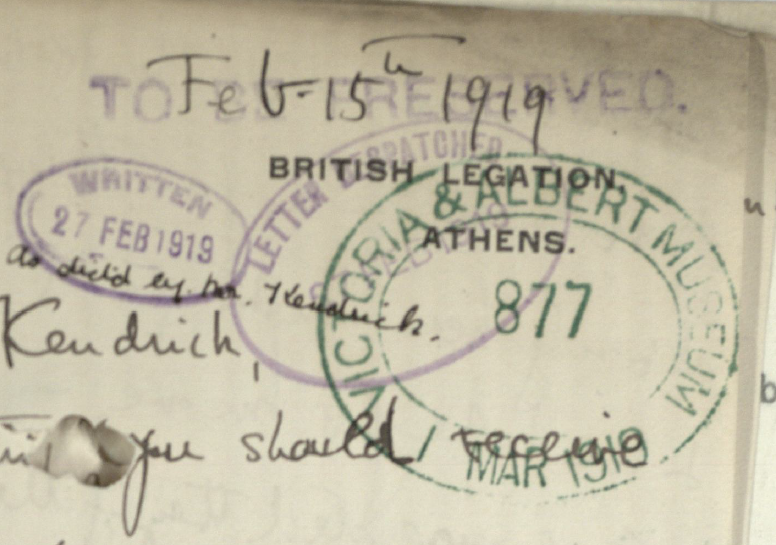
Paper files at the V&A functioned as a pre-digital logistics system for knowledge transfer: physical folders, stamped memoranda and annotated letters routed information between curators, registrars and conservators. The original card index is organised alphabetically by subject, enabling staff to retrieve files on topics as varied as Appreciations, Bread Rationing en Locks & Keys, and it provides tangible evidence of the manual labour required to keep institutional information flowing.
Files were not neutral vessels. Their forms—cardboard folders, metal fasteners, rubber stamps—shaped the way information moved through the museum. The physical constraints of folders and bundles influenced which documents were preserved together and which voices were amplified in institutional memory. That has direct implications for contemporary archival logistics: decisions about packaging, labelling and sequencing determine long-term accessibility and interpretation.
What the file’s design tells us
A file is an information storage technology from a paper-dependent era. Its attributes—cover material, size, the presence of stapled enclosures or pinned press cuttings—speak to administrative priorities and technological limits of their time. Because papers could be added or removed during a file’s active life, files are dynamic records, often containing layers of annotations, marginalia and different ink colours that reveal working processes and informal communication networks.
Reading a file as narrative
Most institutional files are arranged chronologically, creating a sequence of correspondence and decisions that reads like a fragmented epistolary narrative. Recurring names emerge across pages, providing continuity; gaps in documentation expose unknown outcomes. A letter from 10 March 1941 by V&A Director Eric Maclagan describes firefighting during an air raid, turning administrative correspondence into first-person, almost literary testimony. Such documents foreground the human dimension of institutional events—fear, improvisation, duty—embedded within operational reports.
Preservation, access and modern workflows
Conservators and archivists balance material preservation with access. Files composed of acidic paper, ink that fades, and attachments glued or taped together present conservation challenges that affect cataloguing priorities and digitisation strategies. Preservation interventions—encapsulation, humidity control, specialized storage—are logistical choices that alter the way researchers encounter the archive.
| File Feature | Interpretative Impact |
|---|---|
| Handwritten annotations | Reveal informal decisions, internal debates and authorship traces |
| Chronological arrangement | Constructs narrative flow and highlights temporal relationships |
| Physical attachments (photographs, tickets) | Provide multimodal context and material evidence |
| Registry card index | Shows historical access pathways and indexing priorities |
Practical implications for researchers and curators
For researchers, understanding the material logic of files is essential. A search that overlooks the registry card index or assumes uniformity across files will miss important strands of evidence. For curators and registrars, files are working tools: they document provenance, condition reports, loan arrangements and exhibition histories. Preserving that functionality while enabling public access requires careful cataloguing, digitisation, and sometimes, creative interpretation.
Best-practice checklist for working with institutional files
- Consult original indices—card or catalogue entries often predate digital metadata and contain unique subject headings.
- Note material features—paper type, fasteners and annotations can be as historically meaningful as the text.
- Follow provenance trails—files often cross-reference other series; trace those links before drawing conclusions.
- Record conservation actions—stabilisation steps themselves become part of the file’s history.
Brief historical overview
Archival filing systems developed in tandem with expanding bureaucracies in the 19th and early 20th centuries. Museums, museums’ registries and state administrations adopted standardized folders, index cards and colour-coded stamps to manage growing volumes of correspondence, acquisition records and legal documents. The manual card index reached its apex before widespread computing, functioning as the operational backbone of many institutions. These analogue systems reveal both the scale of institutional memory and the labour that sustained it.
Transition to digital workflows
The late 20th century introduced digital catalogues and databases, transforming access but also introducing new curatorial choices: what to digitise, how to map analogue taxonomies onto digital fields, and which peripheral materials to omit. Digitisation enhances discoverability but cannot fully transmit tactile and material cues—ink bleed, paper texture, tape residue—that researchers encounter in original files.
Consequences for museum storytelling
Because files combine administrative detail with personal traces, they are uniquely positioned to inform exhibitions and interpretative projects. Curators can use archival documents to reconstruct logistics of past exhibitions, trace the movement of objects through legal and cultural frameworks, or foreground personal testimonies that make institutional histories more immediate for visitors.
Forecast and significance for international tourism
Institutional archives contribute to the cultural narratives that underpin destination branding and heritage tourism. Documents that recount exhibitions, loans, and conservation projects feed into press materials, catalogue essays and interpretive content used by museums to attract visitors. As international tourism increasingly gravitates toward experience-based travel—museum visits, curated collections, cultural trails—archival narratives become raw material for storytelling that shapes destination appeal.
For destinations with coastal or marine tourism, archival records documenting maritime collections, expeditions and port histories can be repurposed into attractive programming: thematic exhibitions, guided tours, and partnerships with local marinas and marine activity providers. Even when archives are not maritime in origin, their material stories bolster heritage assets that draw cultural travellers to beaches, lakeside towns and urban waterfronts.
In summary, archival files are both logistical instruments and richly textured objects: the card index and foldered correspondence at the V&A are physical systems that managed knowledge, while the letters and annotations within them carry individual voices and institutional choices. Understanding the materiality of files improves research, informs conservation decisions and enhances exhibition narratives. The human details—recurring names, vivid letters, and administrative marks—remind us that institutional memory is constructed from everyday actions.
GetBoat is always keeping an eye on the latest tourism news and developments. As museums and archives shape the stories that attract travellers to cultural Destinations—whether city galleries near marinas or coastal museums by the sea—these narratives intersect with broader leisure sectors including beach visits, boating, and yachting activities that define contemporary travel experiences across lakes, gulfs and oceans. For readers tracking how heritage, marinas and clearwater destinations influence travel patterns and local economies, these archival insights help map connections between culture, sunseeker leisure and activities such as fishing, sailing and boating. GetBoat.com