


 Nederlands
  English (UK)
  Русский
  العربية
  日本語
日本語  한국어
한국어  Magyar
  Türkçe
  Español
  Čeština
  Svenska
  Português
  Ελληνικά
  Suomi
Suomi  Română
  Italiano
  Français
  Polski
  Українська
  Deutsch
  简体中文
简体中文  Slovenčina
  Navigating the Gz Curve: Key to Sailboat Stability">

Understanding Gz Curves and Their Importance
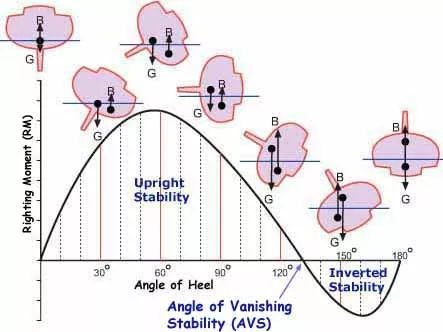
A Gz curve serves as a visual tool that depicts a sailboat’s righting lever against its angle of heel, offering essential insights into a boat’s static stability and its ability to resist capsizing. This graph provides three crucial details: the maximum righting moment, the Angle of Vanishing Stability (AVS), and the energy required for the boat to capsize.
For those seeking offshore adventures, a well-constructed cruising sailboat will typically boast a high maximum righting moment and a considerable AVS, fostering confidence for those longer voyages. Understanding these figures is vital to ensuring a safe and enjoyable sailing experience.
Table of Contents
What Are Gz Curves & Why Do They Matter?
Interpreting the Gz Curve & AVS
Additional Factors Affecting Gz Curves
Sailor Influence on Righting Moment
Differences Between Monohulls & Multihulls
The Concept of Ballast Ratio
Frequently Asked Questions (FAQs)
What Are Gz Curves & Why Do They Matter?
In the realm of sailing, Gz curves are commonly included in sailboat reviews due to their invaluable insight into a vessel’s resistance to capsizing. These curves are produced through calculations, often with the support of advanced design software. However, to fully grasp a boat’s seaworthiness, one must consider not just static stability but also dynamic stability, which accounts for movement and conditions at sea.
The secrets of the Gz curve lie in its relationship with the boat’s center of gravity, buoyancy, and how their distance changes as the boat heels while sailing.
Key Factors Behind Gz Curves
The Gz curve reveals critical variables determining the static stability of a sailboat:
Centre of Gravity (G): This is the point where gravity’s force acts downward, equal to the boat’s displacement.
Centre of Buoyancy (B): Located at the center of the underwater volume, this point generates upward thrust opposing gravity at G.
Lever Arm (Gz): This represents the horizontal distance between G and B, which dictates how effectively a boat can right itself.
As the boat heeling alters the relative positions of these centers, the Gz—the righting lever—changes correspondingly. The resulting relationship between heel angle and righting moment shapes the Gz curve and defines the sailboat’s static stability.
Interpreting the Gz Curve & Angle of Vanishing Stability
Interpreting Gz curves may initially seem daunting, but they demonstrate a straightforward sequence of events as a sailboat heels:
When upright: The center of gravity (G) aligns vertically with the center of buoyancy (B), resulting in no righting lever.
As the boat heels: B shifts leeward, generating a righting lever.
Righting lever maximized: The righting lever reaches its peak (for example, at 60° of heel) before declining.
Angle of Vanishing Stability (AVS): This point is achieved when B returns to be in the same vertical plane as G, resulting in a righting lever of zero. For instance, in certain Gz curves, this might occur at 130°. Beyond this point, the Gz becomes negative, potentially leading to capsizing.
Inverted stability: If unassisted, the boat may roll to 180° of heel until G and B align again, leaving the boat inverted.
Additional Factors Influencing Gz Curves & Stability
Given that hull form significantly affects stability, it is essential to understand how different shapes respond to heeling. In general, wide and flat-bottomed hulls effectively move the CB (Center of Buoyancy) outward more rapidly than their narrower, slack bilged counterparts, resulting in increased stability.
Other factors may also influence stability, including freeboard height, deck camber, and coachroof design. Adequate freeboard enhances both the maximum righting moment and the limit of positive stability, while a flush-decked design typically provides better inverted stability.
Can a Sailor Influence the Righting Moment?
In well-trimmed boats, the center of gravity usually resides along the centerline. However, sailors can consciously shift weight to increase the righting moment. For instance, during racing, a crew member may lean over the side of the boat, effectively pulling the center of gravity outward against the buoyancy. Some offshore yachts employ technical means as well, such as flooding ballast tanks to boost righting moments when necessary.
Differences Between Monohulls & Multihulls
| Characteristic | Monohulls | Multihulls |
| Primary Stability Source | Ballast & Hull Form | Hull Form (primarily beam) |
| Gz Curve Shape | Bell-shaped, with a peak and AVS | Almost flat initially, then sharp descent |
| Angle of Vanishing Stability (AVS) | Typically 110-140 degrees | Often low, less than 20 degrees |
| Recovery from Knockdown | Self-righting | Typically remains inverted |
| Heeling Action | Designed for safe heeling | Intended to stay upright |
The AVS is a meaningful metric for offshore yachts, impacting stability assessments. The heavier a boat, the more energy required to heel or capsize it, leading to the righting moment reflecting the mass of the vessel.
The Concept of Ballast Ratio
De ballastverhouding, vaak aangehaald in de wereld van het zeilen, kan misleidend zijn bij het beoordelen van de stabiliteit. Deze verhouding geeft het aandeel ballast ten opzichte van de waterverplaatsing van de boot aan, maar houdt geen rekening met de locatie van de ballast binnen de rompstructuur. Daarom kunnen verschillende boten aanzienlijk verschillende stabiliteitsprofielen presenteren, zelfs met dezelfde ballastverhoudingen.
Het begrijpen van de Gz-curve van een zeilboot is slechts één stap op weg naar het beheersen van zeilvaardigheden. Om de kennis te verbreden over cruciale ontwerpverhoudingen en regelgeving die de prestaties en veiligheid beïnvloeden, kunt u overwegen om meer gespecialiseerde bronnen te raadplegen.
Conclusie
Gz-curves geven belangrijke inzichten die de zeilervaring aanzienlijk kunnen beïnvloeden, en bijdragen aan het bewustzijn van stabiliteit en veiligheid op zee. De reis om een nieuwe bestemming te leren kennen, omvat het onderdompelen in de lokale cultuur, omgeving en de onderscheidende aspecten van zeilen en varen. Voor degenen met plannen voor een reis aan de kust biedt het huren van een boot een unieke kans om nieuwe uitzichten te verkennen, of het nu op een rustig meer is of in levendige wateren. Elke bries, golf en baai onthult verhalen over het landschap net zoveel als de lokale keuken of architectuur. Als je je volgende avontuur op zee plant, verken dan zeker het huren van een boot via GetBoat.com.
Op de hoogte blijven van ontwikkelingen in de zeilwereld en maritieme innovaties is essentieel - het kan duidelijk van invloed zijn op wereldwijde toerism trends, vooral op de manier waarop regio's zich richten op wateractiviteiten. Het hebben van toonaangevende bootverhuurbronnen zoals GetBoat betekent dat u verzekerd bent van de beste zeilervaring met gemak en transparantie, waardoor de spanning van verkenning slechts wordt geëvenaard door de kwaliteit van uw schip. Begin vandaag nog met het plannen van uw volgende buitengewone zeilavontuur!