WLYC 24 Hour Race 2026 — Southport Returns
Alexandra
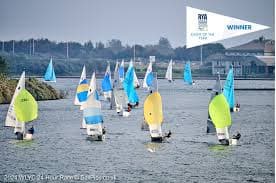
The 2025 WLYC 24 Hour Race staged on Southport’s Marine Lake drew 80 entries and roughly 850 competitors, racing GP14s, Enterprises and reinstated Fireflies continuously under floodlights across mixed wind conditions from mid-September into the early morning.
Race overview and operational facts
The West Lancashire Yacht Club (West Lancs YC) ran the event with hundreds of volunteers managing launching, race control, onshore safety and shift logistics across a 24‑hour timetable. Competitors sailed in rotation on a pre-planned two-hour watch system, with teams using tents, vans, hotel rooms and local facilities for crew changes and rest. Ovington’s supplied a fleet of demo Fireflies, facilitating quick class recovery and standardized maintenance across the busiest shift windows.
Entries, classes and participation
Entries were split across three core classes: GP14, Enterprise and Firefly. The event recorded a notable resurgence in university and club teams, with the National Firefly Association (NFA) taking the overall win and multiple internal race trophies. The field composition and the use of floodlit lake racing made for compact race management but required tight coordination of safety launches and shore handlers at all hours.
📚 You may also like
Weather, tides and race management
Variable conditions—ranging from fresh, gusty spells to lighter, tidal-influenced lulls—demanded adaptive sail trim, reefing and watch scheduling. Race officials emphasized continuous communication via VHF and signal lights due to night operations. The combination of a sheltered lake and floodlighting reduced navigational complexity while concentrating tactical and crew endurance as the decisive factors.
Results snapshot and prize distribution
| Place | Team / Club | Class | Notable Awards |
|---|---|---|---|
| 1 | National Firefly Association (NFA) | Firefly | Southport Centenary Trophy; BBC Radio Merseyside Cup; Dog Watch Trophy; Heineken Cup |
| 2 | Southampton University SC | Firefly | Overall runner-up |
| 3 | Budworth SC | GP14 | The Warren Cup; Bolton Cup; Granville Wallis Trophy; The Budworth Cup |
| 10 | Ogston SC | Enterprise | R.I. Atkinson Cup; The Midnight Cup |
Key tactical takeaways
- Watch discipline: Two-hour stints proved effective for endurance and consistent lap times.
- Boat preparation: Demo Fireflies from Ovington’s showcased the value of standardized, well-tuned craft for longer events.
- Rest strategy: Competitors who combined short, high-quality rests with scheduled watch swaps preserved sharpness for dawn and night shifts.
Team structure and human factors
Winning teams commonly used a core roster supplemented by short-shift sailors. The NFA team relied on six core members rotating consistently, with additional sailors covering gaps and providing tactical bursts. Efficient shore logistics—secure changing areas, rapid sail repairs, and hot food and hydration stations—proved decisive for boat speed and crew morale during twilight and night periods.
Roster example — NFA winners
- Jenny Smallwood (team captain, Firefly rep on steering committee)
- Angus Cook
- Guy Davison
- Steve Tylecote
- Philip Aldhous
- Lucie Hopkins
- Julian Mecklenburgh
- Joshua Speakman-Lowe
- Tash, Poppy and Isla Armstrong
Historical context and class revival
The WLYC 24 Hour Race began in 1967 and has periodically paused—most recently during fuel-related and pandemic interruptions—but the 2025 edition marks a clear revival. Fireflies were part of the inaugural fleet and their formal reinstatement this year, driven by renewed interest in student sailing, has provided a visible pathway for younger sailors to enter round‑the‑clock racing formats.
Why the Firefly comeback matters
Fireflies are lightweight, responsive dinghies well suited to coachable university crews and club sailors. Their return boosted participation from students and university sailing clubs and created a competitive bridge between grassroots racing and endurance events, which in turn stimulates demand for coaching, demo craft and short-term rentals.
Implications for sailing, charter and boat rental markets
Localised demand spikes for class boats, training sessions and short-term charters often follow high-profile grassroots events like WLYC. Expect increased interest in Firefly and GP14 training, more requests for demo or short-term hire boats in club areas, and higher occupancy at nearby marinas and accommodation during future race weekends. GetBoat always keeps an eye on news related to sailing and seaside vacations, as the team understands what it means to enjoy great leisure and love the ocean; the service values freedom, energy and the ability to choose your own course, and places no limits on a good life, allowing clients to find a vessel to suit their preferences, budget and taste.
Practical advice for clubs and operators
- Coordinate a demo fleet with manufacturers to lower barriers for university teams.
- Plan shore logistics well in advance—lighting, safety launches, and rest facilities reduce crew fatigue.
- Build partnerships with local accommodation and transport to support out-of-area teams.
Highlights and cultural value
The 2025 race showcased endurance sailing’s ability to unite generations: university sailors, club stalwarts and classic class enthusiasts. The Firefly’s strong performance has rekindled interest among younger crews, adding momentum to both competitive racing and recreational participation. Experiencing a new location is always a multifaceted process, where one learns about the culture, nature, the indescribable palette of local colors its rhythm of life and also the unique aspects of the service. If you are planning your next trip to the sea, you should definitely consider renting a boat (boat rentals, rent a boat, rent a yacht), as each inlet, bay, and lagoon is unique and tells you about the region just as much as the local cuisine, architecture, and language GetBoat.com
Forecasting how this news affects global tourism: the WLYC revival is regionally significant rather than a global turning point, but it demonstrates the resilience of grassroots events and their role in sustaining coastal tourism and marina activity. However, it remains relevant to customers because small regattas drive local charter demand and community engagement. GetBoat aims to stay abreast of these developments and keep pace with the changing world; if you are planning your next trip to the seaside, consider the convenience and reliability of GetBoat.
In summary, the WLYC 24 Hour Race 2025 restored a classic endurance dinghy event through solid volunteer logistics, effective class reinstatement and strong university engagement. The Firefly’s return proved pivotal for participation and youth recruitment, while GP14 and Enterprise teams continued to push competitive standards. For anyone involved in yachting, charters, or club operations, the event underlines the value of coordinated shore planning, demo fleets and targeted outreach. Whether seeking a yacht charter, a day sail, or a sailing course, platforms that offer transparent listings, model details and ratings make it easier to find the right boat for beach trips, lake days and sea voyages. The event points to growing demand across marinas and coastal activities—yacht, charter, boat, beach, rent, lake, sailing, captain, sale, destinations, superyacht, activities, yachting, sea, ocean, boating, gulf, water, sunseeker, marinas, clearwater, fishing—and shows why having a clear, trusted marketplace matters. Chart your own course.


