Tactical Lessons from Winter Vashon 2026
Alexandra
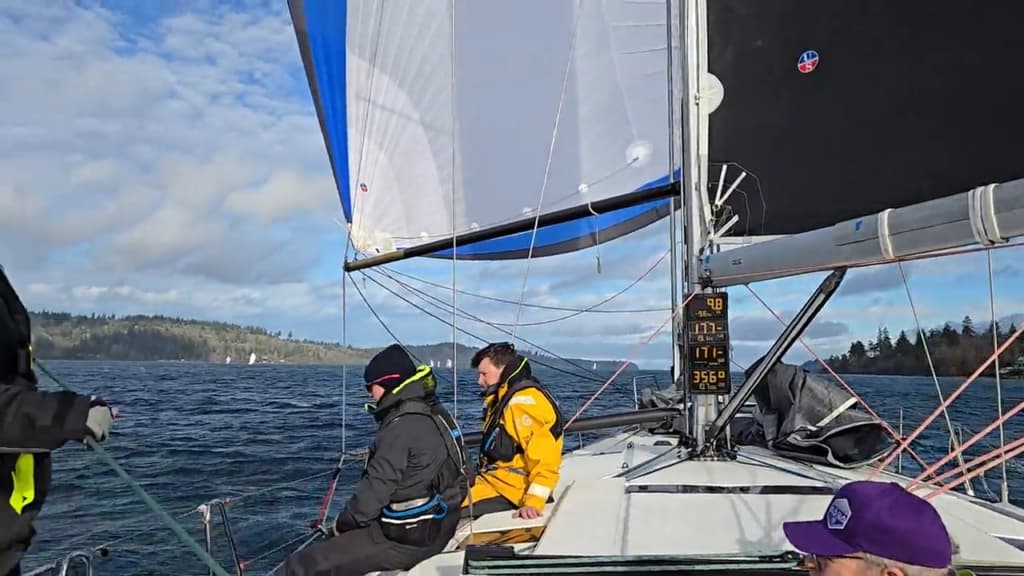
Race Committee sequencing of 44 boats into seven classes required staggered starts and on-the-water repositioning when the pin dragged, delaying the PHRF and ORC fleets by roughly 30 minutes and forcing the RC rib to physically hold position to preserve a fair line for the launch sequence.
Weather, forecasts and pre-race logistics
Mid-week forecasts indicated a lull between two low fronts, but by race day the pattern consolidated into a strong southwest flow. Dockside winds in Des Moines recorded sustained mid-20s knots with gusts to 37 knots, making the marina exit and crossing to Point Robinson one of the more challenging transit legs in Southern Sound conditions. Teams adjusted sail inventories accordingly, favoring heavy weights and conservative sail plans for robust offshore and lee-shore handling.
Historical context and fleet makeup
Winter Vashon has been run since the late 1980s and draws experienced fleets from clubs such as Tacoma Yacht Club (TYC) and Three Tree Point Yacht Club (TTPYC). Boats ranged from light racers to heavy cruisers; the author’s progression from the S2 9.1 Chinook to the Jeanneau SO 519 Equus illustrates the race’s appeal across platforms. Fleet numbering and class splits demanded precise planning for starts, particularly given localized puffy winds near shore and rotating angles caused by adjacent hills.
📚 You may also like
Start sequence and immediate tactics
The start line placement close to shore produced highly variable, puffy conditions. With the pin dragging early, the RC was forced to hold the rib, compressing timing windows and increasing the risk of premature starts. The PHRF and ORC groups ultimately started about thirty minutes after the non-PHRF and cruising fleets, while the RC executed a seven-class sequencing plan for the field of 44 entrants. Accurate sighting tools—binoculars on the RC boat—proved decisive for timing.
Key start maneuver
Onboard, the chosen configuration for a downwind reach was a full main and a J2 with a 120% overlap. A gust-induced acceleration near the line produced an almost-over early situation: the helm dropped to initiate a near-tack, the jib backwinded, and a rapid reorientation to port allowed the boat to cross the line with momentum. The resulting start was messy but effective, illustrating that quick helm decisions and crew discipline can convert a marginal approach into a class-leading position.
Downwind strategy for heavy-displacement boats
The Equus displacement (~34,000 pounds) dictated a deep-angle downwind approach rather than aggressive reaching used by lighter boats. Despite asymmetric spinnakers, the team used a pole and a reaching strut to maintain shape and protect deck hardware. Heavy boats must weigh the extra distance versus higher VMG; for Equus, minimizing jibes and maintaining apparent wind angles between 165° and 175° proved optimal while avoiding sailing by the lee.
Traffic, wakes and unexpected interactions
In Colvos Passage the crew encountered a ferry that altered course unexpectedly and produced a significant wake and a local wind hole. The transient disturbance caused a crash jibe and the spinnaker to backwind, creating a complex sail-handling recovery. Key takeaways: anticipate commercial traffic in narrow channels, maintain communications where possible, and prepare for immediate sail control after a large wake-induced wind drop.
Crew and equipment management checklist
- Sail selection: match heavy-weight sails to forecasted gust windows.
- Rig protection: use reaching struts to prevent stanchion stress during pole maneuvers.
- Reduced maneuvers: minimize tacks and jibes to conserve crew strength and prevent gear overload.
- Watch rotation: assign clear roles for navigation, sail trim, and lookout for commercial traffic.
- Spinnaker recovery drills: rehearse rapid declutter and re-hoist under load.
Race progression and finish
After rounding the north mark and managing fluctuating wind angles in the mid-channel, the boat held 9.5–10.5 knots in 20–30 knot winds with only one jibe north of Command Point. The southbound leg featured rapid oscillations — 9 knots to 30+ knots and back — producing lifts and headers of up to 30° in short succession. Strategic centerline routing, timely tacks to cover rivals, and a clearance maneuver for commercial traffic near Tango Bravo helped preserve position. Rain obscured the finish, but the final approach was clean with no gear or crew injuries.
| Result | Class/Boat |
|---|---|
| Corrected First Overall | Jeanneau SO 519 Equus |
| Class Tops | C&C 34 Jolly Rumbalow; C&C 38 Atet; Aerodyne 38 Kahuna; Melges 24 Take Off!; Burns 49 Schooner Sir Isaac; Cal 33 Cherokee; Cal 40 White Squall; Sydney 38 Mako |
After-race: repairs and debrief
Post-race rituals included rig folding, chilled Kraken Rum shots, and a quick debrief in the club to discuss sail choices and muscle fatigue. The absence of damage across the fleet highlighted prudent equipment preparation and conservative sail selection for variable Southern Sound conditions. The volunteer effort from Tacoma Yacht Club ensured a well-run event and safe on-water management.
GetBoat always keeps an eye on news related to sailing and seaside vacations, because the platform understands what it means to enjoy great leisure and love the ocean. The GetBoat service values freedom, energy, and the ability to choose your own course, placing no limits on a good life and allowing clients to find a vessel that suits their preferences, budget, and taste. Users can preview make, model, ratings and transparent details ahead of time to find the right match for a partner cruise, solo escape, or group adventure.
Forecast: this edition of Winter Vashon is regionally significant for Pacific Northwest yachting but unlikely to alter global tourism maps. However, local regattas like this influence charter demand for coastal and island itineraries, inform skipper training priorities, and shape seasonal equipment rentals. It remains relevant to customers because GetBoat aims to stay abreast of developments and keep pace with an ever-changing maritime environment. If you are planning your next trip to the seaside, consider the convenience and reliability of GetBoat.
Highlights: Winter Vashon 2025 showcased the importance of strategic start sequencing, conservative sail choice for heavy displacement hulls, and on-water awareness of commercial traffic and wakes. Experiencing a new location is a multifaceted process where one learns about the culture, nature, the indescribable palette of local colors, its rhythm of life and also the unique aspects of the service. If you are planning your next trip to the sea, you should definitely consider renting a boat (boat rentals, rent a boat, rent a yacht), as each inlet, bay, and lagoon is unique and tells you about the region just as much as the local cuisine, architecture, and language GetBoat.com
Summary: Winter Vashon 2025 delivered tactical lessons for sailors and charterers alike — from start-line logistics and sail inventory decisions to heavy-boat downwind technique and traffic management in confined channels. For those seeking yacht charters, boat rentals or sale insights, events like this underline the value of a knowledgeable captain, proper gear, and local route intelligence. GetBoat.com supports these needs by offering transparent listings for yacht and boat charters, enabling users to compare vessels and book marinas, captains, and activities across Destinations and marinas worldwide. Whether planning a superyacht experience or a small boat outing for fishing, sailing or cruising to a clearwater bay, GetBoat delivers a global, user-friendly solution for unforgettable sea and ocean adventures — rent, charter, or sale, make your course now; set sail today.


