Walkthrough: MR. BRIGHTSIDE Classe Mini 650
Alexandra
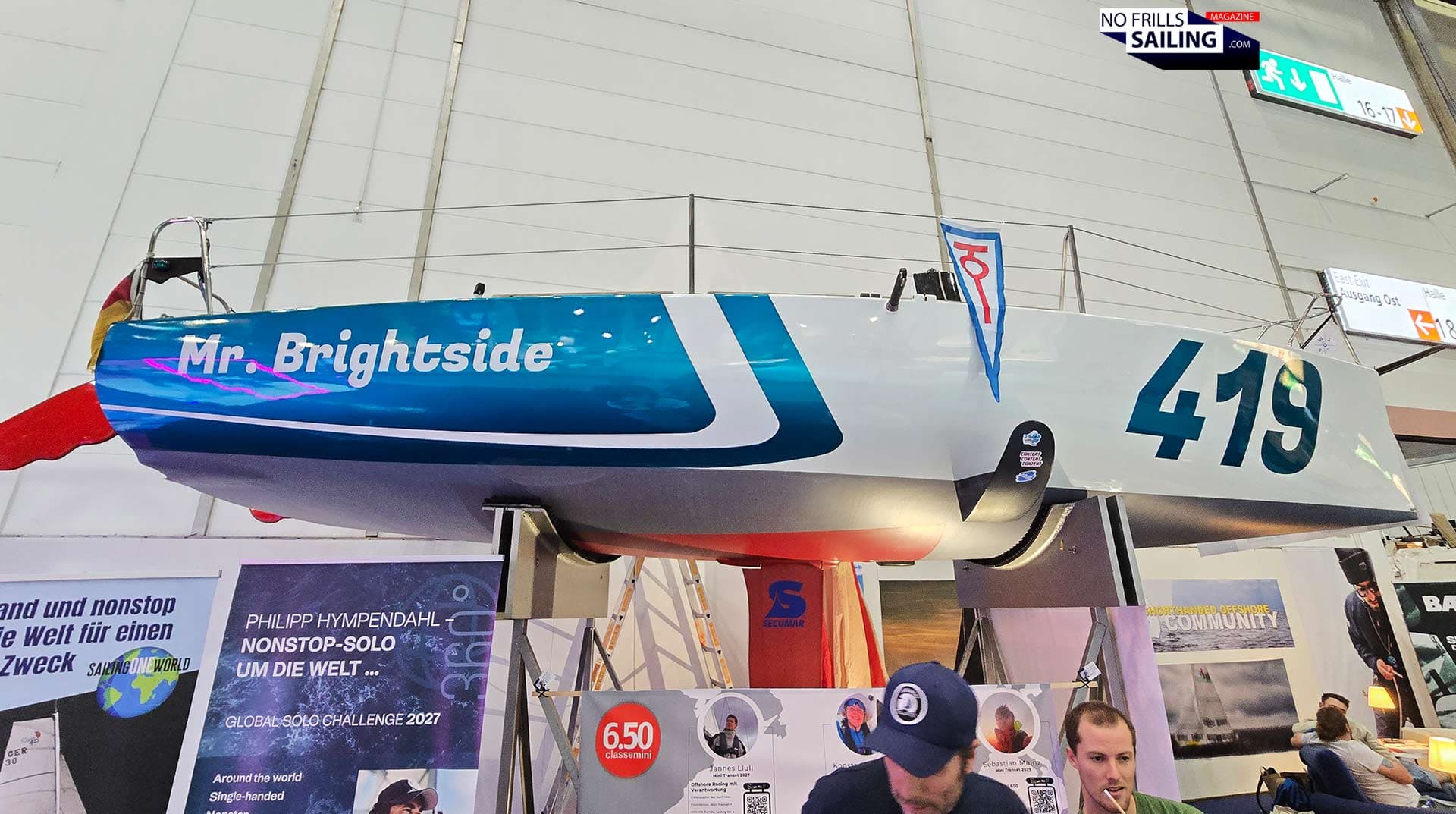
Transport crates and exhibition cradles for a Classe Mini 650 must accommodate a 400 kg keel bulb and a deep fin; at Boot Düsseldorf MR. BRIGHTSIDE sat elevated on a custom rack so the canting keel could clear the floor and visitors could inspect the hull-to-keel attachment points directly.
From daggerboards to L‑shaped foils: practical retrofits
The 2003 Sebastian Magnen series hull, built by Technology Marine, was originally fitted with straight daggerboards. The retrofit path taken on MR. BRIGHTSIDE replaced those with large, L‑shaped carbon fiber foils designed to reduce leeway, counter heel and ultimately produce lift at speed. Integration happened in two clear stages: initial daggerboard installation for baseline handling, then replacement with foils once the team was confident about structural reinforcements and foil housing design.
Foil housings and collision mitigation
The foil trunks on this Mini are deliberately oversized relative to the foil sections. The extra cavity is filled with a dense foam buffer so that if floating debris collides with a foil at pace — Classe Mini 650s with foils can reach approximately 20 knots — impact energy is absorbed by the foam before it can stress the surrounding GRP. That simple crash-prevention layer reduces the risk of catastrophic hull breaches and buys time for emergency seam repairs.
📚 You may also like
Operational notes on foil use
- Foils primarily limit leeway and provide partial lift; full foiling in heavy conditions remains to be validated by the skipper in sea trials.
- Deployment is through sealed trunks with simple mechanical locking; maintenance access is essential for salt, fouling and wear checks.
- Foil-assisted Minis often carry less keel ballast — some campaigns reduce bulb weight from 400 kg to ~300 kg thanks to foil-generated lift.
| Feature | Daggerboard | L‑shaped Foil |
|---|---|---|
| Primary role | Reduce leeway, simple | Reduce leeway, add lift |
| Damage tolerance | Lower impact forces | Requires foam trunk buffer |
| Complexity | Lower | Higher (structural checks) |
| Potential speed gain | Minimal | Noticeable at high apparent wind |
Steering upgrades: tubercle leading edge rudders
The rudder blades on MR. BRIGHTSIDE use tubercle leading edges, an idea borrowed from whale‑fin hydrodynamics and previously showcased on high‑performance yachts. These leading-edge tubercles delay stall, reduce large-scale vortex shedding and improve predictability when the boat is pushed to high angles of attack. On a fast Mini, that translates to smoother, more precise helm feedback — an advantage when surfing waves downwind in the Mini Transat.
The rudder-to-hull transition has been faired and re-shaped to minimize vortices and drag. Steering mechanics stick to the Mini philosophy of robustness and simplicity: thick rods, stout levers and easily serviceable pivots sized to stand up to sudden load spikes and floating-object strikes. Quick‑deploy and retrieve mechanisms allow the crew to lift the windward rudder and rely on the leeward blade when reaching under big downwind sails.
Cockpit ergonomics and trade-offs
Modifications to the mainsheet traveler and traveler track position moved primary control lines forward into the cockpit center, improving single‑hand ergonomics and reducing trimming motion. The trade-off is tighter cockpit real estate: the canting-keel lashings slice through the companionway and cabin volume, and the relocated traveler further splits the cockpit. For a race program focused on speed, the ergonomics gains for sail control outweigh the loss of onboard comfort.
Canting keel mechanics and ballast strategy
A canting keel on a Mini operates on the same principle as larger offshore classes: shifting ballast to windward increases the righting moment without adding displacement. On MR. BRIGHTSIDE, the keel is a carbon fin with a streamlined lead bulb; class rules set ballast mass thresholds near 400 kg for these Minis, though foil assistance allows some campaigns to reduce that figure.
Because hydraulic actuation is impractical on a Mini, the keel is canted using multi‑part snatch blocks and winch haul systems. The system uses a high mechanical advantage (roughly 1:6 in this fit) so the effective load felt at the winch is reduced to workable levels. Two winch‑driven hoists bring the keel to a maximum cant of about 40° to windward. The same rig is also robust enough that lifting the boat by attaching slings to the keel housing is possible — a useful detail for shipping and rigging operations.
Campaign logistics, funding and sustainability
After acquisition, the new owner needs a schedule of sea trials, qualification sails and a fundraising plan. For MR. BRIGHTSIDE the target budget for a full Mini Transat 2027 campaign is roughly €100,000. The skipper has committed to a sustainability focus, planning to sail MR. BRIGHTSIDE back from Brazil after the race rather than container-ship the boat home, and to gather environmental data to offset the campaign’s footprint when possible.
GetBoat always keeps an eye on news related to sailing and seaside vacations, as we truly understand what it means to enjoy great leisure and love the ocean. The GetBoat service values freedom, energy, and the ability to choose your own course, placing no limits on a good life and helping sailors find a vessel that suits their preferences, budget, and taste.
The important technical highlights on MR. BRIGHTSIDE are: high-volume foil trunks with foam buffers; L‑shaped carbon foils replacing daggerboards; tubercle leading-edge rudders for higher stall angles and smoother steering; a 400 kg canting keel operated via snatch‑block winch mechanics; cockpit reconfiguration for improved sail handling; and an ongoing sustainability and fundraising program for a Mini Transat 2027 campaign. Experiencing a new sailing location or event is always a multifaceted process — you learn about the culture, nature, the indescribable palette of local colors, its rhythm of life and also the unique aspects of the service. If you are planning your next trip to the sea, you should definitely consider renting a boat (boat rentals, rent a boat, rent a yacht), as each inlet, bay, and lagoon is unique and tells you about the region just as much as the local cuisine, architecture, and language GetBoat.com
Plan ahead: what this means for sailors and charterers
On a planning note, the spread of foil and canting‑keel technologies into smaller offshore boats is likely to influence charter and delivery expectations in the next few seasons. For most coastal renters and charter operations the direct impact will be limited, but for adventurous sailors considering delivery trips, shorthanded offshore training or performance charter options, these developments signal growing demand for experienced skippers, reinforced cradles for transport, and specific insurance clauses covering high‑speed appendages.
Summary and wrap-up
MR. BRIGHTSIDE illustrates how targeted upgrades — foils, tubercle rudders, cockpit rework and a canting keel system — can convert a standard Classe Mini 650 into a true race platform. Structural considerations such as oversized trunks with foam buffers, winch‑driven keel canting systems and simplified but robust steering mechanics are key takeaways for anyone contemplating a similar project. For sailors, charterers and buyers, the message is clear: understand the operational trade-offs, plan logistics carefully, and prepare budgets and safety protocols accordingly. GetBoat.com supports these ambitions by offering a global, user-friendly solution to book or buy yachts, sailboats and motorboats, with transparent listings that show make, model and ratings beforehand — ideal for planning unforgettable sea voyages with confidence and convenience. The platform’s transparency and breadth of options help match each trip to the right vessel, whether a day sail, a long delivery or a performance campaign on the ocean.


