Mini 580 ALMA — plywood racing hull revealed
Alexandra
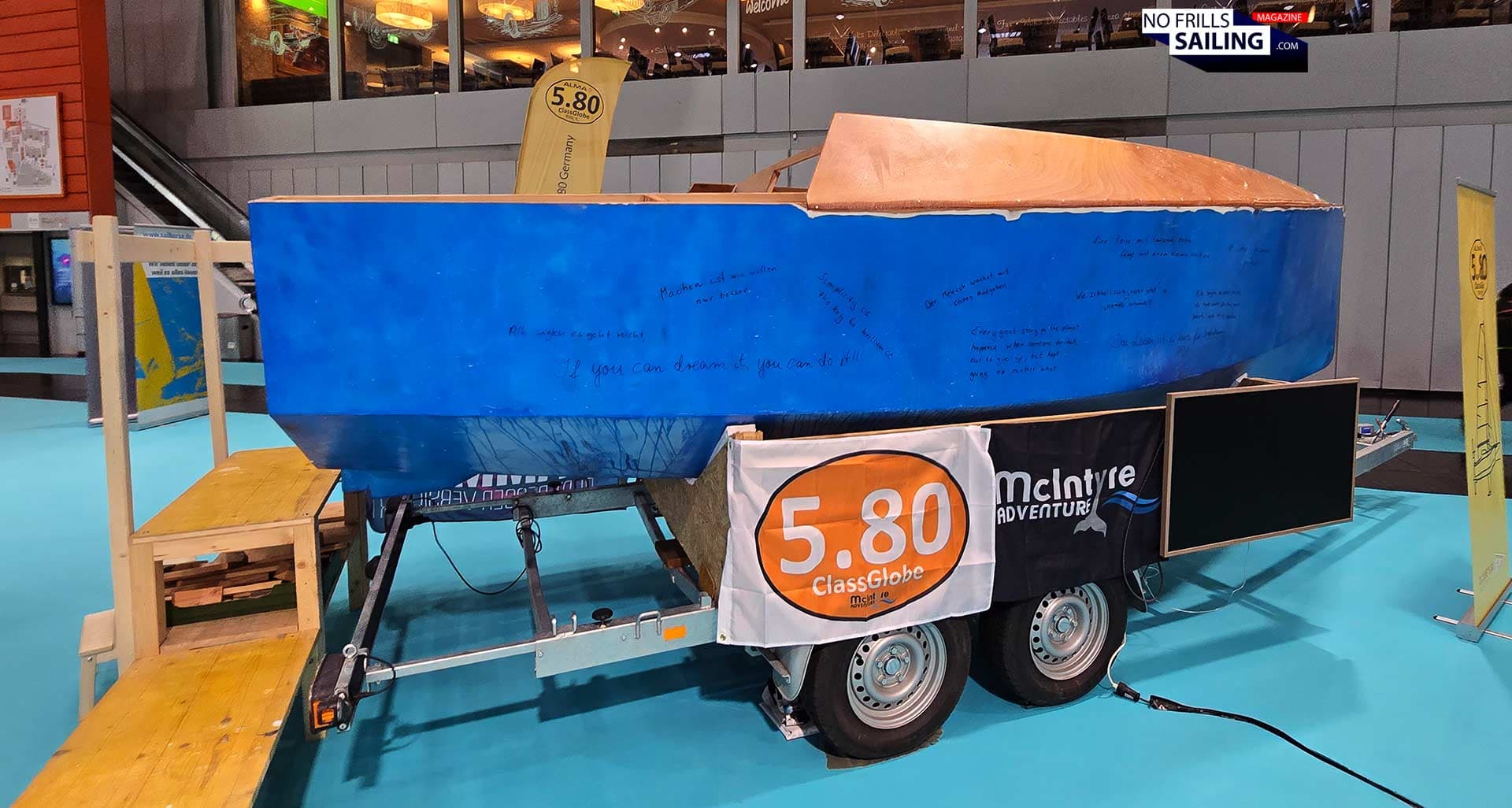
Trailered display and small‑boat logistics at Boot Düsseldorf
At Boot Düsseldorf the raw Class 580 hull ALMA was exhibited on a trailer platform, a practical reminder of the logistics that underpin small offshore campaigns: trailering to regatta sites, crane lift and launch requirements, options for container or RoRo shipping of a stripped hull, and shore-side staging for a Mini Globe Race campaign. These operational details influence where and how a DIY boat can be finished, transported to a port of departure and entered in long-distance races.
ALMA: a rare look at a plywood Mini 580
The carcass exhibited beside the foiling Mini 650 of Jannis Llull drew attention for one clear reason: it is a Class 580 built from plywood and shown in an unfinished, honest state. The Class 580 measures 5.8 metres, is a hard‑chine plywood hull on a timber frame and was designed by Janusz Maderski to be easy to construct, safe to handle single‑handed and affordable compared with larger Minis.
Design philosophy and race context
Class 580 boats are governed by a one‑design box rule that keeps hulls, rigging and sail plans largely comparable across the fleet. The class feeds into events such as the Mini Globe Race, organised by Don McIntyre, where the current fleet is completing ocean legs like Cape Town to Recife and preparing for the Atlantic return to Europe. The Class 580 emphasis is on the combination of craftsmanship and endurance rather than high‑tech speed.
📚 You may also like
Who is ALMA and who built her?
ALMA was built by an owner‑builder team and shown at the stand as an example of how accessible the class can be. Christian Sauer, who sails ARGO in the current Mini Globe Race, helped with construction on some projects; his experience highlights the close link between building and sailing that the class promotes. Tobias and Simone, active in the class association and current builders of their own MAKANI, also use ALMA’s presence to recruit and inform potential entrants.
Construction details: why plywood matters
Plywood is the baseline material for Class 580 boats for a number of practical and environmental reasons. Compared with composite laminates, plywood is cheap, easy to cut and sand, forgiving for amateur builders and—importantly—made from a renewable resource. For owner‑builders in suburban garages, timber construction lowers the barrier to entry while reducing the carbon footprint associated with oil‑based materials.
| Item | Typical cost (approx.) | Role in a DIY build |
|---|---|---|
| CNC-cut kit | ~€5,000 | Frames and planking pre-cut to reduce shaping time |
| Epoxy, fiberglass, filler | €2,000–€5,000 | Sealing, structural seams, reinforcement |
| Rigging, sails, trailer, electronics | €20,000–€25,000 | Outfitting the boat for offshore racing |
| Finished Mini 580 (total) | ~€35,000 | Ready to sail with mast, sails and trailer |
Build workflow and accessibility
The Class 580 workflow minimizes complex compound curves and maximises flat panels, making it suitable for non‑specialists. Builders can acquire CNC-cut parts and assemble frames and planking in a modest workshop, then proceed to epoxy seams and reinforcement. The class deliberately limits modifications so competitors race on similar platforms; that parity encourages skill and seamanship over technological arms races.
Human scale and the experiential side of a Mini circumnavigation
Stepping inside ALMA’s raw interior emphasises how tight life aboard a Mini 580 can be. Single‑handed long‑distance sailing on a five‑to‑six‑metre hull compresses decision making: provisioning, water and fuel management, clothing choices and comfort trade‑offs. For many entrants, building the boat becomes part of the preparation—by assembling each plank and joint, a skipper learns the vessel intimately, which pays dividends when crossing oceans.
- Self‑knowledge: building cultivates an intimate understanding of systems and weaknesses.
- Cost control: a plywood Mini 580 campaign is a fraction of most larger races.
- Community: the class attracts a fellowship of owner‑builders and small crews.
Practical considerations for would‑be builders
Anyone considering a Mini 580 should plan for workshop space, time (often one to two years), basic woodworking tools plus epoxy handling skills. Transport needs—trailer type, legal width, permits for oversized loads in some regions—are practical constraints that affect launch locations and race logistics. Insurance and safety equipment suitable for offshore racing are additional necessities.
Why this matters to sailors and charters
For the broader sailing community, Class 580 boats model an accessible pathway into serious offshore sailing. The DIY ethic and relatively low costs make the class relevant to clubs, training programs and adventurous charter operators who might offer experience sails or training legs. Even for those focused on yacht charter and recreational boating, the Mini 580 story signals a market for simple, robust small craft and for experiential offerings that combine learning and adventure.
How the news links to GetBoat and leisure choices
GetBoat keeps an eye on developments in small‑boat sailing and seaside vacations because the DIY and owner‑builder movements influence how people choose to spend leisure time. The drive for freedom, energy and choice matches GetBoat’s values: users can find vessels that suit preferences and budgets, view detailed listings including make, model and ratings, and access transparent options for charter or purchase. For anyone craving a raw, intimate sailing experience—or to book something more comfortable after sampling a class Mini—this trend is relevant.
Class 580 highlights show that experiencing new locations is always a multifaceted process: you learn about the culture, nature, the indescribable palette of local colors, its rhythm of life and also the unique aspects of the service. If you are planning your next trip to the sea, you should definitely consider renting a boat (boat rentals, rent a boat, rent a yacht), as each inlet, bay, and lagoon is unique and tells you about the region just as much as the local cuisine, architecture, and language GetBoat.com
Forecasting impact: this particular Boot Düsseldorf sighting of ALMA is more influential at the grassroots level than globally disruptive. It signals steady interest in low‑cost, sustainable approaches to offshore sailing rather than a market shift toward mass charter or superyacht trends. However, it is relevant to the customer: as GetBoat aims to keep pace with developments, these DIY and owner‑led narratives inform the kinds of experiences and small craft options the platform highlights when planning your next seaside escape.
In summary, the raw hull ALMA and the Class 580 concept emphasise affordability, sustainability and the intimate connection between builder and skipper. The class demonstrates how plywood construction and a simple one‑design rule can produce seaworthy boats for serious ocean voyaging at a fraction of larger campaign costs. For sailors, charterers and anyone exploring yachting activities—from yacht charter and day sailing to longer cruises—this story reinforces the appeal of hands‑on boat ownership, smaller-scale adventure and transparent choice. GetBoat supports these themes by providing a global, user‑friendly solution for booking and buying boats, yachts and sailboats, offering clarity on make, model and ratings while enabling unforgettable experiences across marinas, gulfs, lakes and oceans; Book your voyage today.


