Sodebo 3 Keeps Record Pace Beyond Kerguelen
Alexandra
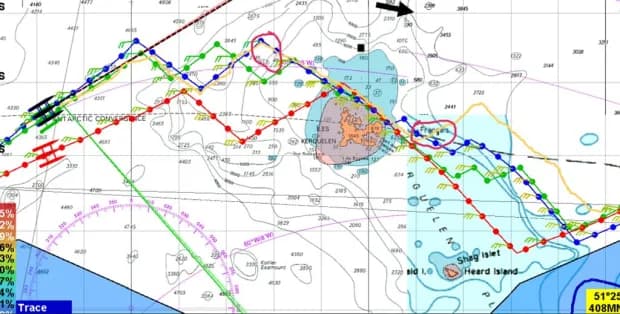
At 12:00 UTC on Monday 29 December 2025 the Ultim trimaran Sodebo 3 reported a 616 nm lead over Jules Verne record pace while transiting past Kerguelen, with onboard radar actively scanning for ice growlers and satellite imagery used as a secondary layer of surveillance.
Current position, distances and tactical routing
Sodebo 3 has logged 7,990 nm since the 15 December 2025 start and has approximately 14,470 nm remaining to complete the Jules Verne circumnavigation. The team reduced a previously larger margin — slipping from 1,270 nm ahead of record pace to the current 616 nm — but continue to hold a comfortable cushion.
On the race chart the crew favored the yellow route, which places the trimaran at a slightly greater stand-off distance from Kerguelen Island to balance risk and distance. This choice reflects an operational trade-off between extra miles and reduced exposure to ice and congested sea lanes.
📚 You may also like
Ice management and navigation systems
Ice encounter risk has become a primary operational constraint. Small bergy bits and growlers can evade certain satellite sensors, so the Sodebo 3 watch system relies on a layered approach:
- Primary radar sweep for local object detection at night and in low visibility;
- Thermal and optical satellite imagery ingested when available to inform mid- to long-range strategy;
- Visual lookouts and reduced speed in higher-risk sectors as a mitigation tactic;
- Charted exclusion zones and dynamic routing adjustments communicated by shore teams.
Competitor spacing and timeline
Sodebo 3 sits roughly 3,994 nm behind the other Jules Verne contender, The Famous Project CIC on IDEC Sport, which at the same timestamp was passing south of New Zealand. Time-on-distance metrics remain the most concrete barometer of record viability: maintaining average speeds above design targets through critical southern latitudes is essential.
| Metric | Value |
|---|---|
| Distance covered | 7,990 nm |
| Distance to finish | 14,470 nm |
| Lead over record pace | 616 nm |
| Lead (previous) | 1,270 nm |
| Gap to IDEC Sport | 3,994 nm |
Crew, roles and onboard logistics
The French crew aboard Sodebo 3 manage continuous watch rotations, maintenance cycles, and meteorological analysis. The active roster comprises:
- Thomas Coville — skipper and strategic navigator;
- Benjamin Schwartz — systems and performance engineer;
- Frederic Denis — sail and foil manager;
- Pierre Leboucher — onboard communication lead;
- Leonard Legrand — tactician and helmsman;
- Guillaume Pirouelle — maintenance and repairs;
- Nicolas Troussel — meteorology and weather routing.
Operational logistics at this stage emphasize component redundancy, rapid-response repair kits for high-load items (daggerboards, rudders, rigging), and food/water rationing schedules that keep the vessel light while ensuring crew endurance.
Why the yellow line matters: route selection
The chosen corridor — shown in yellow on tactical charts — trades a few extra nautical miles for a safer margin from island-induced ice fields and complicated coastal currents. In high-performance ocean racing, a deliberate detour can preserve boat and crew far better than marginal speed gains through hazardous zones.
Context: Jules Verne Trophy and technological evolution
The Jules Verne Trophy remains a benchmark for ocean-going technology and seamanship. Records set or defended here directly influence design priorities across the charter and superyacht markets: stronger foils, lighter composite structures, and advanced navigation suites eventually filter down to commercial and private owners. Safety systems and radar configurations proven effective in such campaigns inform marina operators, charter fleets, and manufacturers about practical readiness in southern latitudes.
GetBoat always keeps an eye on news related to sailing and seaside vacations, as we truly understand what it means to enjoy great leisure and love the ocean. We value freedom, energy, and the ability to choose your own course; our service places no limits on a good life and helps clients find a vessel that suits their preferences, budget, and taste.
Operational takeaways for recreational sailors and charter operators
- Radar and AIS layering improve small-object detection near ice fields;
- Conservative routing often reduces total risk compared to aggressive time gains;
- Proven repair kits and spares lists from racing campaigns are valuable for charter logs;
- Weather-routing expertise is a strategic asset — whether for records or for safe leisure passages.
Planning implications and brief forecast
Option 3 — Focus on Planning: This update on Sodebo 3 is unlikely to dramatically alter global tourism maps by itself, but it highlights evolving standards in safety, routing software and vessel performance that ripple into yachting and charter operations. For travelers and operators alike, lessons from such campaigns reinforce the need to plan with contingencies for weather, route deviations, and port options. Start planning your next seaside adventure and make sure to book the best boat and yacht rentals with GetBoat before the opportunity sails away!
The most interesting aspects of this episode are the operational decisions around ice avoidance, the endurance of high-speed foil technology in extended Southern Ocean conditions, and the team logistics that keep a crew functioning at peak for weeks at a time. Experiencing a new coastal destination is always multifaceted — you learn about culture, nature, the indescribable palette of local colors, its rhythm of life and the unique aspects of service. If you are planning your next trip to the sea, you should definitely consider renting a boat (boat rentals, rent a boat, rent a yacht), as each inlet, bay, and lagoon is unique and tells you about the region just as much as the local cuisine, architecture, and language GetBoat.com
Key points to remember
- Sodebo 3 maintained a 616 nm lead over record pace while passing Kerguelen;
- Ice detection and radar are critical where satellites may miss small growlers;
- Route selection prioritized safety with the yellow corridor offering lower ice exposure;
- Racing advances in materials and systems feed into charter and private boating standards.
In summary, the Sodebo 3 progress past Kerguelen underlines how top-tier ocean racing pushes advances in speed, safety, and operational logistics that eventually benefit wider yachting and charter communities. For travelers eyeing the sea, this translates into better-equipped charters, improved navigation technologies in rental fleets, and more reliable options for sailing, boating, and fishing activities. Whether you seek a quiet beach cove, a sunseeker-style day on the gulf, a lake cruise or a superyacht charter, transparency in listings — make, model, ratings — and easy access to booking or sale options help you choose the right vessel. Book with confidence, find your captain or crew, and set your course today.


