Shearwater Class Marks Seventy Years of Evolution
Alexandra
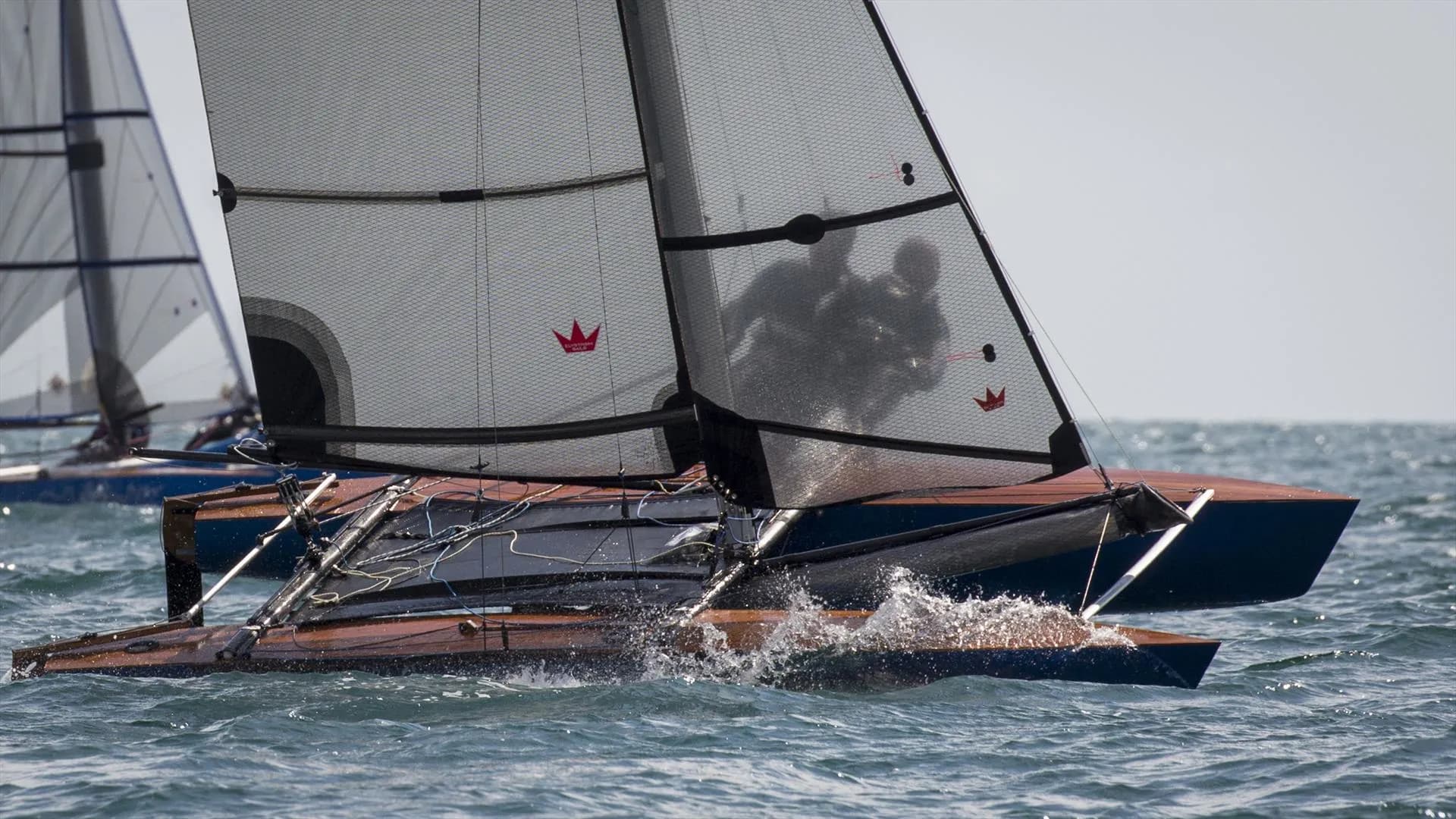
At the RYA Dinghy & Watersports Show on Stand B12, two Shearwater catamarans — a race-winning wooden hull active in 2025 and a nearly finished full-carbon prototype built by Zest Boatworks for Pete Jary — demonstrate a 70-year trajectory from wooden home-builds to advanced composite construction under tightly governed measurement rules.
Measured evolution: how Shearwater kept competitive parity
The Shearwater Class has used a restricted development rule since its inception in 1956, permitting innovation within defined measurement limits rather than enforcing strict one-design conformity. That approach has allowed the fleet to integrate advances in materials and manufacturing—moving from cold-molded timber to GRP to full carbon fibre—while preserving fair competition across generations of boats. One practical effect: an owner-built wooden Shearwater can still be tuned and sailed effectively against a purpose-built composite example.
Key technical features maintained through decades
- Symmetric spinnaker: retained by the class despite many modern catamarans switching to asymmetric downwind sails, contributing to distinctive handling and downwind tactics.
- Two pathways to ownership: home-building using class-owned tooling or commissioning professional builders.
- Measurement envelope: precise limits on hull dimensions, sail area and appendage geometry that encourage incremental improvement rather than wholesale redesign.
Origins and lineage
Roland and Francis Prout pioneered the basic Shearwater concept in the 1950s by lashing two kayaks together, adding a mast and sail. Their experimentation led to Shearwater I and a formal class that blended accessibility with performance. The class’ history is visible on the show stand: a wooden vessel representing the craftmanship of early builders still taking podium finishes, and a carbon textured hull that illustrates the cutting edge of permitted innovation.
📚 You may also like
Showcase at RYA Dinghy & Watersports Show
The RYA event provides a concentrated platform to present both heritage and modernity. The wooden Shearwater on display is notable for continued race results through the 2025 season, while the Zest Boatworks carbon prototype — with some final work by Pete Jary before the 2026 Travellers Trophy — points toward lightweight, stiff construction that exploits allowed measurement margins for performance gains.
Comparison table: wooden vs carbon Shearwater
| Characteristic | Wooden Shearwater | Full-carbon Shearwater |
|---|---|---|
| Typical build method | Cold-moulded or strip-plank home-built | Prepreg carbon layup; professional yard |
| Weight | Heavier, more inertia | Lower displacement, faster acceleration |
| Durability | Long-lived with maintenance | High stiffness; susceptible to impact damage |
| On-water behaviour | Predictable, forgiving | Responsive, higher top-end speed |
| Competitive status | Still race-competitive under class rules | Developing edge within permitted envelope |
Community, calendar and accessibility
Shearwater’s longevity rests as much on culture as on construction. A mix of juniors and veterans—from toddlers learning to sail to competitors over 70—keeps the fleet socially diverse. The 2026 calendar, including six Travellers Trophy events and a week-long Nationals at Stone Week hosted by Stone Sailing Club in August, reflects a healthy regional program that sustains travel and tourism flows to local marinas, clubs and coastal businesses.
Why the class matters to sailing tourism and rentals
- Heritage fleets draw spectators and participants who seek unique boating experiences beyond standard charters.
- Vintage-vs-modern comparisons showcased at events give marinas and charter operators opportunities for themed regattas, day sails and demonstration trips.
- Local economies benefit from entrants and support crews traveling to events, booking accommodation and hiring auxiliary services.
GetBoat always keeps an eye on news related to sailing and seaside vacations, because the platform understands the value of freedom, energy and choosing your own course; users can browse a wide range of options to suit taste and budget, view makes, models and ratings in advance, and pick the right vessel for an intimate day sail, a family charter or a fleet event.
Practical takeaways for sailors, charterers and event planners
- Event planners: mix classic and modern demonstrations to attract broader audiences.
- Charter operators: offer specialty packages—heritage sails, training days or youth clinics—to leverage class interest.
- Owners and builders: restricted development classes reward incremental investment and smart tuning over wholesale replacement.
Operational notes for marinas and clubs
Clubs hosting Shearwater events should confirm launch and recovery bandwidth, trailer parking, and shore-side rigging space to accommodate both older home-built boats and delicate carbon craft. Notice to competitors regarding towage, berthing fees and on-site repair facilities improves turnout and reduces downtime between races.
Highlights of the Shearwater story underline how regional sailing culture, evolving boat technology and welcoming events combine to keep a class relevant. Experiencing a new location by water is multifaceted: one learns about the culture, nature, the indescribable palette of local colors, its rhythm of life and also the unique aspects of the service. If you are planning your next trip to the sea, you should definitely consider renting a boat (boat rentals, rent a boat, rent a yacht), as each inlet, bay, and lagoon is unique and tells you about the region just as much as the local cuisine, architecture, and language GetBoat.com
Outlook and call to action
On the global tourism and travel map the Shearwater’s 70th anniversary is a niche signal rather than a major sea change: it highlights how vintage and restricted-development fleets can sustain local maritime tourism and add flavour to coastal destinations. However, it remains relevant to enthusiasts and regional operators. Start planning your next seaside adventure and make sure to book the best boat and yacht rentals with GetBoat before the opportunity sails away!
In summary, the Shearwater Class exemplifies an effective balance between tradition and progress: a design born from two brothers’ kayak experiment matured through seven decades under a measured development rule to remain competitive today. The RYA Show display — wooden veteran alongside a full-carbon work-in-progress by Zest Boatworks and Pete Jary — is a vivid reminder that sailing combines craft, community and innovation. For those organizing charters, planning regattas or simply looking to rent a yacht or boat for a day at the beach or a week exploring marinas and clearwater coves, platforms like GetBoat.com provide transparent listings, captain options and filters for budgets and activities. Whether you seek a family day-sail, a fishing trip in a sheltered gulf, a lake outing, or a weekend on a superyacht or Sunseeker-style cruiser, the right charter, sale or rent can change a trip—fair winds and enjoy the voyage.


