When Precision and Speed Collide in Sail Racing
Alexandra
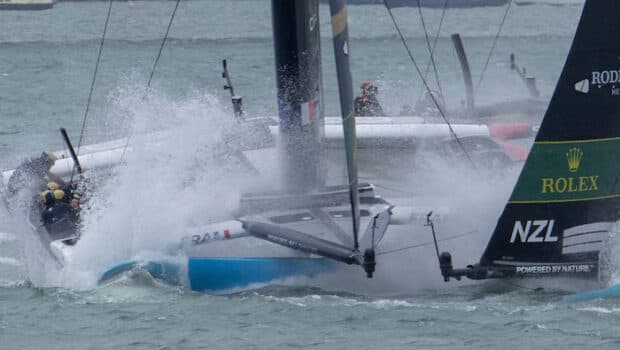
At the second event of the 2026 SailGP season, race operations and remote umpiring logistics were put to the test when two F50s suffered a high-speed collision that sent two sailors to hospital and left one with compound fractures in both legs.
The rule that quietly protects sailors
Across competitive sailing, a stabilizing principle known as the last point of certainty underpins how conflicts are resolved on the water. World Sailing’s umpire guidance states: “Unless the umpire is confident that a change has happened, the decision should be made on the basis that it has not happened. This is referred to as the last point of certainty.”
The same intent appears in the Racing Rules of Sailing: “If there is reasonable doubt that a boat obtained or broke an overlap in time, it shall be presumed that she did not.” That wording deliberately preserves an entitlement to space until uncertainty is resolved — a margin that creates time and distance for human reaction.
📚 You may also like
Why that margin matters
High-performance foiling craft like the F50 operate at velocities where centimeters and milliseconds make the difference between a tactical gain and catastrophe. The last point of certainty is not a loophole; it is a safety buffer. When ambiguity exists, sailors tend to choose conservatively; when certainty is presumed, they optimize aggressively.
How SailGP’s digital umpiring shifted incentives
SailGP has implemented remote umpiring from a digital booth using multiple camera angles, telemetry, and computer-verified position data. The technology is impressive and has raised the spectacle of racing — but precision changes behavior.
Decisions based on post-event measurement remove the on-water standard of what a human could be certain of in real time. In practice, that means overlaps and mark-room disputes are adjudicated to the millimeter after the fact, rather than to what a sailor could safely perceive and react to in the moment.
| Feature | Traditional/Umpired On-Water | Remote/Digital Umpiring |
|---|---|---|
| Decision basis | Human perception and conservative uncertainty | Telemetry and precise timestamps |
| Incentives for sailors | Leave margin; caution | Sail to the razor’s edge |
| Reaction time buffer | Built-in (centimeters/seconds) | Reduced or absent |
| Typical outcome | Fewer catastrophic collisions | Higher chance of high-speed contact |
Behavioral evidence from mixed events
When SailGP and America’s Cup sailors cross into World Sailing–governed grand-prix formats, observers have documented a clear behavioral shift: overlaps are often taken until the last measurable moment at leeward marks, and windward boats press down to minimal separation at full load. These moves may be technically legal under post-event analysis, yet they leave no practical bailout for the boat that had been inside only seconds earlier.
Operational risks and what they mean for organizers
Precision without a human-grade buffer is a classic case of optimizing the wrong variable. Remote systems can confirm what happened, but they cannot increase human reaction speed. At high speed, in spray and noise, sailors do not react in centimeters or milliseconds — they need space and time. Removing that margin is, in plain terms, playing with fire.
Practical mitigations for race committees and regatta logistics
- Reinstate application of the last point of certainty as a guiding operational principle for on-water safety.
- Introduce minimum separation or staggered mark rounding requirements for foiling classes.
- Combine remote adjudication with real-time umpire authority to preserve conservative, human-centered thresholds.
- Mandate additional protective gear and medical readiness at high-speed events to shorten emergency response time.
Balance: spectacle versus safety
The sport faces a binary incentive structure: choose spectacle or choose safety. Technology and precision have advanced the sport’s visibility and performance, but they also teach sailors to exploit the last possible moment. That is a predictable response to the rules given — sailors will sail to the incentives offered.
An umpire familiar with grand-prix racing notes that removing uncertainty from rules enforcement does not make sailing intrinsically safer; it magnifies the consequences when things go wrong. The choice is not anti-technology, but pro-responsibility: systems should preserve the margin that allows humans to react.
In short, organizers, race officers, and governing bodies must reconcile rapid, data-driven adjudication with the human realities of reaction time and physical space. Adjusting operational rules, race logistics, and safety protocols can preserve elite performance while reducing catastrophic risk — and that’s worth doing before another avoidable collision occurs.
Wrap-up: The last point of certainty exists as a deliberate safety buffer in sailing law and umpiring guidance. Remote, highly precise adjudication—exemplified by SailGP’s digital booth—has shifted incentives toward razor-edge sailing, increasing collision risk for foiling boats. Race organizers can mitigate this through rules that preserve human reaction margins, operational changes at marks, and integrated real-time umpire authority. For the wider boating and charter community—from yacht and superyacht operators to people arranging a boat rent or a beachside day trip—this debate matters: it shapes how events are run, how capsized or injured sailors are responded to, and what safety standards appear at marinas and Destinations. Whether you’re planning a sailing charter with a captain, renting a boat on a lake, or eyeing a superyacht sale or a Sunseeker at the gulf, the same principle applies: leave room for mistakes. Yacht, charter, boat, beach, rent, lake, sailing, captain, sale, Destinations, superyacht, activities, yachting, sea, ocean, boating, gulf, water, sunseeker, marinas, clearwater, fishing.
About Greg Kiely: Greg Kiely is a World Sailing International Umpire and a US Sailing Umpire Assessor, former Head Coach at Annapolis Yacht Club, and a member of the New York Yacht Club Judges and Umpires Committee. He regularly officiates high-level match racing, team racing, and grand-prix events.


