Five SailGP Storylines to Watch in Sydney
Alexandra
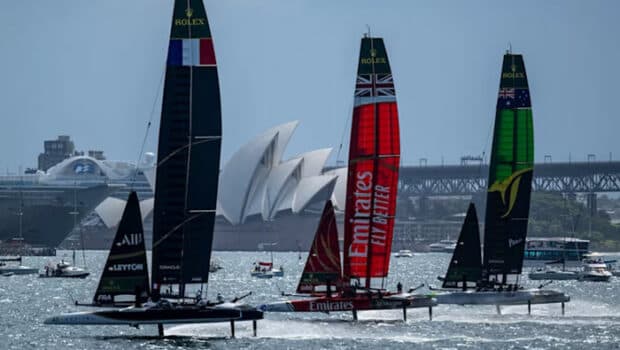
SailGP in Sydney runs on 28 February–1 March 2026 with race windows set for 17:30–19:00 AEDT, featuring 11 competing F50 teams after the withdrawals of France and New Zealand; the compressed field changes logistics for pit rotations, spares handling and event marshaling on Sydney Harbor's confined racecourse.
What to expect on the water during raceweek
Race planners have scheduled a new twilight racing window starting at local golden hour to test F50 systems and crew performance under shifting light and thermal wind patterns. Evening starts require adjusted shore crew shifts, altered launch-and-recovery timelines, and amplified marine traffic control to separate spectator craft from high-speed foiling lanes. Expect tighter marshal zones and revised exclusion areas near the Sydney Opera House and Harbor Bridge during the 17:30–19:00 sessions.
Five on-course storylines
- Home advantage for Australia: Australia leads the Season 6 standings and has a proven podium record in Sydney, bringing strong tactical familiarity with local gust patterns and current flows.
- Twilight racing debut: For the first time SailGP will run multiple evening fleet races, altering visibility, wing trim decisions and foil-ride control for skippers and tacticians.
- Harbor racecourse complexity: Sydney Harbor’s narrow channels and urban wind funnels will create asymmetric gusts and sharp pressure gradients, making mark rounding and downwind transitions decisive.
- Field reduced to 11: The absence of France and New Zealand redistributes Championship points and impacts spare-parts logistics for teams that now carry extra components to cover additional wear.
- Artemis on the rise: Artemis SailGP’s early results show consistent racecraft and foiling efficiency, positioning them as a tactical threat in close-quarters fleet racing.
Current standings and competitive implications
After two events, the points table shows tight margins at the top and mid-fleet churn that will influence crew rotation decisions and chartering of support vessels. The following table summarizes the Season 6 standings after Perth and Auckland.
📚 You may also like
| Position | Team | Skipper / Nation | Results |
|---|---|---|---|
| 1 | Australia | Tom Slingsby (AUS) | 2–1 |
| 2 | Great Britain | Dylan Fletcher (GBR) | 1–2 |
| 3 | France | Quentin Delapierre (FRA) | 3–4 |
| 4 | Artemis | Nathan Outteridge (AUS) | 4–5 |
| 5 | United States | Taylor Canfield (USA) | 5–7 |
| 6 | Spain | Diego Botin (ESP) | 12–3 |
| 7 | Germany | Erik Heil (GER) | 9–6 |
| 8 | Denmark | Nicolai Sehested (DEN) | 8–9 |
| 9 | Canada | Giles Scott (CAN/GBR) | 6–10 |
| 10 | Italy | Phil Robertson (NZL) | 7–13 |
| 11 | New Zealand | Peter Burling (NZL) | 13–8 |
| 12 | Brazil | Martine Grael (BRA) | 10–11 |
| 13 | Switzerland | Sébastien Schneiter (SUI) | 11–12 |
Event format, equipment and prize structure
The SailGP Season 6 format remains uniform: teams race identical F50 catamarans in up to seven qualifying fleet races per event, with the top three advancing to an event final. All teams use standardized configurations chosen from four wingsail sizes (18m, 24m, 27.5m and 29m) and selectable T-foil and rudder settings tailored to forecasted wind conditions.
Prize money and incentives
- Total prize pool for 2026: USD $12.8 million.
- Event winner: $400,000; second: $260,000; third: $140,000.
- Season points leader bonus: $400,000; Championship Final Race winner: $2 million.
Season logistics and calendar
Season routing places multiple high-profile events across diverse maritime venues, each requiring bespoke marine operations planning—from helicopter lifts of spares in island venues to road transport and crane operations for catamaran shore handling. Notably, the schedule lists Geneva as the relocated 11th event instead of Saint-Tropez, adding inland-water logistics challenges.
| Event | Dates | Venue |
|---|---|---|
| 1 | Jan 17–18 | Perth, Australia |
| 2 | Feb 14–15 | Auckland, New Zealand |
| 3 | Feb 28–Mar 1 | Sydney, Australia |
| 4 | Apr 11–12 | Rio de Janeiro, Brazil |
| 5 | May 9–10 | Hamilton, Bermuda |
| 6 | May 30–31 | New York, USA |
| 7 | Jun 20–21 | Halifax, Canada |
| 8 | Jul 25–26 | Portsmouth, GBR |
| 9 | Aug 22–23 | Sassnitz, Germany |
| 10 | Sept 5–6 | Valencia, Spain |
| 11 | Sept 19–20 | Geneva, Switzerland |
| 12 | Nov 21–22 | Dubai, UAE |
| 13 | Nov 28–29 | Abu Dhabi, UAE |
Historical context and wider significance
Since its launch in 2018, SailGP has positioned itself as an annual global inshore league showcasing nation-branded teams racing identical foiling catamarans. The championship has accelerated technological development in high-speed foiling, standardized event formats, and introduced fan-forward race presentation. Urban harbor venues—Perth, Auckland and Sydney among them—have become economic catalysts, drawing spectators, support crews and marine suppliers into concentrated activity zones where marinas, charter operators and local tourism businesses see direct benefits from increased demand for short-term berths and spectator boating.
For international tourism, SailGP functions as both a spectacle and a logistics testbed: mass-spectator control, charter-boat scheduling, hospitality on marinas and last-mile transfers blend to create high-value seasonal demand. Twilight racing in Sydney will also test how evening events can extend visitor engagement and spur new marine activities—dinner charters, evening marina activations and low-light spectator cruises.
Forecast for sailing-related tourism impact
Twilight formats and tighter city-center courses are likely to boost short-duration charter bookings and increase attention on marina infrastructure. Expect an uptick in demand for captained charters, spectator boat rentals and premium hospitality packages on race days. Successful evening race operations could prompt other venues to trial night or dusk racing, adjusting local maritime regulations to accommodate later operational windows and enhanced lighting and safety protocols.
In sum, Sydney’s SailGP event blends sporting intensity with significant operational complexity: adjusted race times, a reduced fleet, and a historic harbor course create a tactical spectacle that also pushes logistical and tourism planning.
As the fleet foils past the Opera House and under the Harbor Bridge, the event is set to influence how marinas manage surge demand for berths, how charters price captain-led outings, and how local operators package shore-side activities. For anyone tracking the intersection of high-performance sailing and tourism—yacht charter markets, superyacht services, boat rent platforms, marinas and offshore activity planners—Sydney will provide useful signals for the season ahead.
GetBoat is an international marketplace for renting sailing boats and yachts, probably the best service to find charters to suit every taste and budget. For sailors and holidaymakers considering yachts, charters, captain services or boat rent near the race, this event highlights demand shifts across beaches, marinas and bay Destinations—impacting yacht sale interest, rental availability, on-water activities, fishing charters, and the broader yachting economy from superyacht service providers to local charter operators. Explore options on GetBoat.com for listings that match your preferred sailing experiences, whether a day sail in clearwater bays, a lake cruise, or an ocean race spectator trip.


