New Zealand F50 collision: cause, logistics and consequences
Alexandra
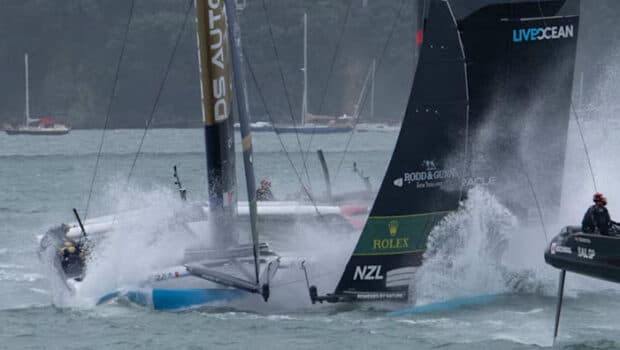
The New Zealand F50 was ruled unrepairable on-site after the collision with France, forcing SailGP to rework spare-boat allocations, crane and shipping slots, and crew transport logistics ahead of the Sydney event.
Sequence of events and key performance data
High-rate telemetry and video reconstruction show the New Zealand F50 was traveling at 49 knots when a gust hit the fleet as they bore down on the first mark. The sudden acceleration increased lift on the hydrofoils, raising the boat's ride height until the leeward foil pierced the surface, initiating a rapid side slip and a spike in leeway.
Flight-control inputs were active during the sequence but data indicates the hydrodynamic and aerodynamic state changed faster than the systems could recover. The rudder briefly lost effective flow before reattachment, the windward bow immersed, and the boat rounded up sharply, decelerating in a matter of seconds. With the French F50 close astern at speed there was insufficient time or distance to avoid contact.
📚 You may also like
Technical breakdown
| Parameter | Recorded value / observation |
|---|---|
| Boat speed | 49 knots at gust onset |
| Primary trigger | Rapid gust → increased foil lift → increased ride height |
| Critical failure mode | Leeward foil ventilation → side slip → loss of predictable control |
| Systems checked | No mechanical or software faults identified pre‑impact |
| Human factors | Crew control inputs applied but could not recover the envelope |
Engineer assessment and comments
SailGP performance engineers attribute the incident to a very fast chain of aerodynamic and hydrodynamic events which pushed the F50 beyond its controllable envelope. The data-driven review combined onboard telemetry, simulator recreations, and video analysis to reconstruct the sequence to within seconds of accuracy.
Penalties, standings and format implications
The penalty review upheld that New Zealand breached Rule 14 (avoid contact), resulting in an eight-event point penalty. France was found to have had no reasonable opportunity to avoid the collision. The decision affects season standings and strategic planning for crews who now must factor in retroactive point adjustments.
| Top 5 — Season 6 (after 2 of 13) | Skipper (Nation) |
|---|---|
| 1. Australia | Tom Slingsby (AUS) |
| 2. Great Britain | Dylan Fletcher (GBR) |
| 3. Spain | Diego Botin (ESP) |
| 4. France | Quentin Delapierre (FRA) |
| 5. Artemis | Nathan Outteridge (AUS) |
Operational fallout for events and the wider boating community
From a logistics and charter perspective, losing a syndicate-owned F50 between events reverberates beyond SailGP: spare catamarans, heavy-lift cranes, trucking windows and berth allocations must be rescheduled. For marinas and local service providers this means juggling dock space and technicians; for charter operators and yacht brokers, high-profile incidents raise awareness around crew training and equipment redundancy.
Immediate mitigations under review
- Refined flight-controller response algorithms and tolerances
- Enhanced crew procedures for gust-induced high-ride events
- Pre-event allocation of dedicated spare boats and transport contingencies
- Simulator training modules focused on foil ventilation recovery
- Updated safety briefings for crowded racecourse scenarios
Season logistics, prize structure and F50 setup
The season continues across 13 events with identical F50 configurations chosen per forecast: four wingsail sizes (18m, 24m, 27.5m, 29m), two T-foil daggerboards (high and low speed) and rudders with selectable speed settings. Prize money totals USD $12.8 million, and event winners take $400,000 per regatta, with the Championship Final Race winner pocketing $2 million.
Upcoming schedule highlights
- Feb 28–Mar 1 — Sydney, Australia
- Apr 11–12 — Rio de Janeiro, Brazil
- May 30–31 — New York, USA
- June 20–21 — Halifax, Canada
- Nov 21–28 — Dubai & Abu Dhabi, UAE
What this means for charter operators and sailors
I'll be blunt: when a top-tier racing platform hits the wall, shore-side operators feel it. Charter captains and marina managers should expect tighter turnarounds for event berthing and an uptick in demand for simulator-style crew training packages. For renters hunting a calm day on the water, be prepared for occasional schedule shuffles around major regattas — it's a small world out there on the ocean.
In short, the collision was not traced to a hardware or software fault but to a rapid environmental and hydrodynamic sequence that exceeded controllability. The consequences are technical, competitive and logistical: a damaged F50 out of action, revised shipping and crane plans, upheld sporting penalties, and a renewed focus on crew and system mitigations that will ripple into how charters, marinas and captains plan for high-performance and recreational boating alike.
Wrap-up: The New Zealand F50 incident was caused by a rapid gust-driven foil ventilation event at 49 knots leading to side slip and contact with France. No system malfunction was found, but the boat is out for the next event, forcing logistical rearrangements. Penalties were applied under Rule 14 and the season standings remain tightly contested. For anyone involved in yacht charter, boat rent, marinas or yachting activities, this episode underscores the value of simulator training, spare-boat logistics and crew preparedness across destinations from gulf harbors to open ocean regattas — whether you run a superyacht sale, a small fishing trip on a lake, a Sunseeker rental or a weekend of sailing and boating in clearwater, the lessons here matter to captains and crews planning for sun, sea and wind.


