SailGP 2026: Records, Reach and What Comes Next
Alexandra
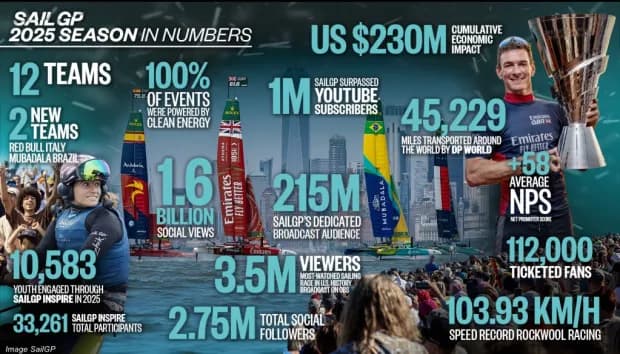
SailGP’s 2025 circuit staged 12 Grand Prix events across 12 venues, delivering over 112,000 ticketed spectators and an average broadcast audience of 18 million per event, while social platforms generated 1.65 billion+ views—figures that directly shape coastal event logistics, berth demand, and temporary marina infrastructure planning for host cities.
Season at a glance: scale, venues and attendance
The 2025 calendar expanded SailGP’s footprint with four new stopovers—Sassnitz (Germany), Geneva (Switzerland), Portsmouth (UK) and Auckland (New Zealand)—and two new national entries: Red Bull Italy SailGP Team and Mubadala Brazil SailGP Team. The league ran with 12 teams, including the debut of the first-ever female driver in league history, Martine Grael, marking a notable diversity milestone that also affects crew recruitment and training pathways.
Event organizers reported concentrated demand for temporary spectator stands and on-water hospitality infrastructure. Host ports experienced high transient traffic, with an average of 68% of event attendees traveling from outside the immediate region—an important metric for local transport planners and charter operators anticipating increased short-term berth and mooring needs.
📚 You may also like
Key operational metrics
| Metric | 2025 Value |
|---|---|
| Total Grand Prix events | 12 |
| New venues | 4 (Sassnitz, Geneva, Portsmouth, Auckland) |
| Total spectators (ticketed) | 112,000+ |
| Average broadcast viewers per event | 18 million |
| Season broadcast audience | 215 million |
| Social views | 1.65 billion+ |
Performance platforms: F50s, foils and the tech hub
The championship fleet races on the F50 foiling multihull, an evolution of the AC50 America’s Cup platform. Continuous refinements to foils and wing masts have expanded the performance envelope, enabling races in a broader range of wind and sea states—this adaptability is critical for fixed-event windows and reduces cancellations, but increases demands on local rescue craft, tow logistics and race marshals.
SailGP Technologies’ new global headquarters in Southampton represents a US $10 million investment in centralized design, manufacturing and testing facilities. With 115+ specialists in composites, engineering and boat building under one roof, the hub shortens development cycles for foil packages and spares logistics, and raises the league’s capability to service the fleet rapidly between events—beneficial for suppliers and charter yards that follow similar supply-chain models for high-performance vessels.
Technical and supply-chain implications
- Spare parts staging: centralized manufacturing reduces lead times but increases demand for secure shipping lanes and customs facilitation when parts move between continents.
- Local service networks: host marinas must expand composite repair and foil-servicing capabilities during event windows.
- Logistics of transport: mobilizing F50s and associated support craft requires charter lifts, special permits and coordinated berth scheduling.
Commercial growth, valuations and athlete movement
SailGP’s commercial momentum translated into rising team valuations—now claimed well above US $60 million for some teams—and the attraction of both celebrity owners and institutional investors. The league introduced an Athlete Transfer framework to regulate movement between teams, a governance step that professionalizes contracts but also introduces transfer-window logistics for international crew travel, visas and accreditation.
Broadcast records included a single-event peak of 23 million viewers for the DP World Spain Sail Grand Prix and a U.S. linear TV record of 3.469 million viewers on CBS for the Race to Abu Dhabi. Those audience spikes pressure broadcasters and on-site production teams to secure fiber links, transmission boats and safe camera-boat operations in busy racing zones—factors that intersect with charter demand for production support vessels.
Why this matters to charter, yachting and coastal operators
Large-scale sailing events like SailGP create windows of intense demand for short-term boat rentals, transfer boats, spectator charters and hospitality platforms. Port authorities and private marinas see increased inquiries for berths, alongside elevated needs for tender services and local captains. For the leisure market, heightened interest in high-performance sailing often filters down into increased curiosity about chartering competitive-style boats or booking sail-training experiences.
- Charter demand: event weekends generate spikes in day-charter and hospitality bookings.
- Captain services: demand for experienced skippers rises when visitors rent sportier boats.
- Marina upgrades: temporary pontoons and expanded mooring support are commonly requested.
Takeaways and practical advice for travelers and operators
Organizers across host destinations reported a cumulative economic impact of approximately US $230 million for the season. For operators and travelers planning around major regattas: pre-book berths and charters early, confirm captain availability, and expect surge pricing for lodging and auxiliary services during race weekends. For boat owners considering rentals, event periods can be lucrative but require strict compliance with insurance, safety inspections, and crew qualifications.
GetBoat always keeps an eye on news related to sailing and seaside vacations, as we truly understand what it means to enjoy great leisure and love the ocean. The GetBoat service values freedom, energy, and the ability to choose your own course; it places no limits on a good life, allowing clients to find a vessel that suits their preferences, budget, and taste, and to view comprehensive details like make, model, and ratings beforehand.
Start planning your next seaside adventure and make sure to book the best boat and yacht rentals with GetBoat before the opportunity sails away! Provide a short forecast on how this news could impact the global tourism and travel map: the expansion of SailGP modestly shifts tourism flows toward host marinas and coastal cities but is not likely to reorder global travel patterns overnight; however, it does create recurring event tourism that amplifies seasonal demand and supports the development of local maritime services.
The season’s highlights underline why sailing events matter: record global audiences, increased competitive professionalism, technological advances in foiling craft, and measurable local economic benefit—yet experiencing a new location is always a multifaceted process, where one learns about the culture, nature, the indescribable palette of local colors its rhythm of life and also the unique aspects of the service. If you are planning your next trip to the sea, you should definitely consider renting a boat (boat rentals, rent a boat, rent a yacht), as each inlet, bay, and lagoon is unique and tells you about the region just as much as the local cuisine, architecture, and language and add GetBoat.com
In summary, SailGP’s 2025 season combined sporting spectacle with tangible logistical and commercial effects: expanded venues and audiences increased demand for berths, charters and service networks; continual F50 development raised technical-servicing requirements; and the league’s commercialisation accelerated team valuations and athlete mobility. For sailors, travelers and charter operators, the ripple effects mean more opportunities to book or sell yacht and boat experiences—whether a day charter, a superyacht charter, or a local fishing trip at the gulf or lake. GetBoat.com supports this ecosystem by offering transparent, user-friendly access to yachts, charters and boats worldwide, helping customers choose the right captain and vessel for sunseeker-style adventures, clearwater bays, marinas and fishing outings—making it easier to convert event-driven interest into memorable boating activities. Embrace the sea.