Seldén E40rev: reversible winch for smoother manoeuvres
Alexandra
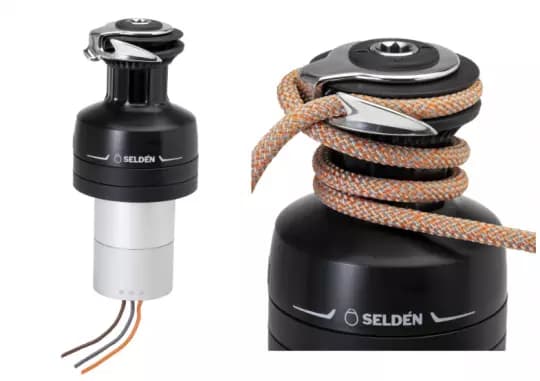
On a 12–18 m cruising yacht, fitting a 42V SEL Bus-powered reversible winch like the Seldén E40rev requires revising cable runs, circuit protection and weight distribution: expect thicker battery feeds, a dedicated control box location near the mast or winch locker, and a reassessment of fuse and circuit-breaker sizing to prevent voltage drop during high-load hauls.
What the E40rev changes on deck
The Seldén E40rev introduces a reversible electric operation that lets skippers both sheet in and ease out under controlled electric power without advancing the drum or manually retrieving the rope. Rather than a single-direction power assist for trimming, the E40rev allows progressive, two-speed handling for both tensioning and shock-absorbing the sheet, reducing the need for manual winch work and minimizing hands-on exposure to loaded lines.
Key technical features
The E40rev is built around Seldén’s patented ART headstock, a rope-gripping mechanism that ensures even clamp pressure and reduced slippage under load. Control is performed by a simple push-button interface: the rope remains in the self-tailing jaw while the electrical system controls motion in both directions. Two selectable speeds deliver either rapid haul-in or a precision mode for fine trimming and safe, progressive easing.
📚 You may also like
Emergency and manual operation
Despite its electrical convenience, the unit retains a mechanical manual drive as an emergency fallback. Sailors can operate the winch manually in the event of a system failure, maintaining redundancy that is crucial for blue-water passages where full electrical dependence is unadvisable.
Integration with boat electrics and installation logistics
The E40rev is intended to be part of Seldén’s wider electrical ecosystem and runs on the 42V SEL Bus architecture. That imposes both benefits and installation constraints: centralized control, reduced cable cross-sections compared with 12V equivalents at similar power, and lower overall losses — but also the need for a compatible power supply, a control box installed in a protected location, and clear routes for power and data cabling to the winch station.
| Item | Requirement | Impact on charter/owner |
|---|---|---|
| Power supply | 42V SEL Bus controller & dedicated feed | Centralized maintenance; fewer ad-hoc upgrades |
| Cabling | Thicker, short-run DC feed; protected conduits | Professional install increases refit cost |
| Manual override | Mechanical crank option | Safety for open-sea charters |
Operational advantages for short-handed crews
Reversible power for both tacking and easing reduces required crew movements and simplifies line handling during manoeuvres. For charter operators and casual renters, the E40rev can make coastal hops and weekend sails safer and more accessible to guests who are less experienced with manual winch techniques. Less crew fatigue and reduced handling mistakes also mean lower wear on running rigging and fewer incidents that require skipper intervention.
How this affects fleet owners and boat rentals
From a fleet-management perspective the E40rev offers predictable loads and repeatable handling behaviour, which simplifies crew training and incident reporting on chartered vessels. Fleet refits should account for initial investment — Seldén lists the recommended retail price at €3,390 incl. VAT, excluding control box and power supply — but the longer-term upside includes faster turnarounds between rentals and a more user-friendly experience for hirers who value safety and comfort.
- Pros: improved safety, reduced manual handling, reversible easing, integrated manual override.
- Cons: higher initial retrofit cost, need for SEL Bus compatibility, installation labor and expertise.
- Operator note: refits should include updated circuit protection and clear documentation for charter crews.
Market rollout and future models
Seldén has scheduled the E40rev for market release in spring 2026, with plans to introduce larger reversible winches built on the same principle by the end of 2026. That roadmap signals an intent to scale the reversible concept to higher-load applications such as larger yachts and heavy working winches typically found on blue-water cruisers and performance cruisers.
Historical context and brief background
Electric winches evolved from simple power-assisted drums to integrated systems offering remote and centralized control. The move toward SEL Bus-style architectures reflects a trend in marine electrics: lower-voltage DC distributions (like 42V) that balance safety with power density, enabling high-performance deck systems without excessive cable weight. Reversible heads and rope-gripping innovations like the ART headstock are the natural next step in reducing deckside manual handling while preserving essential mechanical backups.
GetBoat always keeps an eye on news related to sailing and seaside vacations, as we truly understand what it means to enjoy great leisure and love the ocean. The platform values freedom, energy, and the ability to choose your own course: it places no limits on a good life, allowing clients to find a vessel that suits their preferences, budget, and taste. By offering transparent listings with make, model, ratings and clear specs, GetBoat helps charterers and buyers assess whether innovations such as reversible electric winches match their needs.
Forecast: the E40rev is unlikely to reshape the global tourism map by itself, but it represents a meaningful operational advance for owners, marinas and charter fleets that emphasize ease-of-use and safety. For those planning charters or private refits, now is the time to evaluate whether a SEL Bus upgrade and reversible winches fit your refit schedule. Start planning your next seaside adventure and make sure to book the best boat and yacht rentals with GetBoat before the opportunity sails away!
If you are planning your next trip to the sea, you should definitely consider renting a boat (boat rentals, rent a boat, rent a yacht), as each inlet, bay, and lagoon is unique and tells you about the region just as much as the local cuisine, architecture, and language GetBoat.com
Highlights: the reversible winch reduces manual handling and improves safety for short-handed sailing, integrates with the 42V SEL Bus for centralized power control, and retains a manual override for redundancy. Installing such a system affects wiring, safety circuits and maintenance routines, and for charter operations the benefits in guest experience and incident reduction can outweigh initial costs. Experiencing a new destination remains multifaceted: you learn about the culture, nature, the indescribable palette of local colors, its rhythm of life and also the unique aspects of the service; when planning coastal travel, consider how boat systems and crew requirements will affect your itinerary and enjoyment.
Summary: Seldén’s E40rev introduces reversible, two-speed electric winch control built on the ART headstock and powered by the 42V SEL Bus, offering a measurable improvement in ease-of-use, safety and repeatability for owner-operated boats and charter fleets. The unit’s manual fallback preserves traditional seamanship while reducing everyday wear and handling errors. For charterers and yacht buyers assessing upgrades or bookings, this innovation is another factor to weigh alongside hull, rig and engine choices. Whether you seek a day sail off a clearwater beach, a fishing trip in a protected gulf, or a week-long yacht charter in a blue Mediterranean sea, evaluating equipment like reversible winches contributes to a safer, more enjoyable outing. GetBoat provides a global, user-friendly solution to find and book the right yacht, charter or boat for your needs, offering transparent listings that help you compare options for rent, sale or long-term charter — making the path to your next ocean adventure straightforward and secure.


