How to Fit Reefing Points and Luff Slides
Alexandra
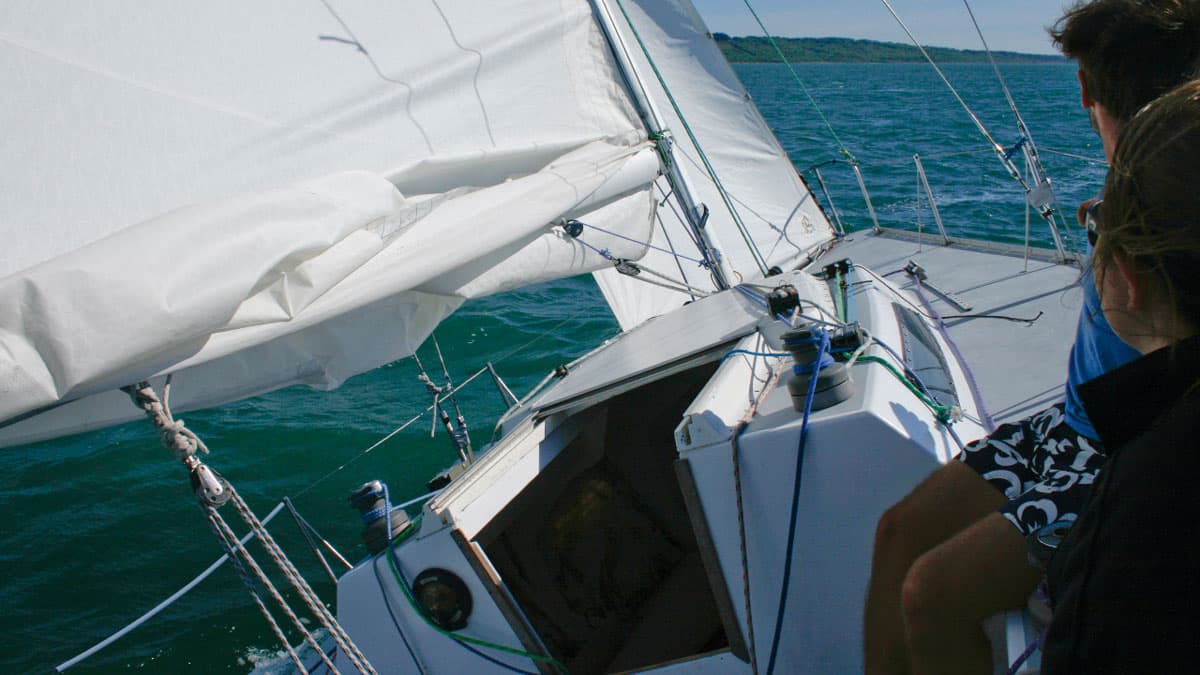
Sourcing the right materials and planning the deck run paid off: matching Dacron cloth to the mainsail, ordering 20mm and 14mm stainless cringles, and booking access to a hydraulic press enabled fitting two deep reefs at precise positions — luff 2.0m and 3.8m, leech 2.35m and 4.35m — on a second‑hand Etchells mainsail from a Quarter Tonner.
Measurements and reef geometry
For compact, performance-oriented boats the reef positions must both reduce sail area and preserve usable boom geometry. The chosen layout produced two deep reefs, each shortening the luff by roughly 2.0m. Because the boom drooped with full sail, the leech cringle placements were set to lift the boom by approximately 30cm for the first reef and 15cm for the second, improving sheeting angle and sightlines at reduced sail.
| Element | Vertical distance from foot | Purpose |
|---|---|---|
| First luff reef | 2.0 m | Primary reduction; deep reef for heavy conditions |
| Second luff reef | 3.8 m | Further area reduction for strong winds |
| First leech cringle | 2.35 m | Raise boom 30 cm |
| Second leech cringle | 4.35 m | Raise boom 15 cm |
Reinforcing the sail for reefing loads
Reef cringles take concentrated loads and need staged reinforcement. The approach used layered patches of Dacron sized by an 8% rule of thumb of the sail side length, giving the largest patches roughly 85cm × 35cm. The leech patches were one extra layer thicker than the luff ones to resist higher loading.
📚 You may also like
- Layer plan: luff – three layers; leech – four layers.
- Patch shape: trimmed quadrilateral (triangle with clipped corners) to balance strength and weight.
- Edge reductions: each added layer reduced by ~8cm on top/inner edges and ~2.5cm on the base.
Cutting and assembly
Sailcloth edges were sealed with a hot knife where possible; if not available, a repeatedly heated sharp blade was used. Individual patch pieces were stacked and temporarily bonded with double‑sided tape before sewing. The largest element of each patch was added last, stitched around its perimeter and tacked to underlying layers to spread loads evenly.
Step‑by‑step reinforcement workflow
- Make cardboard templates and position them on the sail to verify look and clearance.
- Cut patch pieces, seal edges, and assemble with double‑sided tape to hold shape.
- Unpick sail tabling on luff/leech to allow patch sliding beneath the tape edge.
- Attach partial patch with tape, align carefully to sail curvature, and sew around free edges.
- Add the final outer layer, stitch perimeter, then stitch to underlying layers.
- Resew tabling to anchor patch and finish neat edges.
Adding the cringles and ties
Cringles can be made with webbing and rings or fitted as spiked metal eyes. For speed and durability the sail was taken to a sailmaker to fit metal cringles: 20mm for heavily loaded leech points, 14mm for clew/less stressed points. The larger cringles required a press; smaller ones can be riveted in with a hammer and punch.
Non‑load bearing sail ties were added 15cm below the straight line between luff and leech cringles. These tie points were given minimal reinforcement: a small self‑adhesive Dacron patch about 5cm² on each side with rounded corners. Ideal spacing for tie and slide eyes is about 60cm apart to keep even distribution of loads and tidy reefing.
How to add cringles (concise)
- Measure and mark cringle positions; bend a batten between luff and leech to verify line.
- Fit reinforcing patches and position cringle dies centrally.
- Use hydraulic press for large cringles; hammer/punch for smaller sizes.
- Check alignment and stitch tabling back over the cringle edges.
Deck layout and line runs for short‑handed sailing
For single- or short‑handed helm, lead reef controls aft to the cockpit. On deep reefs where single‑line boom reefing is impractical, rig separate luff and leech pennants for each reef. Align clutches directly with the expected load line — between mast base and secondary winches — to minimize friction and simplify operation. Avoid long diverted runs through organisers unless neatness is valued more than low friction.
Fitting luff slides and piston hanks
Eyelets for slides are punched just behind the luff. Use spiked eyes sized to the combined thickness at the luff and close them with a punch die. Slides should match the mast luff groove and move freely. For headsails, piston hanks or hook hanks can be used; piston hanks often have a tang that must be hammered closed. Note that many piston hanks are single‑use: for older sails consider sewn‑through hanks or sourcing second‑hand fittings.
Luff slides and fittings: how to pick the best
Choose slides that are a smooth fit in the mast groove and robust enough for repeated use. Plastic easy‑fit shackles speed assembly for mainslails; bronze or stainless hooks for piston hanks give longevity on headsails. Match materials to service conditions — stainless hardware for saltwater resilience, Dacron patches for cost‑effective reinforcement.
Practical checklist
- Order matching Dacron and correct cringle sizes in advance.
- Schedule access to a heavy‑duty sewing machine or sailmaker for thick stacks.
- Book time at a sail loft with a hydraulic press for large cringles.
- Plan deck lead and clutch positions before cutting the sail.
- Practice punches and stitching on scrap cloth to set machine tension.
GetBoat always keeps an eye on news related to sailing and seaside vacations, as we truly understand what it means to enjoy great leisure and love the ocean. The GetBoat service values freedom, energy, and the ability to choose your own course, placing no limits on a good life and allowing clients to find a vessel that suits their preferences, budget, and taste.
This project is significant locally for owners of small racing and cruising yachts, but globally it is a routine sailmaker task rather than a major market shift. The practical impact on tourism is modest: better reefing and sail fittings make short‑handed coastal charters and day hires safer and more comfortable, which in turn supports reliable boating experiences for holidaymakers. Start planning your next seaside adventure and make sure to book the best boat and yacht rentals with GetBoat before the opportunity sails away!
Highlights: fitting correct reef positions and adequate reinforcement materially improves sail handling and safety; matching hardware (14mm/20mm cringles) and planning deck leads reduces friction and makes reefing from the cockpit possible; adding luff slides and appropriate piston hanks simplifies sail hoisting and lowers the threshold for hiring or charters. Remember that discovering a new coastal destination is a layered experience — you learn about culture, nature, the local palette and rhythm of life, and the unique aspects of service. If you are planning your next trip to the sea, you should definitely consider renting a boat (boat rentals, rent a boat, rent a yacht), as each inlet, bay, and lagoon is unique and tells you about the region just as much as the local cuisine, architecture, and language GetBoat.com
In summary, careful measurement, layered Dacron reinforcement, and the right cringle and slide hardware transform a second‑hand mainsail into a reefable, short‑hand friendly sail. Properly positioned reefs and a considered deck layout reduce workload, improve visibility and safety, and expand charter suitability. Whether you’re preparing a yacht for charter, a day hire, or private cruising, these upgrades support better sailing — from yacht charters and superyacht refits to small boat rentals — and make the experience on the sea, gulf, lake or ocean safer and more enjoyable. Book now and set your own course.


