Quisisana’s Remarkable Return at Dunkirk Anniversary
Alexandra
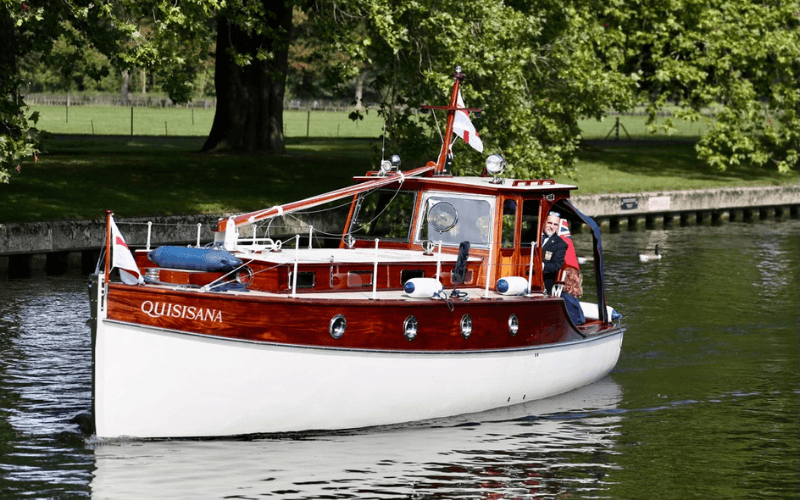
Quisisana completed the Ramsgate–Dunkirk crossing in May 2025 as part of the five‑yearly flotilla, operating at an economical cruise of 8 knots with reported fuel consumption around 4 litres per hour, and carrying a serving Coldstream Guards officer for the commemorative passage.
Restoration logistics and shipyard workflow
The rebuild followed a classical production-restoration workflow: acquisition of a partially conserved hull, structural re‑keel and replanking, renewal of deck beams, and meticulous interior refit to conceal modern systems. Work was carried out at a compact specialist operation where a nominated lead craftsman manages client decisions and progress on a day‑to‑day basis—an approach that proved critical to keeping the project on schedule for the Dunkirk crossing.
From shed in Lincolnshire to Ramsgate parade
Quisisana was discovered out of the water in a shed alongside MTB102, with much of her centreline and planking already tackled by Mark Welch. Acquisition was brokered through the Association of Dunkirk Little Ships (ADLS) and recommended by Ian Gilbert. The owner, Philip Christodolou, treated the hull as a blank canvas and worked closely with a rebuild team led by Malcolm and Chris at a small restoration yard that specialises in classic wooden craft.
📚 You may also like
Project timeline (high level)
| Stage | Action | Outcome |
|---|---|---|
| Acquisition (2024) | Purchase of hull and prior conservation assessment | Blank canvas with partial replanking |
| Structural rebuild | Re‑keel, replank (larch), repaired ribs, new deck beams | Seaworthy hull and improved longitudinal strength |
| Superstructure & systems | Cabin trunk widened, wheelhouse fitted, twin diesels and tankage | Modern comfort with period aesthetic |
| Sea trials & crossing | Shakedown, adjustments, Ramsgate–Dunkirk crossing | Successful participation in 2025 flotilla |
Design choices and technical specifications
The restoration combined a respect for the original Thornycroft 1927 lines with pragmatic alterations for modern use. Key decisions included widening and slightly raising the cabin trunk to improve headroom, installing a sympathetically styled open‑backed wheelhouse, and using traditional materials—mahogany coachroof and straight‑laid teak decks—while hiding electrical and comfort systems behind period‑appropriate panelling.
| Specification | Value |
|---|---|
| Builder | Thornycroft |
| Year launched | 1927 |
| Length | 30 ft (9.1 m) |
| Propulsion | Twin diesel engines |
| Fuel capacity | ~400 litres (across four tanks) |
| Nominal cruise | 8 knots |
| Estimated restoration cost | £150,000–£250,000 (owner final) |
Systems and hidden modernity
The interior preserves a pre‑war visual language while concealing modern conveniences. Systems installed include twin diesels, a 400‑litre diesel capacity, blackwater holding tank, water tanks, calorifier, diesel heater, two fridges, a strong battery bank and concealed USB charging. Fixtures such as the sink, oven and kettles are stowed or retractable so the cabin appears period‑authentic when not in use.
- Comforts: large heads with shower, two single saloon berths, double master cabin with wardrobes
- Cockpit arrangement: seating for six, rounded benches, proper helm seat
- Materials: larch replanking, mahogany above rubbing rail, straight‑laid teak decks
Historical significance and cultural resonance
Quisisana is documented in wartime photography showing soldiers aboard during Operation Dynamo under the command of A.J. Weaver. That provenance shaped restoration choices—the owner sought not only a beautiful boat but one that could perform in commemorative service. The crossing in 2025, with Major Tim Woodbridge aboard as Coldstream Guards liaison, fulfilled that brief and underscored the project’s cultural purpose.
Owner profile and motivations
Philip Christodolou brought a mix of entrepreneurial energy and personal history to the project: early career merchandising for music tours and a stint developing Ferrari merchandise informs a perfectionist approach to presentation and detail. That attention drove the choice to invest heavily in authenticity and craftsmanship, prioritising decisions that would both preserve heritage and provide modern safety and comfort.
Restoration v. authenticity: practical trade‑offs
Today’s restorations routinely prioritise exterior authenticity and interior usability. Quisisana’s team followed this template: keep original lines and finish where it matters to the eye, but redesign internal arrangements and systems to meet modern expectations for living aboard and safe, repeatable seafaring. This balance explains why projects often escalate from tidy budgets to higher final sums when quality and redundancy become non‑negotiable.
Why this matters for sailing and boat rentals
Historic restorations like Quisisana shape public interest in classic craft, festivals and marina traffic, and influence charter demand for distinctive vessels. For operators and renters, the result is a richer offering: well‑executed classics provide unique charter experiences for couples, families or groups, and set a standard for blending authenticity with reliability. GetBoat always keeps an eye on news related to sailing and seaside vacations, recognizing that access to thoughtfully restored vessels supports memorable leisure on the water and that freedom to choose a boat suited to budget and taste is central to quality maritime tourism.
The key lessons from Quisisana’s story are practical: meticulous project management, clear owner–shipyard communication, and prioritising seaworthiness permit historic yachts to be used safely in high‑profile events.
Experiencing a restored classic in a new destination highlights how visiting a place is a multifaceted process—learning its culture, nature, the palette of local colours, the rhythm of life and unique aspects of service. If you are planning your next trip to the sea, you should definitely consider renting a boat (boat rentals, rent a boat, rent a yacht), as each inlet, bay, and lagoon is unique and tells you about the region just as much as the local cuisine, architecture, and language GetBoat.com
Provide a short forecast on how this news could impact the global tourism and travel map: restoration stories like Quisisana tend to have localized influence—boosting festival attendance, marina visits and classic‑boat charter interest—without dramatically shifting global tourism patterns. However, they are significant for niche markets and enthusiasts. Start planning your next seaside adventure and make sure to book the best boat and yacht rentals with GetBoat before the opportunity sails away!
In summary, Quisisana’s rebuild demonstrates how careful conservation, modern systems integration and committed ownership create a vessel that can both honour history and deliver contemporary cruising. For sailors, charterers and buyers, the tale underscores the appeal of unique yachts and boats—whether for a beach weekend, lake cruise or ocean charter—and the importance of transparency in sale or rental listings. GetBoat.com supports these aims by offering global, user‑friendly options for booking and buying yachts, sailboats and motorboats with transparent details like make, model and ratings to help match clients to the right vessel—choose your course.


