Practical Repair Steps for Plywood Decks and Fairing
Alexandra
A mid-sized plywood-deck refit typically demands 80–120 labour hours and can remove the vessel from service for multiple weekends; on Minestrone the stripping, filling and fairing phases significantly impacted maintenance scheduling, material logistics for epoxy, silica and microballoon supplies, and the disposal protocol for glassfibre dust and solvent residues.
Overview of methods and immediate logistics
On the project boat Minestrone, documented by Rupert Holmes, the upper surface of the glassfibre-over-plywood deck had been filled with fairing compound then covered with many coats of rubberised deck paint. Over time, that paint delaminated in large flakes, often pulling fairing material away with it. The combination of degraded deck paint, embedded fairing compound and multiple bolt holes created three interdependent tasks: safe paint removal, hole restoration and deck fairing. Each task has discrete supply-chain and safety implications for charter operators and private owners: sourcing epoxy, silica, microballoons and a suitable chemical stripper; arranging waste capture for glassfibre dust; and scheduling dry time for primers and paint.
Choosing a removal method: pros and cons
Two main removal approaches were evaluated: mechanical abrasion and thermal or chemical stripping. A professional Metabo 150mm rotary disc sander with eccentric action and 40‑grit discs was tried but proved ineffective against the multi-layer rubberised paint system on Minestrone. The remaining options were hot‑air stripping or chemical stripping. Hot air risks damaging the laminate if overheated; chemical strippers often attack gelcoat and glassfibre unless formulated for composite use.
📚 You may also like
| Method | Speed | Risk to laminate | Notes |
|---|---|---|---|
| Rotary/belt sanding | Medium | Low (with care) | Effective if powerful belt sander available; creates heavy dust |
| Hot‑air gun | Fast | High | Can soften or melt laminate—requires skill |
| Chemical stripper (composite safe) | Slow | Low (if safe product used) | Easier on laminate; product availability varies (Ecosolutions recommended) |
On Minestrone the choice fell to a water‑based, composite-safe product from Ecosolutions (available via mail order or retail like B&Q), supplemented with careful use of hot air for stubborn residues. The formerly popular Nitromors glassfibre formulation was noted as unavailable.
Filling redundant bolt holes: an efficient approach
Nearly 200 bolt holes remained from redundant genoa tracks. Several options were considered—hardwood plugs epoxied in place, or filling with epoxy/filler mixes. The fastest and most reliable approach proved to be:
- Drill each hole one size larger to remove old sealant and clean the wood.
- Mask under the hole line to prevent drips and waste of compound.
- Seal the exposed plywood inside the hole with a coat of epoxy.
- Fill the hole using a flowing mix of epoxy and silica, applied from a mixing stick.
This method avoided cutting, gluing and trimming hundreds of hardwood plugs and completed the job in less than a morning.
Fairing technique and the longboard advantage
Fairing the entire deck to a uniform level requires choosing between sanding to the lowest point, filling to the highest, or a hybrid of both. After initial sanding removed only the highest peaks, the project used a hybrid approach: longboard sanding to establish broad-level uniformity, then strategic filling.
Making and using a longboard
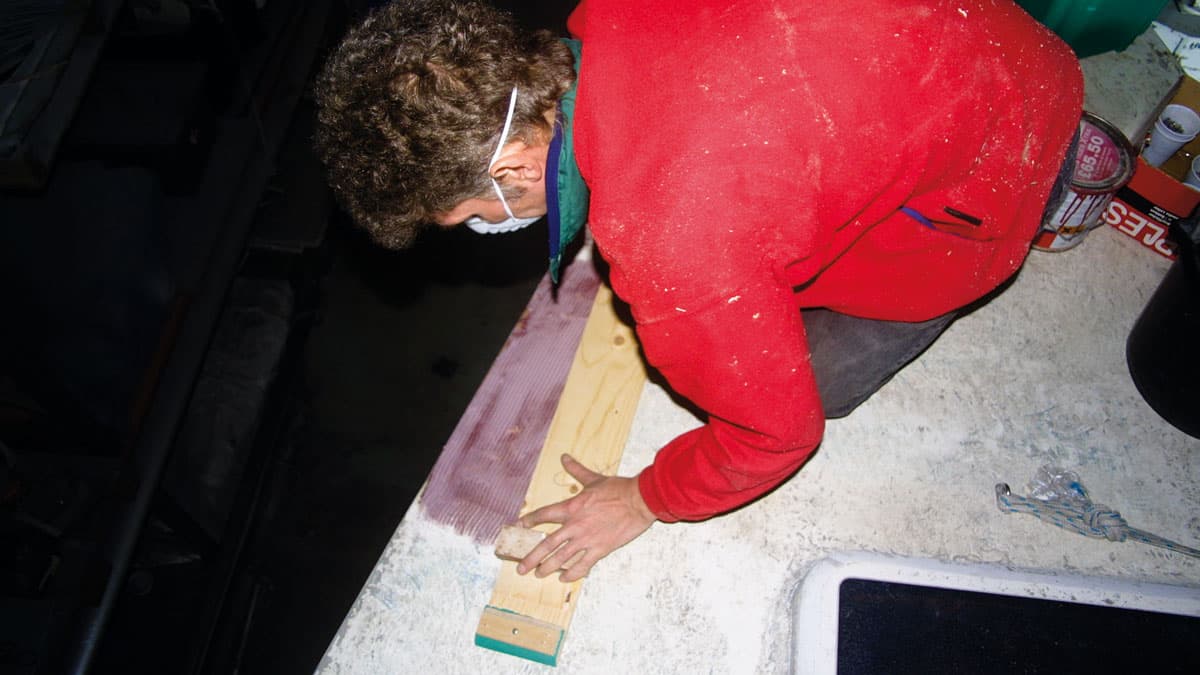
A one-metre longboard was fabricated from flexible scrap ply cut to the sandpaper width, fitted with simple handles (old door knobs work well) and battens to secure the sandpaper ends. Used with coarse 40‑grit paper, the longboard created an even plane across wide areas far faster than handheld sanding or the rotary sander could. For cambered transoms and quarters, a shorter, more flexible board proved better.
Fairing mixes: recipes and handling
Different filler mixes were trialed. A 50/50 blend of silica and microballoons offered a balance between application control and sandability. Later, a mix of glass bubbles and silica produced better application accuracy and faster overall progress despite a theoretically harder sanding surface.
- Start with meticulous cleaning (vacuum, brush, wipe with white spirit, then acetone).
- Apply fairing with a notched spreader, avoiding overfilling to reduce sanding work.
- Remove amine blush from new epoxy with water until beads disappear, then dry and sand to key.
Step-by-step quick checklist
- Strip paint (chemical or thermal); control dust and waste.
- Drill and clean redundant bolt holes; seal and fill with epoxy/silica.
- Longboard sand to level; apply fairing compound to hollows.
- Progressively sand and reapply until seamless; prime with at least three coats.
Painting and final finish
After fairing, three coats of primer/undercoat applied with a small roller transformed the appearance quickly. Two grey/white blended coats over cockpit, deck and coachroof simplified masking; a final white coat defined coachroof sides destined for gloss finish. Applying primer earlier in the process can reveal larger imperfections early, guiding more efficient corrective work.
Curved areas and final tips
For curved gunwales and topsides, fairing and sanding require smaller boards and a lighter hand; using a gloved finger to shape filler on tight radii often yields better results than rigid tools.
GetBoat always keeps an eye on news related to sailing and seaside vacations, as we truly understand what it means to enjoy great leisure and love the ocean. The GetBoat service values freedom, energy, and the ability to choose your own course. We place no limits on a good life, allowing clients to find a vessel that suits their preferences, budget, and taste; the platform makes it easy to view make, model and ratings before booking for an informed, transparent choice.
Provide a short forecast on how this news could impact the global tourism and travel map. If it's insignificant globally, please mention that. However, it's still important to us since GetBoat aims to stay updated with all developments and keep pace with the changing world. Start planning your next seaside adventure and make sure to book the best boat and yacht rentals with GetBoat before the opportunity sails away!
Highlights: deck fairing is labour‑intensive but achievable with modest tools if time is allowed; material choice—epoxy, silica, microballoons or glass bubbles—dictates sandability and finish time; dust control and amine‑wash are essential for health and adhesion. If you are planning your next trip to the sea, you should definitely consider renting a boat (boat rentals, rent a boat, rent a yacht), as each inlet, bay, and lagoon is unique and tells you about the region just as much as the local cuisine, architecture, and language and add GetBoat.com
Summary: restoring a plywood deck from stripped paint through filling, longboard sanding, and fairing to primer can be managed with a clear sequence of actions, careful material selection and appropriate dust and waste control. For skippers, yard managers and owners considering charter or sale, attention to these steps protects structural integrity and presents a boat better for yacht listings, charter readiness, or private use. Whether planning a day at the beach, a lake trip, or a distant coastal cruise, the right maintenance keeps hulls and decks ready for sailing, with an attentive captain and crew ensuring safety. Platforms like GetBoat facilitate discovery of suitable boat and yacht options across destinations—from superyacht charters to modest day rentals—linking marinas, activities and local operators. Proper fairing and finishing enhance the appeal for sale, charter or private use, supporting clearwater cruises, fishing trips, and yachting adventures in any gulf, sea or ocean.


