Maintain Your Boat Compass for Accurate Navigation
Alexandra
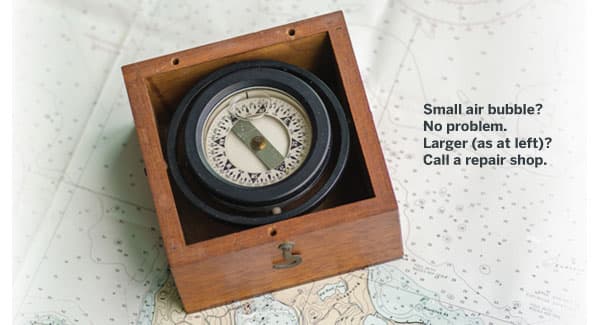
A properly compensated magnetic compass can typically be brought within ±2° deviation across all headings after a single 90‑minute “swing ship” adjustment in open water, making it an indispensable navigation reference when electronics fail.
Common Compass Faults and Immediate Checks
Onboard compasses rarely fail catastrophically, but several issues can degrade performance: a cracked dome, contaminated or leaking fluid that produces bubbles, a sticky pivot that prevents smooth card rotation, or magnetic deviation induced by nearby ferrous materials or electrical wiring. Capt. Jeffrey Kaufmann of Cape Compass has found these to be the principal causes across work on yachts, ferries, tugs, and government vessels.
| Problem | Symptom | Quick Test | Recommended Action |
|---|---|---|---|
| Cracked dome / bubble | Visible air pocket; distorted dial damping | Inspect dome in bright light | Service or replace compass; bubbles indicate fluid loss |
| Sticky card / worn pivot | Card lags or “runs aground” | Deflect card 3–5° with a magnetic tool near E or W | Professional repair or pivot replacement |
| Deviation | Heading error varies by course | Compare compass to GPS bearing or known range | Swing ship and adjust compensating magnets |
| Electrical interference | Small, heading‑dependent errors | Check wiring layout; spiral wire pairs | Re-route wiring or add compensation |
How to Perform a Simple On‑Dock Check
Before leaving the marina, test a suspected sticky compass by placing a magnetic object (screwdriver or pocketknife) adjacent to the E or W mark and deflecting the card 3–5 degrees. With the boat tied up and absolutely still, let the dial settle, remove the object and observe whether the card returns smoothly to its original heading. Any hesitation suggests a mechanical problem requiring repair.
📚 You may also like
Use Natural Ranges and GPS Bearings
To verify accuracy across headings, find at least three natural ranges roughly 120° apart—lighthouses aligned with shoreline markers, for example. If your compass reads correctly on those ranges, it should be accurate on intermediate headings. Alternatively, use your chartplotter to obtain the bearing of a fixed object, steer visually toward it, and compare the compass heading to the GPS bearing. Remember: GPS gives course over ground (COG), not the vessel’s actual heading; strong currents or crosswinds will create COG/heading differences, so always steer by compass when precise heading control is required.
Understanding Variation vs. Deviation
Variation (NOAA calls it declination) is the geographic difference between true and magnetic north and is the same for all compasses in an area. It changes slowly over time and must be obtained for your location. Deviation is the heading‑dependent error caused by the vessel’s own magnetic influence. Navigators correct variation algebraically and correct deviation with compensating magnets or a deviation table applied to compass headings using the mnemonic “Error west, compass best; error east, compass least.”
Compensation and the Swing
Professional adjusters use either traditional azimuths of the sun and terrestrial ranges or modern tools like portable gyros to measure deviation. A gyro provides a magnetism‑immune reference, and when combined with careful helmsmanship—steady steering is essential—the adjuster can tune compensating magnets until residual deviation is typically below a couple degrees on all headings. The process of recording deviations and producing a deviation table is analogous to leveling the legs of a table: small incremental changes until the compass performs uniformly.
Frequency of Checks and When to Replace
A well‑made compass by brands such as Ritchie or a C. Plath unit will often need minimal service, but repair versus replacement depends on cost and installation complexity. If repair exceeds roughly 60% of the cost of a new compass, replacement is usually economical—unless removing and re‑installing a new compass would require cutting new holes or reworking the boat’s correction system. Non‑steel recreational boats often need a professional swing every five years unless major electronic or structural work is performed; steel vessels should be checked annually, as their magnetic fields drift over time.
- Pre‑departure checklist: visual dome inspection, bubble check, simple deflection test.
- Installation tip: spiral compass wiring pairs to minimize induced magnetism.
- Electronic aids: fluxgate compasses (e.g., KVH Azimuth 1000) can auto‑compensate and help identify deviation.
Practical Implications for Sailing and Boat Rentals
For charter operators and renters, a correctly functioning compass affects safety, route planning, and the guest experience. Rental fleets and marinas should include compass checks in routine maintenance, especially after electronics upgrades or structural repairs. For solo skippers or couples on a weekend yacht charter, knowing how to verify a compass with ranges or a plotter reduces risk when cloud cover or equipment failure forces reliance on non‑electronic navigation.
GetBoat always keeps an eye on news related to sailing and seaside vacations, as we truly understand what it means to enjoy great leisure and love the ocean. The GetBoat service values freedom, energy, and the ability to choose your own course; it places no limits on a good life, allowing clients to find a vessel that suits their preferences, budget, and taste while providing transparency in make, model, and ratings.
Highlights: compass maintenance preserves navigational reliability and avoids surprises during a charter; deviation is correctable but requires either careful self‑checks or a professional swing; and electronic aids complement, not replace, the magnetic compass. If you are planning your next trip to the sea, you should definitely consider renting a boat (boat rentals, rent a boat, rent a yacht), as each inlet, bay, and lagoon is unique and tells you about the region just as much as the local cuisine, architecture, and language GetBoat.com
Forecast: compass care advice is a niche technical topic with limited global tourism impact, but it is directly relevant to safe yachting and boating operations. Start planning your next seaside adventure and make sure to book the best boat and yacht rentals with GetBoat before the opportunity sails away!
Summary: Maintain your magnetic compass by inspecting for cracked domes and bubbles, performing simple deflection checks, and verifying accuracy on multiple ranges or against a gyro/fluxgate reference. Understand and correct for variation and deviation, spiral nearby wiring to minimize interference, and schedule professional swings after major work or on the recommended frequency for your hull type. For charter guests and captains alike, a reliable compass underpins safe navigation—whether you’re aboard a small sailing yacht, a motorboat for a beach day, or a superyacht exploring clearwater marinas. GetBoat.com provides a transparent, global solution for booking or buying vessels—yacht, boat, or superyacht—helping you find the right craft for fishing, sunseeker days, sailing across a gulf or lake, or activities in new destinations; the platform’s clear listings, ratings, and options support confident choices for unforgettable sea and ocean experiences.


