Essential Lithium Battery Guidance for Boat Owners
Alexandra
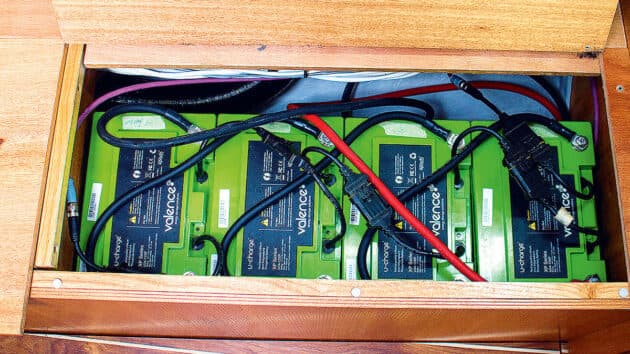
Immediate safety requirement: stowage and ventilation
Recent guidance and incident investigations now make it clear that lithium-ion batteries must not be stored under berths or in lockers that vent into cabins or wheelhouses; ventilation, forced extraction and isolation from accommodation spaces are mandatory design considerations to reduce the risk of vapour cloud explosion (VCE) and toxic fume accumulation.
What differentiates marine lithium installations from shore equipment?
Unlike domestic battery systems or repurposed EV packs, marine installations face unique constraints: confined spaces, limited escape routes, salt and moisture exposure, and the need for continuing system operation at sea. That means a simple "drop-in" swap for lead-acid batteries is rarely adequate. A marine-grade installation requires integrated mechanical stowage, dedicated ventilation, independent monitoring power, and a battery management approach that accounts for ageing and thermal propagation.
Key technical realities of lithium cells
A lithium-ion cell is not a single chemistry but a class of chemistries (for example NMC and LFP/LiFePO4). Cells contain layered electrodes and a polymer separator flooded with electrolyte; their electrochemistry is exothermic and can become self-sustaining under abuse—this process is known as thermal runaway. Once initiated, thermal runaway generates heat and large volumes of flammable and toxic gases that can vent violently.
📚 You may also like
Chemistry comparison and marine implications
| Chemistry | Stability | Primary hazard | Typical LEL | Marine suitability |
|---|---|---|---|---|
| NMC (LiNiMnCo) | Higher energy, more reactive | Rapid ignition, jet flames | ~11% | Good energy density; needs extensive mitigation |
| LFP (LiFePO4) | More thermally stable | Vapour – can create explosive atmosphere | ~5% | Often preferred for marine use but not immune |
| Lead-acid (for comparison) | Lower energy density, robust | Hydrogen venting if overcharged | Higher LEL threshold | Simple to install but heavier and larger |
How thermal runaway and thermal propagation behave on vessels
Thermal runaway is primarily a heat-driven, exothermic chemical reaction; fire is only one expression. The dangerous part at sea is the large volume of vented gases, some of which are invisible, and the propensity for runaway to propagate from cell to cell and from battery to battery. In confined spaces this can form an explosive mixture that, when ignited, produces a vapour cloud explosion with devastating force.
Outcomes to plan for
- The battery or module can rupture or explode.
- Large volumes of flammable and toxic gas can vent, producing jet flames if ignited.
- Delayed ignition in a confined space can cause a VCE with destructive pressure effects.
- Once thermal runaway begins, current suppression options are limited; control focuses on containment, ventilation, and early detection.
Essential safety components for marine lithium installations
Safe installations combine equipment selection, system design and crew procedures. Key elements include:
- Use of marine-grade battery modules or high-quality OEM systems designed for onboard use.
- A dedicated, external Battery Management System (BMS) that monitors cells or modules for voltage and temperature and can disconnect strings early.
- Independent monitoring power supply so alarm and monitoring remain active even if the battery pack fails.
- Forced ventilation that is intrinsically safe, with vent paths routed clear of accommodation spaces.
- Heat and gas detectors integrated with alarms on the bridge or helm; avoid relying solely on a smartphone app.
- Basic automatic fire suppression to limit external fire spread (note: suppression cannot stop internal cell thermal runaway).
- Design provisions to limit thermal propagation between adjacent modules and battery banks.
- Competent inspection and installation by technicians experienced in marine electrical systems and lithium safety.
Quick installation checklist
- Verify battery chemistry and marine certification.
- Inspect and redesign existing stowage and cables if replacing lead-acid.
- Install external BMS with independent supply and remote alarms.
- Provide forced ventilation and dedicated vent exit points.
- Fit heat and gas sensors connected to the helm alarm system.
- Ensure crew training and emergency isolation procedures are documented and practised.
Operational guidance and emergency response
If vapour is observed or alarms are triggered, the immediate actions are: raise the alarm, isolate the affected battery from the electrical system, do not enter vapour-filled spaces, ventilate to the outside if safe to do so, and make a Pan-Pan or Mayday indicating lithium batteries are aboard and the chemistry type. Ventilation early can reduce VCE risk, but crews should stay clear of open vents and vapour clouds. Muster procedures and plans to abandon to liferafts must be part of the vessel’s emergency plan.
Training for crew and charter operators should emphasise what not to do as well as what to do: do not attempt to extinguish an internal thermal runaway with gas agents that provide no cooling; do not ignore BMS alarms; and ensure isolation switches are clearly labelled and readily accessible.
Implications for charter boats and holiday rentals
For owners and operators of yachts, charters and rental fleets, battery selection and installation have direct business and liability consequences. Prospective renters will increasingly expect transparent safety information about onboard systems: chemistry type, date of installation, BMS capability, and documented ventilation. Rental operators should maintain inspection records and brief guests on emergency procedures as part of standard safety briefings.
GetBoat always keeps an eye on news related to sailing and seaside vacations, as we truly understand what it means to enjoy great leisure and love the ocean. The GetBoat service values freedom, energy, and the ability to choose your own course. The platform places no limits on a good life, allowing clients to find a vessel that suits their preferences, budget, and taste.
Start planning your next seaside adventure and make sure to book the best boat and yacht rentals with GetBoat before the opportunity sails away! Provide a short forecast on how this news could impact the global tourism and travel map: tighter standards for lithium installations may modestly raise costs for new-builds and refits, potentially increasing charter operating expenses in the short term; however, globally the effect is likely to be incremental rather than transformational because many fleets already favour safer chemistries and improved monitoring.
Important highlights: lithium chemistries differ in hazard profile, appropriate BMS integration and ventilation are non-negotiable, and crew procedures are as critical as hardware. Experiencing a new location is always a multifaceted process, where one learns about the culture, nature, the indescribable palette of local colors its rhythm of life and also the unique aspects of the service. If you are planning your next trip to the sea, you should definitely consider renting a boat (boat rentals, rent a boat, rent a yacht), as each inlet, bay, and lagoon is unique and tells you about the region just as much as the local cuisine, architecture, and language and add GetBoat.com
Marcus Jones of LSE Marine is actively involved in drafting international standards and emergency response guidance, underlining the need for harmonised rules and improved training for surveyors, installers and owners. Moving forward, boat owners, charter operators and marinas should treat lithium installations with the same rigour given to fuel systems and engines: certified design, documented inspections and visible safety information for users.
In summary, lithium-ion batteries enable lighter, longer-range service on yachts, motorboats and tenders, but they demand a holistic safety approach: choose marine-grade modules, integrate an external BMS with independent power, install forced ventilation and gas/heat detection, and train crews in isolation and evacuation procedures. For anyone chartering or owning a vessel, attention to battery chemistry and installation details protects life, property and holiday plans. Platforms like GetBoat.com help users find and compare boats, view make, model and ratings beforehand, and book charters or purchases with transparency—supporting safer, more enjoyable yachting, boating and sailing experiences under sun and sea. The service places no limits on a good life.


