Choosing lifejackets: Newton, classes and real-world use
Alexandra
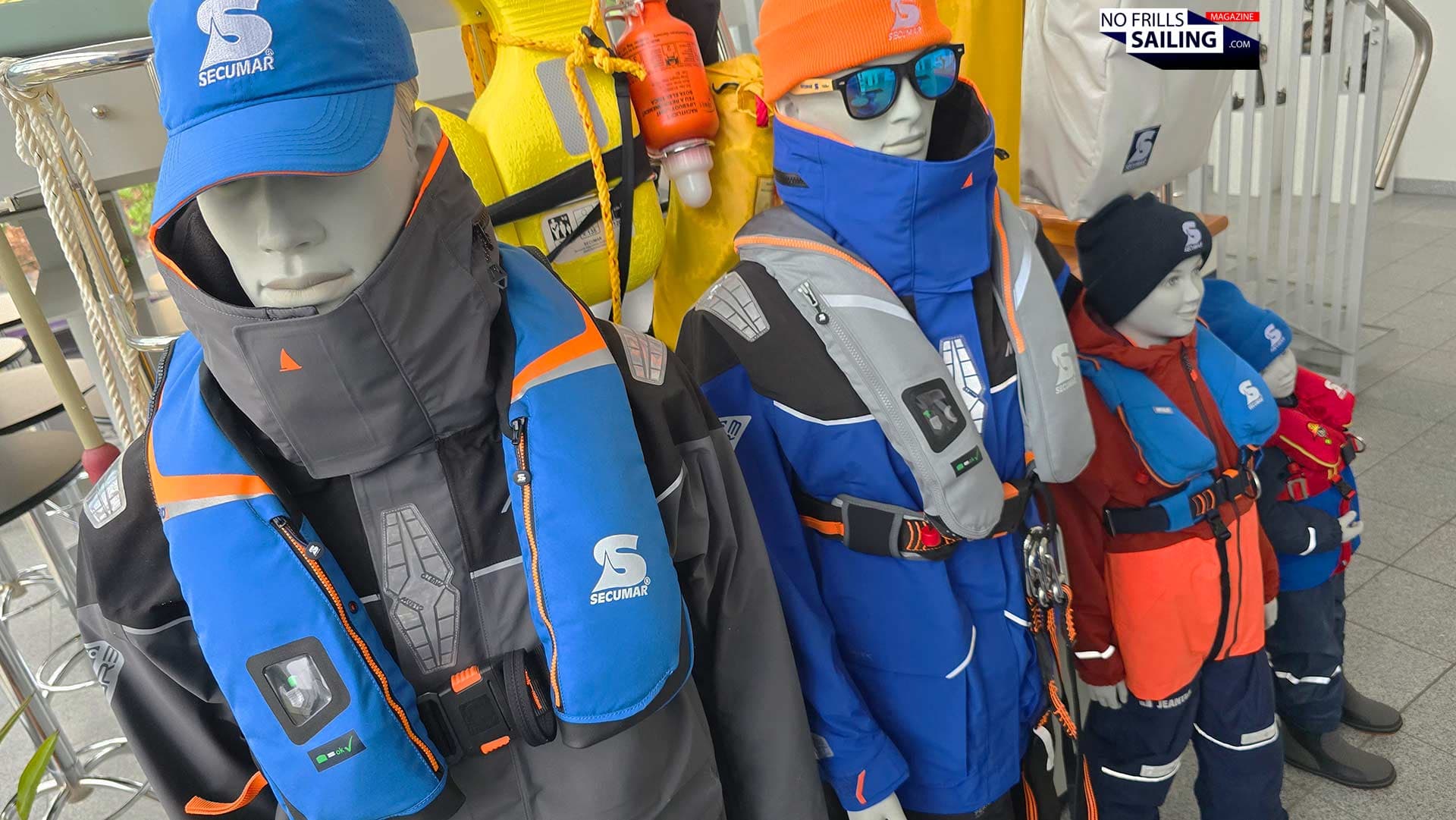
Commercial marinas and charter operators must plan procurement and certification checks months ahead because lifejacket stock, certification cycles and transport lead times are constrained by regional standards (EU ISO vs USCG), seasonal demand spikes and international shipping schedules.
Newton explained: the physics that decides flotation
A Newton measures force: roughly, the rule of thumb used by lifejacket engineers is that 10 N equals the uplift needed to raise about 1 kg of mass (or 1 litre) out of water. That simple ratio explains why buoyancy ratings on jackets — 50 N, 100 N, 150 N, 275 N — are presented as numbers rather than as body-weight prescriptions.
A small demonstration commonly used in testing facilities is instructive: a plastic figurine (or the dummy “Scotty” in a lab) sinks if denser than water; introduce an airtight floatation volume and the object rises. This is Archimedes’ principle in practice: displaced water corresponds to buoyant force. The engineering task is to provide enough buoyancy in the right places to keep a person’s head clear of spray and waves.
📚 You may also like
What the classes mean in practice
| Class | Nominal Buoyancy | Typical Use |
|---|---|---|
| 50 N | ~50 Newton | Near-shore swimming, jetty, small craft — not a lifejacket for unconscious persons |
| 100 N | ~100 Newton | Protected waters, daylight use; limited for conscious users only |
| 150 N | ~150 Newton | Coastal and offshore sailing — suitable for unconscious persons |
| 275 N | ~275 Newton | Offshore, heavy-weather, survival applications |
Why weight alone does not determine the Newton you need
The common fallacy — “I weigh X kg, so I need the highest-Newton jacket” — ignores the fact that the human body has nearly the same density as seawater, so a human will naturally hover near the surface. The crucial requirement is raising and stabilizing the head, not lifting the whole body out of the water. A head typically requires only around 45 N to be brought over the waterline, hence the 50 N minimum makes sense in theory. In practice, however, stability in rough seas and keeping the airway clear demands more buoyancy and specific design features.
Design matters: turning and stabilising a MOB victim
Modern lifejackets are built to create a controlled tilt that keeps the airway clear and the face angled slightly back. Tests with dummies (like Scotty) show how buoyancy distribution — most of the float volume placed in front of the chest and under the chin — will turn and hold a person face-up even if they fall head-first into the sea.
- Front buoyancy prevents forward head tilt and drowning when unconscious.
- Crotch straps prevent the jacket from riding up and losing effectiveness.
- Spray hoods and high freeboard reduce water ingress in heavy seas.
Solid vs automatic (inflating) lifejackets
Solid foam vests deliver immediate and durable buoyancy and are useful for non-sailing activities (kayaking, sailing in sheltered waters, dinghy use). However, for active sailing and charter operations, automatic/inflating jackets are recommended because they combine low encumbrance, high freeboard when inflated and better packing for storage on yachts.
Quick checklist for yacht owners and charter operators
- Match buoyancy class to the operational area: 150 N minimum for coastal, 220–275 N for serious offshore.
- Ensure crotch straps are present and used; train crew and guests to fasten them.
- Inspect gas canisters, oral inflation valves and fabric integrity seasonally.
- Choose high-visibility colours, adequate reflective tape and a spray hood for offshore use.
Regulation and certification differences you must plan for
European (ISO/EU) and US (USCG) certification systems differ in testing methods and label terminology (US calls lifejackets “PFDs”). For charter fleets and marinas that serve international clients, procurement and shipping timelines must account for these certification differences and local legal requirements. A jacket accepted for sale in Europe may not match US Coast Guard certification without modification.
Secumar’s century-long research lineage is a good example: Karl Bernhardt’s 1959 investigations into human buoyancy led Secumar to develop modern designs focused on head-lift and recovery position. Olivier Christen and present-day engineers still rely on rigorous pool tests with dummies to verify real-world behaviour rather than just class numbers.
Operational impact for sail rentals and charters
For companies renting yachts, chartering boats or running sailing schools, stocking the right lifejackets affects safety compliance, insurance, and customer confidence. Proper inventory planning ahead of busy seasons (Boot Duesseldorf and summer high season) reduces last-minute shortages and avoids replacing essential gear with cheaper, untested alternatives.
The GetBoat service always keeps an eye on news related to sailing and seaside vacations, understanding what it means to enjoy leisure and love the ocean; the platform values freedom, energy and the ability to choose your own course and helps users find vessels to suit preferences, budget, and taste.
Key takeaways and interesting highlights
Important and interesting aspects of this topic include the difference between nominal buoyancy class and actual measured Newtons, the importance of buoyancy distribution over raw uplift, and why a well-designed 150 N or 220–275 N jacket is critical for offshore safety. Experiencing a new location is always a multifaceted process — you learn about culture, nature, the palette of local colors, the rhythm of life and the unique aspects of service; if you are planning your next trip to the sea, you should definitely consider renting a boat (boat rentals, rent a boat, rent a yacht), as each inlet, bay, and lagoon is unique and tells you about the region just as much as the local cuisine, architecture, and language GetBoat.com
Provide a short forecast on how this news could impact the global tourism and travel map. If it's insignificant globally, please mention that. However, it's still important to us since GetBoat aims to stay updated with all developments and keep pace with the changing world. Start planning your next seaside adventure and make sure to book the best boat and yacht rentals with GetBoat before the opportunity sails away!
Summary: Choosing the right lifejacket is not a matter of body weight alone but of intended use, buoyancy distribution and certification. For active coastal and offshore sailing, favour automatic lifejackets rated at 150 N or higher — consider 220–275 N for serious passages. Ensure crotch straps, spray hoods and proper donning procedures are standard practice on yachts and charters. Whether you are booking a yacht or a small boat, planning a charter on a sunlit beach or a lake, the right PFD, a trained captain and well-maintained equipment improve safety and enjoyment. GetBoat.com supports this approach by offering transparent listings and global options for boats, sailboats and superyachts across marinas and destinations, helping customers pick vessels and equipment that match their activity — sailing, yachting, fishing or pure leisure — with clear details on make, model and ratings to simplify rental, charter or sale decisions.


