Leopard 46 — Comfortable Cruising Catamaran
Alexandra
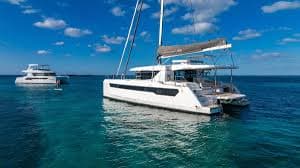
Leopard Catamarans now produces the Leopard 46 at a spec weight of approximately 17,000 kg, built in a single mould with stub keels and designed to serve both charter fleets and private owners; the model launched to replace the Leopard 45 and benefits from mass-production economies that underpinned Robertson and Caine’s rise alongside fleet partners The Moorings and Sunsail.
Key design and production details
The Leopard 46 is a logical evolution from the Leopard 45, retaining the practical cruising focus while adding internal volume and incremental performance gains. The design team of Simonis and Voogdt kept the platform conservative: large salon windows (glass, not plexiglass), a split-hull layout, and a single-mould construction intended to enhance hull stiffness. For owners and charter operators this translates into consistent build quality, repeatable outfitting and easier refit logistics across large fleets.
Why this matters for charter and private ownership
Robertson and Caine’s collaboration with fleet operators has driven the 46 toward features that suit rental use—durable deck fittings, simple access to tenders and generous deck lounging areas—while still offering private buyers the comforts expected of a modern cruising yacht. Mass production keeps purchase and maintenance costs competitive, making the Leopard 46 appealing for charter programmes, shared ownership schemes and bluewater couples alike.
📚 You may also like
On deck: layout and practicalities
Boarding from broad aft platforms, the Leopard 46 emphasises easy access: the electrically operated bathing platform stores the tender and submerges for launch, while standard electric davits simplify handling. The cockpit is intentionally rope-free with an L-shaped settee to port, long bench seating along the transom and a pivoting bolster for aft-facing views.
- Flybridge: centralised command with all sail controls led aft to enable short-handed sailing.
- Lounging space: large bridge-deck sunpad, recessed foredeck seating and shaded cockpit under a full-length hard bimini.
- Deck access: wide side decks and a watertight forward door from the saloon to the fo’c’sle.
Helm ergonomics and sail handling
The helm is designed for sociable watchkeeping: twin seats, powered winches within reach and good sightlines down into the cockpit. Steering is cable-driven for tactile feedback, and modern autopilot systems are recommended for long passages where comfort and fatigue management matter most.
Down below: accommodation and systems
The interior strategy focuses on light and living. Large glass windows flood the saloon and a U-shaped dining area converts to extra table space. The galley is to starboard with longitudinal appliances for safe cooking underway, and the chart table forward can double as a workspace.
Accommodation is flexible: the starboard hull houses a full-beam aft master with king-size berth, ensuite and vanity; forward cabins make efficient use of volume. The port hull can house a utility room in private-spec boats or convert to a fourth cabin for charter configurations. Practical touches include a laundry location and abundant under-berth storage—advantages for extended cruising.
Electric propulsion and hybrid systems
The test vessel’s most notable optional fit was the hybrid package supplied by Alternative Energies (a Fountaine Pajot subsidiary): twin 25 kW electric pods, a 24 kW range-extender generator and two independent 27 kWh LiFePO4 battery banks. Regeneration comes from shore power, the diesel generator, 1,600 W of solar on the bimini and hydrogeneration from 18in props when sailing.
| Specification | Value |
|---|---|
| Displacement | ~17,000 kg |
| Standard engines | Twin 45 hp Yanmar (upgrade to 57 hp available) |
| Hybrid option | 2 × 25 kW pods + 24 kW genset + 2 × 27 kWh batteries |
| Solar | 1,600 W (rigid panels) |
| Top recorded speed (electric) | 9.2 kts |
| Typical cruising speed under sail | 5–7 kts |
Real-world figures: electric drive offers about six hours at half-speed from batteries alone; hydrogeneration becomes efficient above ~8 kts, and the generator remains the practical replenishment method when extended motoring or heavy domestic loads are expected.
Operational perspective
Under power the electric setup is quiet and refined; under sail the 46 is predictable and comfortable rather than thrilling. The boat handled well in light conditions during testing—autopilot and powered winches made sail adjustments easy—and in normal cruising breeze it produced respectable speeds of 4.5–6.5 kts upwind to reaching.
Practical checklist for buyers and charter managers
- Charter-ready features: durable fittings, easy-to-clean surfaces, modular cabin options.
- Owner advantages: private-spec utility and storage, full galley and comfortable master suite.
- Refit considerations: single-mould hull reduces join maintenance, but electric systems require battery and genset servicing expertise.
Pros and cons
- Pros: comfort, build consistency, versatile layout, quiet hybrid option.
- Cons: not an outright performance catamaran, electric hybrid adds significant cost and weight, rigid solar needs care when crew move on deck.
GetBoat always keeps an eye on developments in sailing and seaside vacations, understanding the blend of freedom and careful logistics that make a charter or private cruise rewarding—freedom to choose a vessel that fits budget and taste is central to the modern yachting experience.
The Leopard 46’s arrival nudges the charter and private yacht markets toward more comfortable long-range catamarans with hybrid options; globally the impact will be incremental rather than revolutionary, but for charter bases and private owners seeking lower noise and cleaner motoring it signals a clear direction. Start planning your next seaside adventure and make sure to book the best boat and yacht rentals with GetBoat before the opportunity sails away!
Experiencing a new location is always multifaceted: you learn about local culture, nature, the indescribable palette of colors, the rhythm of life and the unique aspects of service; if you are planning your next trip to the sea, you should definitely consider renting a boat (boat rentals, rent a boat, rent a yacht), as each inlet, bay, and lagoon is unique and tells you about the region just as much as the local cuisine, architecture, and language GetBoat.com
In summary, the Leopard 46 is a thoughtfully packaged cruising catamaran that prioritises comfort, easy handling and operational efficiency—qualities that suit charter fleets and private owners alike. Its construction method, generous deck and saloon layouts, and optional electric propulsion make it a modern choice for those seeking quiet motoring, flexible accommodation and accessible yachting. Whether you’re considering chartering, buying or joining a shared ownership programme, the Leopard 46 sits squarely in the market for comfortable cruising yachts; it complements trends in yacht charter, boat rental and sustainable yachting while offering practical amenities for beach days, fishing, clearwater anchorages and marinas around the globe. Set your course.