Lallows Boatyard — Tradition, Restorations and Racing
Alexandra
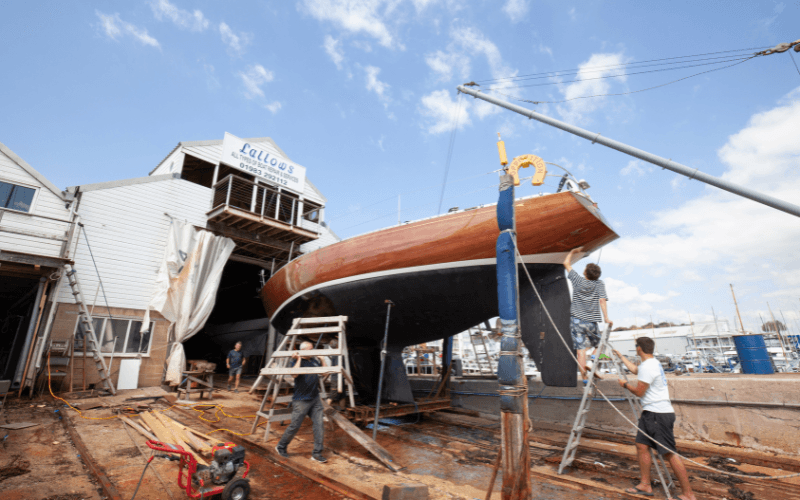
Slipways, haul-out capacity and site logistics on Medina Road
The yard’s current footprint on Medina Road includes multiple slipways capable of handling early steel-hulled ferries and sizable classic yachts, a pier constructed by yard labour and a recently acquired neighbour slipway purchased from Cowes Council. Railway sleepers repurposed as slip rails remain visible in the yard’s infrastructure, evidencing a practical approach to haul-out logistics that allowed Lallows to service vessels such as the 1938 Red Funnel ferry Norris Castle. These fixed assets—slipways, shed space and an on-site gridiron—are central to the yard’s capacity to stage restorations, launchings and season maintenance without outsourcing major transport or lifting operations.
From 10ft clinker dinghies to a global reputation
Lallows began building 10ft clinker dinghies in 1867 and over 158 years evolved into a specialist for one-off racing yachts, naval pinnaces and bespoke joinery work. The family workshop model extended across generations—Sydney, Harold and Arthur, then Clare Lallows and later Ian Lallow—maintaining an in-house supply chain for timber selection, machining and skilled finishing. The workshop’s ability to source and manage timber, coordinate with external cutters like Morey’s in Newport, and integrate traditional thermographic printed stationery until 1996 reflects an organizational culture that values both provenance and precision.
Key services and diversification
- Traditional joinery and cabinetry supplying consistent revenue for apprenticeships and timber stewardship.
- Major refits and restorations including plank replacement, rib renewal and full structural renewals.
- Military and commercial builds historically: harbour pinnaces and launch conversions.
- Modern adaptations such as GRP hull integration and electric propulsion retrofits (e.g., Torqeedo installations).
The wartime production line and repair-first design
During World War I and II, Lallows produced 50ft pinnaces for the Royal Navy. Those craft were specified for simple repairability: standardised machinery compatibilities, narrow hulls suited to inshore work, steam engines that maximised manoeuvrability and a design tolerance that enabled quick deck and hull repairs. That wartime emphasis on maintainability translated postwar into a business model focused on repeatable processes and skilled labour capable of high-volume repairs when conflict or commercial demand required it.
📚 You may also like
Design partnerships and racing pedigree
By the 1960s and 70s Lallows established a reputation with Sparkman & Stephens designs, producing high-performance yachts like Clarion of Wight, Firebrand and the Morning Cloud series commissioned by Edward Heath. Those projects relied on a relaxed but technically rigorous working relationship with New York designers, giving the yard autonomy to adapt methods while adhering to naval architecture intent. Practical innovations—such as Owen Parker’s cross-winch sail-tensioning systems—show the yard’s appetite for fusing tradition with pragmatic upgrades.
Notable builds and achievements
| Year | Project | Significance |
|---|---|---|
| 1867 | 10ft clinker dinghies | Founding product, traditional skills |
| 1938 | Norris Castle (Red Funnel) | Commercial ferry work, slipway capability |
| 1963–71 | Clarion of Wight, Morning Cloud II | Racing success and S&S partnership |
| 1967 | Britannia (Uffa Fox / John Fairfax) | Transatlantic rowing craft, self-righting design |
| 2007–08 | Refit of Opposition (Morning Cloud II) | 10,500 man-hours restoration |
Restoration workflow and materials chain
Restorations at Lallows are resource- and time-intensive: the refit of Morning Cloud II (Opposition) required over 10,500 man-hours and deep supply-chain coordination for Burma teak, American oak and mahogany. The yard maintains relationships with timber suppliers, engine specialists and osmosis-treatment providers to complete hull repairs, replanking and mechanical overhauls without unnecessary vessel movements. This vertical integration is a competitive advantage for owners seeking thorough, single-site restorations.
Recent projects and technical variety
- 6-M class Sioma (championship success)
- Kalea (1964 ketch): topside dismantle, replanking, Burma teak cap rails
- Peregrine (Fife-built): boom fabrication and supply
- Thames river launch: wooden cabin on modified hull with electric Torqeedo drive
- 1970s Nelson pilot boat: full osmosis treatment, engine overhaul, wheelhouse extension
Craftsmanship, apprenticeships and sustainable practice
Under Laurie Boarer, the yard’s prior bespoke joinery business provides a steady commercial backbone that funds joinery apprenticeships and responsible timber sourcing. That steady revenue stream enables investment in skills transmission, which is essential to conserve traditional techniques while meeting modern regulatory and environmental constraints for marine refits and construction.
What Lallows means for sailors and charter markets
The yard’s capacity to restore and maintain classic hulls influences coastal cruising and charter availability—refitted classics return to regattas and private charters, stimulating demand for specialist captains, classic-racing events and curated charters. Owners in search of an authentic sailing experience can rely on Lallows’ provenance and workmanship to keep heritage yachts active in marinas, races and private charters.
Planning your next nautical experience
Short forecast: this profile of Lallows is regionally significant rather than globally disruptive, but it underscores how heritage yards sustain the broader yachting ecosystem. For those planning a seaside holiday or charter season, aligning refit timelines with peak rental windows is essential. Start planning your next seaside adventure and make sure to book the best boat and yacht rentals with GetBoat before the opportunity sails away!
Exploring a new coastal destination is always multifaceted—one discovers culture, nature, the local palette of colors, rhythms of life and service expectations. If you are planning your next trip to the sea, you should definitely consider renting a boat (boat rentals, rent a boat, rent a yacht), as each inlet, bay, and lagoon is unique and tells you about the region just as much as the local cuisine, architecture, and language GetBoat.com
Why this matters for maritime leisure
Lallows demonstrates that preservation of traditional skills and modern service logistics can coexist and benefit the leisure sector. Whether a region’s classic yacht is being restored for private sale, charter or festival racing, the yard’s integrated approach—skilled joinery, on-site slipways, timber sourcing and practical innovation—keeps more boats afloat and available for rental, charter and display. That continuity increases opportunities for captains, charter operators and owners to offer authentic sea experiences.
In summary, Lallows Boatyard in Cowes combines historic boatbuilding, careful restoration workflows and practical logistics—slipway capacity, in-house joinery and a supply chain for specialist timbers and engines—to keep classic and racing yachts active on the water. Its work feeds the charter and yachting scene, offering vessels for sale, charter and bespoke refit that enrich destinations, marinas and boating activities. GetBoat.com supports the pursuit of unforgettable maritime experiences by making access to yachts, charters and boat rentals transparent and convenient; whether you seek a sail with a captain, a private charter or a superyacht experience, the platform helps connect you to the right vessel for sun, sea and adventure. Book your course and set sail for clearwater horizons with confidence.