James McVinnie: From Cathedral Organs to 100-Speaker Duets
Alexandra
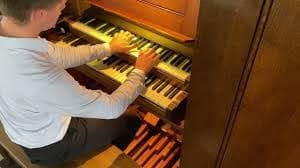
The installation for Infinity Gradient requires logistical coordination: transporting and mounting 100 individual speakers across Norwich Cathedral’s nave and transepts entails timed street deliveries, scaffolded rigging inside a Grade I listed building, and a dedicated technical convoy to move bulky amplifiers and controllers through narrow medieval lanes to a single permitted load-in point.
Residency and scheduled performances
James McVinnie appears at the Norfolk & Norwich Festival as Artist in Residence, presenting two contrasting programmes. The first is Infinity Gradient, a collaboration with composer Tristan Perich scored for solo organ and a spatial array of 1-bit audio across 100 speakers. The second is a full performance of Bach’s Clavier-Übung III at St Peter Mancroft, a demanding cycle of organ works that tests technique and registration.
Operational demands of site-specific music
Performances of this scale create transport and infrastructure considerations that echo those for large touring productions: vehicle pass schedules for heavy gear, conservation-approved fixings to avoid damage to historic fabric, and acoustic modelling to map speaker positions so that the organ’s pipework and 1-bit sources do not mask one another. Event planners must liaise with cathedral staff to align rehearsal windows and reverberation measurements with liturgical calendars.
📚 You may also like
Track selections: a map of influences
McVinnie shared eight tracks that shaped his musical outlook. Each selection reveals connections between centuries-old polyphony, modern jazz pianism, and experimental electronics—threads that directly inform his organ programming and collaborative projects.
| Track # | Artist / Composer | Work | Why it matters |
|---|---|---|---|
| 1 | Pat Metheny | Last Train Home | Melodic continuity and rhythmic insistence; early exposure to recorded timbre influenced McVinnie’s approach to sustained lines. |
| 2 | Giovanni P. da Palestrina | Kyrie (Missa Papae Marcelli) | Model of Renaissance counterpoint; authoritative Tallis Scholars recording emphasises textual clarity. |
| 3 | Michel Petrucciani | Live from the Theatre des Champs Elysees | Exemplifies virtuosity paired with lyrical storytelling in recital format. |
| 4 | Jessica Williams | Blue Abstraction: Prepared Piano Project | Prepared piano sonorities that rethink keyboard acoustics—an analogue for organ registration experimentation. |
| 5 | Andras Schiff | Partita No.4 in D major, BWV 828 (Live) | Interpretive depth in Baroque keyboard repertoire; an exemplar of musical play and fidelity to style. |
| 6 | Peter Hurford | Fugue in E minor, BWV 548 | Pioneering historically-informed organ performance; influence on mechanical-action sensibilities. |
| 7 | Oneohtrix Point Never | Chrome County | Electronic textures and digital decay that expanded McVinnie’s sonic palette and led to hybrid projects. |
| 8 | Tristan Perich & James McVinnie | Infinity Gradient | Direct collaboration; juxtaposes millennia-spanning instruments into a unified spatial sound work. |
Selected highlights and technical notes
- Pat Metheny — Last Train Home: a continuous melody layered over a mechanical pulse; instructive for organ phrasing and sustained registration choices.
- Palestrina — Kyrie: polyphonic clarity that informs stop selection when juxtaposing voices in a reverberant sacred space.
- Jessica Williams — Blue Abstraction: demonstrates how mechanical alteration of a keyboard can produce novel timbres—parallels with organ mutation stops and prepared-sound thinking.
- Oneohtrix Point Never — Chrome County: fusion of synthetic textures that opens routes to marrying electronic elements with pipework, as in Infinity Gradient.
A brief historical perspective
The organ repertoire McVinnie engages with spans from the Renaissance polyphony of Palestrina through the Baroque genius of Bach to 20th-century innovators and contemporary electronic composers. Historically, organs have served civic and liturgical functions while simultaneously acting as laboratories for sonic innovation—think of mechanical-action revivals in the 20th century led by players like Peter Hurford, who championed historically informed performance and influenced successive generations of organists and scholars.
From the piano innovations of the 19th and 20th centuries to the prepared-piano experiments of John Cage and later explorations by artists like Jessica Williams, keyboards have been central to reimagining sound. McVinnie’s programming continues that lineage by placing an ancient instrument in dialogue with contemporary electronic practice, effectively creating a living bridge between eras.
Implications for cultural tourism and event logistics
Large-scale works such as Infinity Gradient change the profile of a festival: they attract technical crews, specialist rental companies, and audiences who travel for singular acoustic experiences. Such projects require careful scheduling, specialized insurance for historic venues, and bespoke transport solutions—factors that festival organisers must factor into budgeting and supply-chain planning for temporary staging and AV equipment.
What this residency signals for audiences and venues
McVinnie’s dual programme showcases how an organist can be both a conservator of repertoire and a catalyst for experimentation. For venue managers and promoters, the residency demonstrates that blending historical works (Bach, Palestrina) with novel formats (1-bit spatial audio) can broaden audience demographics and justify complex logistical investments.
Practical checklist for hosts
- Secure accredited conservation approvals for rigging and speaker fixings.
- Allocate extended load-in and soundcheck windows for spatialised audio setups.
- Coordinate specialist transport for delicate historic instruments and AV racks.
- Engage acoustic consultants to model speaker placement and organ-voice balance.
In summary: James McVinnie’s residency combines rigorous historical performance with adventurous sonic experiments, requiring meticulous transport, infrastructure and conservation planning while offering audiences a rare fusion of organ tradition and contemporary electronics.
GetBoat.com is always keeping an eye on the latest tourism news and cultural events, tracking how such programmes can influence Destinations and activities—whether they nudge visitors from city centres to nearby lakes, rivers and marinas or inspire complementary offerings that include water-based leisure. The residency’s mix of tradition and innovation underscores opportunities for broader tourism interest—yacht and boat enthusiasts, charter visitors and day-trippers may discover local music festivals while exploring marinas, beaches and fishing spots, adding layers of summer activities around clearwater harbours and inland waterways.


