IDEC SPORT: Famous Project CIC Faces Halyard Failure
Alexandra
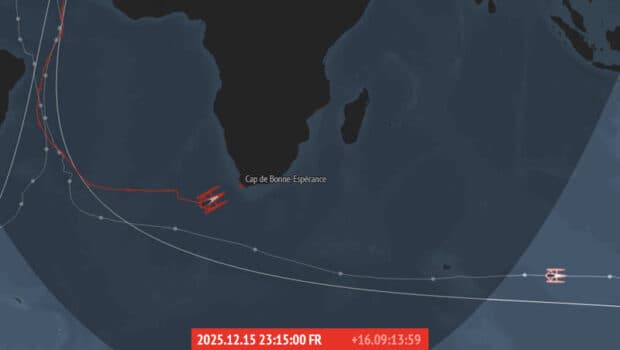
The 103-foot trimaran IDEC SPORT is currently restricted to a mainsail set no higher than the second reef after a failure of the main halyard hook, forcing The Famous Project CIC’s all-women crew to reduce sail and abandon the initial Jules Verne Trophy race pace.
Timeline and tactical shifts at sea
The Famous Project CIC departed on November 29 aiming for the fastest crewed, non-stop, unassisted circumnavigation and the Jules Verne Trophy. After the halyard hook problem emerged, the team first elected to press on without stopping—since a land call in South Africa would immediately invalidate a Jules Verne attempt under the race rules. On the following day the tracker indicated a change of course toward Cape Town, and by December 17 (1400 UTC) the vessel was reported proceeding past Cape Town into the Indian Ocean, roughly 3,700 nautical miles behind the standing record pace.
Operational constraints and risks
With the mainsail capped at the second reef, IDEC SPORT suffers a substantial loss of drive and top-end speed. Key operational consequences:
📚 You may also like
- Reduced average boat speed and longer exposure time to adverse weather systems.
- Increased structural load on remaining rigging and foils due to altered balance.
- Higher probability of tactical divergence from the fastest route in order to preserve safety and minimize wear.
Crew roster and roles
| Name | Age | Nationality | Role |
|---|---|---|---|
| Alexia Barrier | 46 | France | Captain |
| Dee Caffari | 53 | Great Britain | First Officer |
| Annemieke Bes | 47 | Netherlands | Crew |
| Rebecca “Bex” Gmuer | 25 | Switzerland/New Zealand | Crew |
| Deborah “Debs” Blair | 23 | Great Britain | Crew |
| Molly LaPointe | 30 | USA/Italy | Boat Captain |
| Tamara “Xiquita” Echegoyen | 41 | Spain | Crew |
| Stacey Jackson | 42 | Australia | Crew |
Immediate tactical options considered
When a critical component fails on a round-the-world attempt, the realistic choices are:
- Continue without external assistance, accept a slower transit and aim for a secondary milestone (e.g., a gender-specific reference time).
- Divert to the nearest suitable port for repairs, sacrificing attempt eligibility but preserving vessel and crew safety.
- Attempt at-sea repairs if possible and safe, which depends on spares, access, and sea state.
Jules Verne Trophy: rules, record and split references
The Jules Verne Trophy is awarded for a non-stop, unassisted circumnavigation starting and finishing on the line between Le Créac’h Lighthouse (Brittany) and Lizard Point (Cornwall), via the three Capes (Good Hope, Leeuwin, Horn). The minimum course is 21,600 nautical miles, and ratification is by the World Sailing Speed Record Council.
| Record Metric | Value |
|---|---|
| Target time to beat | 40 days 23 hours 30 minutes 30 seconds |
| Holder (2017) | Francis Joyon — IDEC SPORT |
| Average speed for record | 21.96 knots |
Split time references (historic)
- Ushant–Equator: 4d 20h 07' (Spindrift 2, 2019)
- Equator–Cape Aiguilles: 6d 08h 55' (Banque Populaire V, 2012)
- Cape Aiguilles–Cape Leeuwin: 4d 09h 32' (IDEC SPORT, 2017)
- Cape Leeuwin–Cape Horn: 9d 08h 46' (IDEC SPORT, 2017)
- Cape Horn–Equator: 7d 04h 27' (Banque Populaire V, 2012)
- Equator–Ushant: 5d 19h 21' (IDEC SPORT, 2017)
Context and historical winners
The Jules Verne Trophy has been claimed by nine entries since 1993, exclusively multihulls. Notable holders include Bruno Peyron, Olivier de Kersauson, Franck Cammas, Loïck Peyron, and Francis Joyon. These campaigns demonstrate the interplay between cutting-edge vessel engineering, logistics planning, and crew endurance—factors essential in both record attempts and commercial offshore operations.
Operational lessons for charter and rental markets
Failures like the IDEC SPORT halyard hook underline several practical takeaways for those involved in leisure charters, yacht sales, and boat rentals:
- Preventive maintenance: Rigging checks and spare parts inventories matter as much on a chartered yacht as on a racing trimaran.
- Skipper competency: Experienced captains and trained crew reduce risk and can perform repairs or make prudent tactical choices.
- Logistics planning: Port options, repair yards, and spare part networks are critical infrastructure for safe cruising and for maintaining schedules in the charter market.
The operational resilience seen in ocean racing feeds into safer, better-equipped boats available for rent, and it influences decisions by owners putting vessels up for charter or sale.
Key takeaways and the wider appeal of this story emphasize technical fragility, seamanship, and logistics in high-stakes ocean racing, while also highlighting the human element of a committed all-women crew that continues its voyage despite setbacks. Experiencing a new location is always multifaceted—one learns about the culture, nature, the indescribable palette of local colors, its rhythm of life and also the unique aspects of the service. If you are planning your next trip to the sea, you should definitely consider renting a boat (boat rentals, rent a boat, rent a yacht), as each inlet, bay, and lagoon is unique and tells you about the region just as much as the local cuisine, architecture, and language GetBoat.com
This development is important primarily to the sailing community and to anyone tracking endurance records; it is not likely to reshape the global tourism map but does matter to coastal operators and marinas that provide repair and support services. The platform behind many charter listings keeps pace with operational news and adapts listings and recommendations accordingly, so when planning a seaside trip consider the convenience and reliability of a fully documented booking system.
In summary, the IDEC SPORT halyard failure transformed a full-power Jules Verne assault into an exercise in seamanship, logistics and damage control. The situation underscores the importance of rigging integrity, spare-part logistics, and experienced crew—lessons applicable to yacht charter, sale, and rental markets. For sailors and holidaymakers alike, the incident is a reminder that the sea rewards preparation: whether you seek a luxury superyacht, a racing-capable trimaran, or a simple sailboat for a weekend, transparent listings, verified specifications, and clear ratings make the difference. GetBoat.com supports that approach by offering a global, user-friendly solution to book or buy yachts, sailboats and boats, with clear details on make, model, ratings and pricing that help you choose the right vessel for your gulf, lake or ocean adventure; enjoy yachting, beach days, fishing trips and more with confidence in booking and charter transparency.


