Gitana 18 — the radical foiling Ultim trimaran
Alexandra
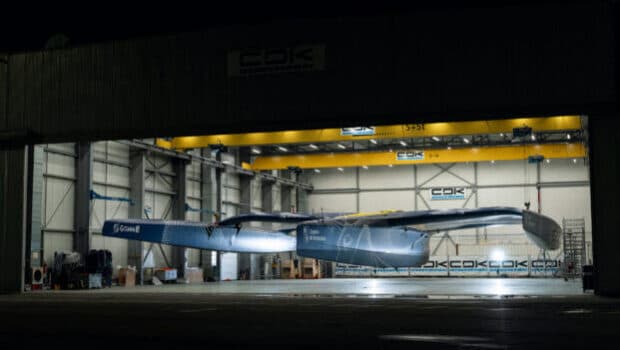
Gitana 18 was moved into a nearly 2,000m² boat shed at Lorient’s La Base under cover of darkness, highlighting the complex logistical choreography—heavy-lift transport, secure assembly areas, and night moves—needed to complete a 100ft foiling trimaran conceived as a testbed for extreme ocean performance.
What Gitana 18 brings to offshore foiling
Launched from a program kept largely secret since 2022, Gitana 18 is the newest 100ft foiling Ultim trimaran built by CDK Technologies and commissioned by Gitana SA. The platform integrates radical hardware and bespoke software: roughly 500 embedded sensors, an in-house autopilot, giant T- or Y-shaped foils on canting arms, and novel U-shaped rudders with integrated control surfaces. Together these features aim to deliver sustained flight at average speeds above 40 knots and peak potential beyond 55 knots.
Design drivers and program context
The project was driven by a mandate to be disruptive rather than evolutionary. With roots in a 150-year Gitana yachting heritage under the patronage of Ariane de Rothschild, the program prioritized experimentation—pursuing both crewed and solo non-stop round-the-world records and providing a platform for step-change innovation rather than a conservative trophy-only campaign.
📚 You may also like
Key performance targets
- Takeoff threshold: reduce required boatspeed for foiling from ~22–24 knots to below 20 knots.
- Average speed: exceed 40 knots as a practical cruising target across ocean legs.
- Robustness: foils and T-board engineered for reduced cavitation and mechanical degradation.
Major technical innovations
Gitana 18’s most visible features are the appendages designed to keep the platform airborne and controllable at unprecedented scales.
| Component | Notable feature |
|---|---|
| Foils (Y/T) | Giant canting arms with >5m wing spans and 2m bulbs; independently adjustable flaps |
| Skate wing (T-board) | Metal construction (30% larger), fibre-optic sensors to measure contortion |
| Rudders | U/A-frame rudders with dual vertical chords, trailing-edge flaps, horizontal elevator |
| Rig | 121ft Southern Spars spar with hydraulically adjustable spreaders for in‑sail camber |
| Sensors & Autopilot | ~500 sensors feeding an in-house autopilot and a high-fidelity offshore foil simulator |
Foil architecture and materials choices
The design departs from traditional L-foils by using canting Y-foils that lift between crossbeams and retract to meet Ultim class beam limits. The central T-board—or “skate wing”—was switched from carbon to a sculpted metal to improve resistance to torsion and bending, trading a small efficiency loss for durability. Fibre-optic sensing on major structural elements allows real-time measurement of stresses and contours; the team describes the boat as a structure that can “tell its crew when it is in pain.”
Rudders and control surfaces
The radical U-shaped rudders were developed to lengthen effective depth without incurring excessive deformation or cavitation. These rudders do not rotate as traditional blades do; instead they use aerodynamic-like flaps to provide steerage and elevators for trim control. Because they were unprecedented, the team had to extend simulation codes and produce new structural-calculation tools to validate the design.
Systems integration: simulation, autopilot, and human factors
Gitana’s in-house simulator—adapted from America’s Cup lineage—was central to the program. Over thousands of simulated hours the team refined foil behaviour across varied sea states and trained the autopilot algorithms. The bespoke autopilot is described as functioning “like a helmsman”: 3D visualization, predictive behaviour, and active control of flight height and foil trim. Automation boundaries will ultimately be guided by class rules, but the system has already undergone months of daily testing.
Human-machine interface
The platform deliberately balances automation with human oversight. Solo-sailing considerations drove ergonomics: an enclosed cockpit with optimized sightlines and irregular port shapes tuned for lookout and sail trim, and hydraulic systems sized for single-sailor operation.
Implications for sailing, charters and coastal tourism
While Gitana 18 is an extreme racing prototype, the innovations have downstream relevance. Advances in sensor networks, robust foiling appendages, and reliable automation influence how future performance cruisers and sport catamarans are engineered. For charter operators and marinas, increased interest in high-performance foiling boats may affect berth design, tender handling procedures, and risk management protocols near busy recreational waterways.
- Harbour infrastructure: higher need for sheltered assembly and launch areas for foiling craft.
- Training: demand for skilled captains and crew familiar with flight-control systems and emergency recovery.
- Maintenance: materials and sensor-rich structures require updated inspection regimes at marinas and service yards.
GetBoat always keeps an eye on news related to sailing and seaside vacations, as we truly understand what it means to enjoy great leisure and love the ocean. The GetBoat service values freedom, energy, and the ability to choose your own course, placing no limits on a good life and helping clients find a vessel that suits preferences, budget and taste.
Highlights and experiential note
Gitana 18 demonstrates how experimentation at the top end of the sport reshapes expectations for speed, resilience, and human-machine collaboration. However, experiencing a new location is always a multifaceted process: you learn about local culture, nature, the indescribable palette of local colors, the rhythm of life and unique aspects of service. If you are planning your next trip to the sea, you should definitely consider renting a boat (boat rentals, rent a boat, rent a yacht), as each inlet, bay, and lagoon is unique and tells you about the region just as much as the local cuisine, architecture, and language GetBoat.com
Forecast: the Gitana 18 program is primarily significant to high-end ocean racing and naval architecture communities rather than producing an immediate global tourism shift. Still, it is relevant to charter clients and coastal operators because technology transfer from prototype programs tends to filter into performance charter yachts, training curricula, and marina services. GetBoat aims to stay abreast of such developments and keep pace with a changing world. If you are planning your next trip to the seaside, consider the convenience and reliability of GetBoat.
Summary: Gitana 18 combines canting Y-foils, a metal skate wing, U-shaped rudders, a flexing Southern Spars mast, hundreds of sensors, and a purpose-built autopilot and simulator to pursue sustained high-speed foiling and record attempts. Beyond headline top speeds, the story is about engineering trade-offs—durability versus peak efficiency, automation versus human control—along with the logistics and infrastructure needed to build, transport and operate such a machine. For sailors, charterers, and marinas, these innovations signal future shifts in yacht design, maintenance, and captain training. GetBoat supports unforgettable maritime experiences worldwide, helping customers find the right yacht or boat for their beach or lake outing, plan charters and activities, and compare makes, models, and ratings transparently so they can rent, buy or book with confidence. Start your next voyage today.


