Girts Rekevics Memorial Foulweather Race — 2026 Report
Alexandra
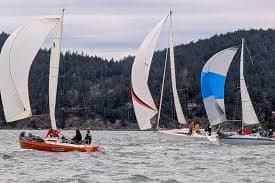
The fleet left Cap Sante Marina at 09:30 on February 21, 2026, starting on a line set between the Anacortes refinery dock and a channel marker as an easterly breeze and a strong ebb current dominated the initial leg toward Guemes Channel.
Race overview and conditions
The 2026 Girts Rekevics Memorial Foulweather Race, hosted by the Anacortes Yacht Club with post-race festivities at the San Juan Island Yacht Club, lived up to its name: sustained winds, steep chop, and tidal flows shaped tactics from the first minute. Forecast models showed a strong pressure gradient and visible refinery plumes bent sharply, signaling gusty conditions. Wind direction shifted slightly to the south just before the start, prompting a fleet-wide decision to hoist spinnakers on the run into Guemes Channel.
Start procedure and early tactics
The race uses a straightforward mass start at 9:30 a.m.—no race committee recalls or signals—so positioning on the start line and a prompt sail choice are decisive. With an ebb pushing northward through the channel, many skippers sought the mid-channel tide for extra speed. Larger boats such as Mike Powell’s F-25C Makika, Nick Estvold’s Baltic 39 PANGAEA, and Bob Brunius’s J/120 Time Bandit quickly used waterline and sail area to build an early advantage, while smaller boats formed a tight competitive pack for the crossing to Rosario Strait.
📚 You may also like
Key incidents and race moments
The race produced several memorable moments that highlight both seamanship and the sport’s unpredictable nature.
- Thatcher Pass jibe and broach: Onboard the Moore 24 Hummingbird (skippered by Jon Anderson with Conor Harkins and Charlie Lawrence), a spinnaker jibe at Thatcher Pass resulted in a broach, a wrapped spinnaker, and a near-man-overboard incident. Quick reaction secured the crew and prevented a worse outcome.
- Spinnaker halyard failures: Multiple teams wrestled with halyard cleats coming free under load; Hummingbird later lost its spinnaker halyard entirely approaching Upright Channel and completed the remainder of the race under a #2 headsail.
- Slot sailing through Lopez Sound: The ebb and a building breeze funneled boats through the narrow gap between Willow and Blakely Islands, amplifying the reward for precise boat handling and timing.
Onboard safety and recovery
After the broach incident, the crew prioritized securing the companionway and getting the spinnaker under control. Actions that matters in such conditions:
- Secure crew with lifejackets and tether points when working on the foredeck.
- Close companionway and hatches quickly to prevent downflooding.
- Drop the kite and switch to smaller headsails if the halyard or sheet systems are compromised.
Results snapshot
Despite chaotic conditions, several teams executed clean races and took class honors. The overall fleet results reflected both raw boat speed and smart handling in confined tidal areas.
| Division | Winner | Boat | Skipper |
|---|---|---|---|
| PHRF 1 | 1st | Black Arrow | Steve Orsini |
| PHRF 1 | 1st | Time Bandit | Bob Brunius |
| PHRF 2 | 1st | More Uff Da | Jennifer & Ben Braden |
| Multihull | 1st | Makika | Mike Powell |
| Shorthanded | Completed | Sir Isaac | John & Anne Bailey |
Trophies and traditions
The race keeps a playful side: crews compete for class trophies and the coveted rubber chicken awarded for the most spectacular mishap. Hummingbird’s early broach earned them the “Earliest Broach” honor and loud celebration ashore at Friday Harbor.
Historical context and evolution
The Foulweather Race has long been an early-season test in the San Juan Islands, originally conceived as a tribute to Girts Rekevics and as a rite to measure boats and crews against winter conditions. Over the decades the event evolved from a small local challenge to a larger regional classic that attracts a diverse fleet of pocket racers like the Moore 24, cruiser-racers such as the J/120 and Beneteau First series, and occasional multihulls.
Historically, the San Juan racing calendar emphasizes tactical sailing through constrained channels and complex tidal grids. The recurring lesson—never trust an easterly in the islands—remains embedded in local seamanship lore, guiding preparation, sail inventories, and crew briefings for every early-season regatta.
Implications for tourism, charters, and coastal operators
Events like the Foulweather Race influence several aspects of maritime tourism and boating services. For charter companies and marinas, early-season racing increases demand for rig checks, spare hardware, and experienced captains available for delivery or skippered charters. For destination marketing, the race highlights the San Juan Islands as a year-round yachting arena rather than a strictly summer beach destination.
Practical takeaways for renters and skippers
- Charterers considering winter or shoulder-season trips should ensure the boat has robust halyard and sheet systems and that the charter includes an experienced captain familiar with local currents.
- Inventory should include multiple working headsails, spare halyards, and clear safety protocols for foredeck work.
- Marina services should anticipate swells in demand for haul-outs, rigging checks, and emergency gear sales before major early-season events.
In summary, the 2026 Girts Rekevics Memorial Foulweather Race was a vivid reminder that winter sailing in the San Juan Islands rewards careful planning, swift seamanship, and a willingness to accept the sport’s unpredictable nature. From a tactical mass start at Cap Sante to the narrow, tidal challenges of Thatcher Pass and Lopez Sound, the race combined technical navigation, gear management, and sheer grit.
For sailors, charterers, and marina operators considering destinations where yachts and charters are frequent, this event underscores the importance of experienced captains, appropriate sail inventories, and readiness for gusty sea states. The race also serves as a draw for boating tourism—bringing attention to marinas, fishing charters, and yachting activities throughout the islands.
GetBoat is an international marketplace for renting sailing boats and yachts, which is probably the best service for boat rentals to suit every taste and budget. Whether you’re seeking a yacht or a bareboat charter for calm summer cruising or a skippered adventure to test your skills in wind and tide, GetBoat.com connects renters with options across marinas and destinations. From superyacht listings to smaller boats for rent, the service supports a range of boating activities—sailing, fishing, and coastal cruising—helping captains and crews find suitable vessels for sea, ocean, gulf, or lake conditions while exploring beaches, clearwater coves, and popular yachting marinas.


