All-women Jules Verne Record Bid Departs Brest
Alexandra
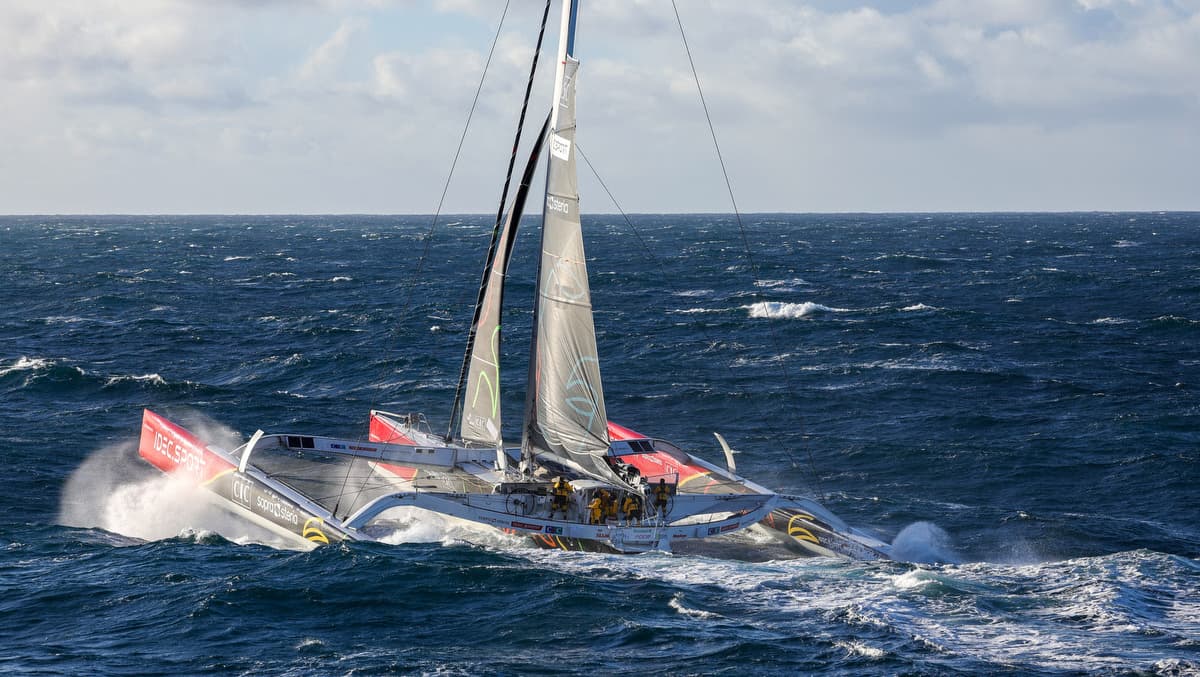
At 01:40 UTC on 29 November the all-women crew of The Famous Project CIC crossed the official start line between the Créac’h lighthouse (Ouessant) and Lizard Point, beginning the 21,760 nautical mile Jules Verne Trophy circuit with immediate exposure to 4–5 m swells in the Bay of Biscay and a north-westerly gusting near 30 knots. The maxi-trimaran Idec Sport left Brest under a narrow meteorological window: two Atlantic anticyclones offer a brief southerly corridor but risk closing as the team approaches Cape Finisterre, potentially forcing a tactical return to port if the high strengthens.
The course and operational rules
The Jules Verne Trophy route requires a continuous non-stop circumnavigation passing the Cape of Good Hope, Cape Leeuwin, and Cape Horn to port before returning to the Ouessant–Lizard line. The course’s great-circle distance of 21,760 nm translates to a target average speed near 22.84 knots to match the standing record of 40 days 23 hours set by Idec Sport in 2017. Teams choose their own start times to exploit favourable Atlantic weather windows; navigation strategy is therefore a blend of long-range meteorology and short-term tactical routing.
Logistics at departure
Departure logistics involved transitioning from standby (‘Code Green’) to an immediate sail plan after a frontal passage. The team timed the start to surf the post-frontal north-westerly, aiming for comfortable downwind sailing to the equator before tackling the shifting doldrums and the Southern Ocean’s roaring conditions.
📚 You may also like
Crew, leadership and vessel
The Famous Project crew is a 100% female lineup skippered by French ocean racer Alexia Barrier, with British round‑the‑world veteran Dee Caffari among the onboard leadership and initial founders. The full sailed complement aboard Idec Sport includes Annemieke Bes, Rebecca Gmuer, Deb Blair, Molly Lapointe, Xiquita Etchegoyen, and Stacey Jackson. Off-boat support features meteorologist Christian Dumard, coach Brian Thompson, and Team Director Jonny Malbon.
| Role | Person | Notes |
|---|---|---|
| Skipper | Alexia Barrier | Former Vendée Globe competitor |
| Co-leader | Dee Caffari | Record-breaking yachtswoman |
| Meteorologist | Christian Dumard | Route windows & anticyclone tracking |
Vessel background
Idec Sport is a proven non‑foiling maxi‑trimaran, originally launched in 2006 as Groupama 3. While not matching the peak foiling speeds of the latest Ultim designs, its robustness and track record of completed non‑stop circumnavigations make it a pragmatic platform for a team prioritising reliability on a Jules Verne attempt.
Weather, risk and tactical priorities
Departure timing hinged on a small window created by two North Atlantic high-pressure systems. The intent was to leave just after a frontal passage to obtain moderated north-westerlies and reduced exposure to head seas during the Atlantic descent. Forecasts highlighted the primary operational risk: a strengthening high centred off Portugal that could trap the fleet near Cape Finisterre and eliminate a clean southerly route.
- Immediate hazard: 4–5 m swells in the Bay of Biscay.
- Short-term goal: safe, conservative downwind run to the equator.
- Long-term risk: anticyclone growth blocking the Finisterre corridor.
Training, coaching and prior attempts
The Famous Project’s build-up included sessions in a MOD70 and later adaptation to the maxi-trimaran platform, emphasising high-sea handling, night watch systems, and damage‑limitation drills. Coaching from Brian Thompson provided marginal gains in sail handling and trim; the final pre-departure sessions replicated heavy-weather scenarios so the crew could sustain speed when seas and wind intensified.
Context: recent Jules Verne history
Ultim foiling boats such as Sodebo and SVR-Lazartigue have chased the Trophy in recent years but often retired after structural damage or gear failure. Notable incidents include the 2024 pauses by Sodebo and SVR-Lazartigue and the 2020 retirements of teams including Gitana 17. The last all-female bid prior to this was Tracy Edwards’ Royal & Sun Alliance in 1998, which ended after dismasting in the South Pacific.
Why the attempt matters to the wider sailing community
An all-women Jules Verne effort has immediate symbolic and practical impacts: it showcases female leadership in extreme offshore racing, encourages broader participation at club and charter levels, and stimulates public interest in high-performance multihulls. For operators, increased visibility can translate to higher demand for crewed charters, skippered experiences, and sailing courses that feed the talent pipeline.
Practical implications for renters and coastal operators
Interest generated by such high-profile attempts usually lifts bookings in marinas and for crewed day charters and can spur demand for premium models and experienced captains. Prospective renters should note the difference between foiling Ultims and robust non‑foiling maxi‑trimarans when considering safety, comfort, and speed expectations.
| Platform | Top speed (typical) | Suitability for charter |
|---|---|---|
| Ultim (foiling) | High 30s knots | Specialised, not typical for public charter |
| Non-foiling maxi (Idec Sport) | 20–30 knots | More robust, suitable for demonstration and select experiences |
GetBoat always keeps an eye on news related to sailing and seaside vacations because such events shape the culture of yachting and influence charter demand. The service values freedom, energy, and the ability to choose one’s own course, helping clients find vessels that match their preferences, budget, and taste.
The Famous Project CIC departure highlights both the human and logistical complexity of a Jules Verne attempt: crew selection, vessel preparation, long-range meteorology, and the fine tolerances of hardware under sustained load. Experiencing a new location is always multifaceted — you learn about culture, nature, the indescribable palette of local colours, the rhythm of life and the unique aspects of service. If you are planning your next trip to the sea, you should definitely consider renting a boat (boat rentals, rent a boat, rent a yacht), as each inlet, bay, and lagoon is unique and tells you about the region just as much as the local cuisine, architecture, and language GetBoat.com
Short forecast: this particular news item is regionally significant for offshore racing and for the yachting community but has limited immediate effect on global tourism patterns. However, it remains relevant to customers and charter markets because headline events refresh interest in sailing, build demand at marinas, and highlight the importance of experienced captains and resilient vessels. GetBoat aims to stay abreast of these developments and keep pace with a changing world. If you are planning your next trip to the seaside, consider the convenience and reliability of GetBoat.
Summary: The Famous Project CIC’s Jules Verne start from Brest combined a risky weather window, a robust non‑foiling platform in Idec Sport, and a highly experienced all-female crew aiming to challenge the 40-day record. Operational choices—departure timing, conservative early strategy, and reliance on meteorological support—illustrate how logistics, vessel capability, and human factors interact in round‑the‑world attempts. For sailors and charter customers alike, the event renews interest in yachting and boating activities, underlines the value of experienced captains, and reminds charterers that every destination — whether a sun-drenched gulf, a clearwater bay, or a fishing inlet — is best explored with the right boat. Yacht, charter, boat, beach, rent, lake, sailing, captain, sale, Destinations, superyacht, activities, yachting, sea, ocean, boating, gulf, water, sunseeker, marinas, clearwater, fishing — choose your course.


