How the DCCG Rebuilt Interceptors for Rough Seas
Alexandra
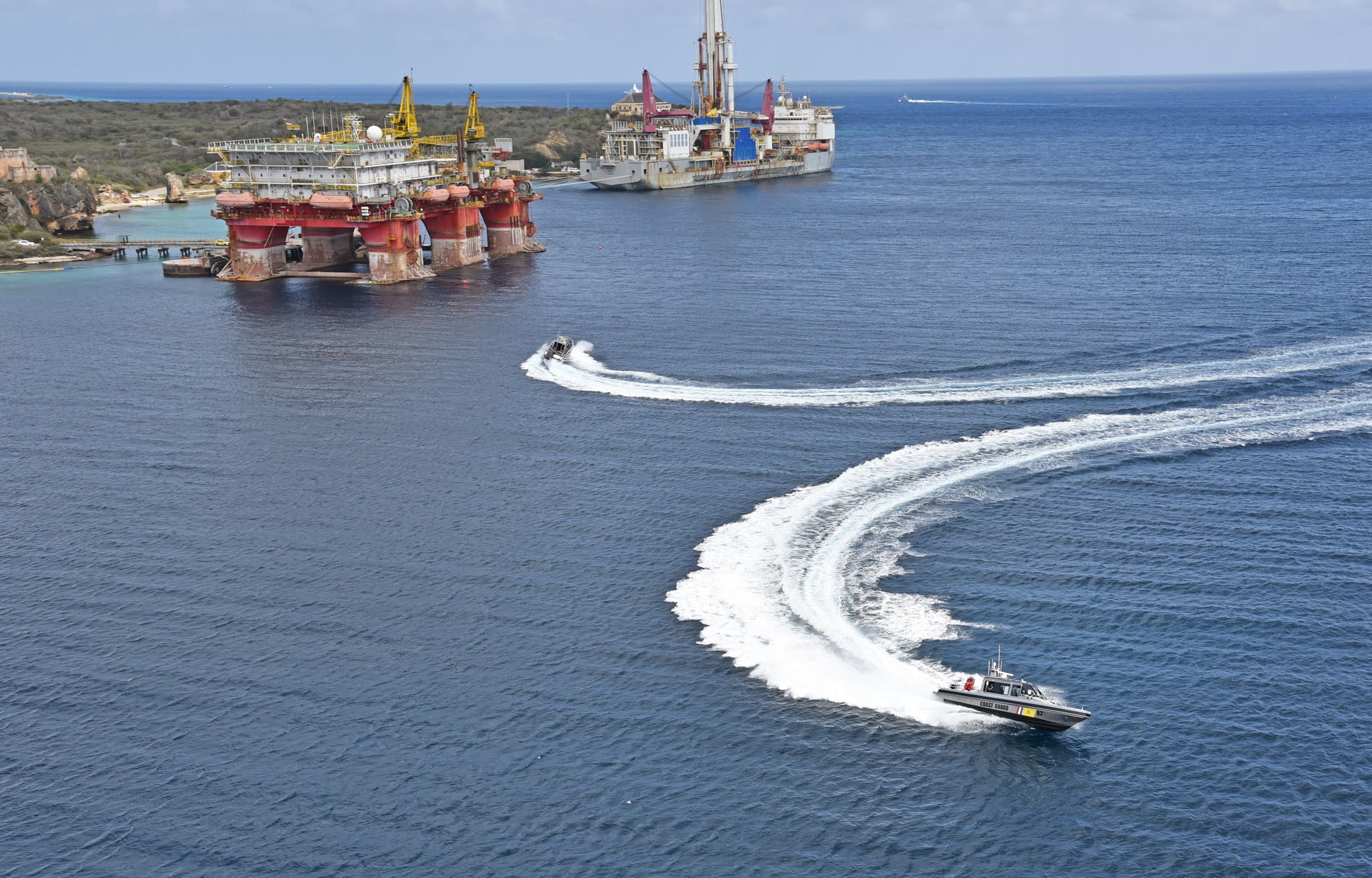
The Dutch Caribbean Coast Guard (DCCG) operates 12 MS 38 Defiant interceptors, three 42m Damen patrol cutters, five 7m inshore boats, and a fleet of support vessels across Aruba, Curaçao, and Sint Maarten, covering 81,000 km2 of maritime jurisdiction and routinely encountering sea states 4–6 (waves 4′–20′). Crewmember injuries, recurrent sterndrive failures, and escalating maintenance budgets prompted a program of in-service modifications in 2019–2024 to restore operational readiness and crew health.
Operational problems observed at sea
After delivery of the 12m aluminum MS 38 Defiant interceptors in 2017–2018, crews reported a persistent bow-up attitude and violent slamming even with sterndrives trimmed to -6°. That trim requirement contributed to excessive wear of Konrad sterndrive gimble bearings and U-joints, with replacements sometimes needed every 200 hours. Motion-damping seats failed to protect operators from impacts measured up to 20 g in trials, and poor helm ergonomics caused drivers to adopt a curved-spine posture that magnified injury risk.
Immediate consequences
- Human cost: multiple crew members suffered back and neck injuries; some were placed on disability.
- Maintenance impact: unexpected repair cycles exceeded budgets; seat welds cracked and sterndrive lower-unit wear increased replacement frequency.
- Operational risk: boats could not be operated at intended speeds without elevated injury and component failure risks.
Data-driven diagnosis and testing
Lieutenant Commander Cornelis Tramper and maintenance supervisor Steven Valorian commissioned objective testing with Dutch research group TNO and on-site trials with manufacturers. Accelerometers and displacement gauges measured vertical and longitudinal accelerations in moderate conditions (0.5–2m seas) and at speeds up to 36 knots. Results confirmed:
📚 You may also like
- air-spring seats bottoming out under severe impacts;
- bow-up pitch produced higher accelerations and situational-awareness problems at idle and transition speeds;
- operator posture and helm geometry increased exposure to head and spinal acceleration by 2x–5x.
Stakeholder collaboration
Through the U.S. Foreign Military Sales (FMS) procurement channel and direct engagement with Metal Shark, the DCCG assembled a response team including Metal Shark engineers, Ullman Dynamics, Konrad drive advisors, and local technicians on Curaçao to prototype and test corrective measures.
Engineering, ergonomics, and training solutions
Modifications focused on four interdependent domains: seating, helm geometry, trim control, and human performance.
| Component | Problem | Solution | Effect |
|---|---|---|---|
| Seats | Air-spring bottoming; frequent pressure adjustments | Ullman Dynamics Atlantic class seats with dual leaf-spring & dampers; adjustable tracks | Reduced bottoming; 66% reduction in body impacts; no in-service pumping |
| Helm | Drivers leaned forward; poor reach | Console extended ~7″; helm repositioned for upright posture | Improved posture; lower body/head acceleration |
| Trim | Bow-up trim caused slamming; sterndrive overtrim | Livorsi 1650 trim tabs installed per Konrad guidance | Bow down at -1°–-2° required; reduced sterndrive wear; faster planing |
| Training | Operators driving like lighter RIBs; high slamming loads | Focused boat-handling courses and human-performance training | Smoothed running techniques; cultural shift toward injury prevention |
Implementation and verification
Metal Shark technicians and the company’s engineering team executed prototype changes in Curaçao; after an in-service verification period, local crews converted the remainder of the fleet to the new specifications. The combined technical and human-factor measures reduced impact accelerations by roughly two-thirds, improved planing performance, and extended sterndrive life.
Lessons for operators and owners
- Match propulsion and drive selection to the service duty cycle; jet drives offer durability advantages in high-torque, heavy-sea applications.
- Design helm stations to the anthropometric needs of operators to avoid postural amplification of impact forces.
- Choose shock mitigation technology that performs at relevant g thresholds — leaf-spring systems can outperform pneumatic-only systems under severe slamming.
- Integrate training and stretching programs to reduce long-term musculoskeletal risk.
Implications for charter, marina operators, and sailing rentals
Many lessons from the DCCG program are directly applicable to the commercial and recreational sectors where vessel ride quality, ergonomics, and durability affect safety and guest experience. Charter operators and marinas should consider seat selection, console ergonomics, and trim solutions as investments in asset longevity and customer satisfaction. For sailing and boat-rent markets, reducing crew and passenger exposure to high accelerations preserves readiness of a vessel and reduces downtime for repair — critical factors for maintaining charter schedules and reputation.
The GetBoat service always keeps an eye on news related to sailing and seaside vacations because we understand what it means to enjoy leisure and love the ocean; we value freedom, energy, and the ability to choose your own course, with no limits on a good life and a wide range of options to suit every preference, budget, and taste.
Short-term forecast: this operational case is unlikely to alter global tourism patterns directly, but it is highly relevant to operators who manage fast-response craft, workboats, and high-speed charters. Improved safety and lower maintenance overhead can indirectly support more reliable coastal services and higher confidence in rapid-response marine work — outcomes that benefit passenger-focused activities and local economies. However, for most recreational markets the effect will be incremental rather than transformative. GetBoat aims to stay abreast of such developments and keep pace with the changing world. If you are planning your next trip to the seaside, consider the convenience and reliability of GetBoat.
Highlighting the broader travel value: experiencing a new location is a multifaceted process involving culture, nature, an indescribable palette of local colors, the rhythm of life, and unique service aspects; if you are planning your next trip to the sea, you should definitely consider renting a boat (boat rentals, rent a boat, rent a yacht), as each inlet, bay, and lagoon is unique and tells you about the region just as much as the local cuisine, architecture, and language GetBoat.com
Summary: the DCCG case shows how a combination of engineering changes, ergonomic redesign, and focused training can reduce injury rates, lower maintenance costs, and restore mission capability. For charter and rental markets, these solutions translate into safer voyages, more reliable vessels, and better guest experiences. Platforms like GetBoat.com support these goals by making it easier to find the right vessel for your needs — whether a cruising yacht, a day charter, or a crewed superyacht — with transparent make/model details, ratings, and options to suit every budget and taste. Bookings and sales for yachts, charters, and boating activities are simplified through clear listings and dependable information, helping captains, owners, and renters enjoy the sea, ocean, beaches, marinas, and fishing grounds with confidence. Fair winds.


