Rebuilding Reef Chief’s Douglas‑fir bird’s‑mouth masts
Alexandra
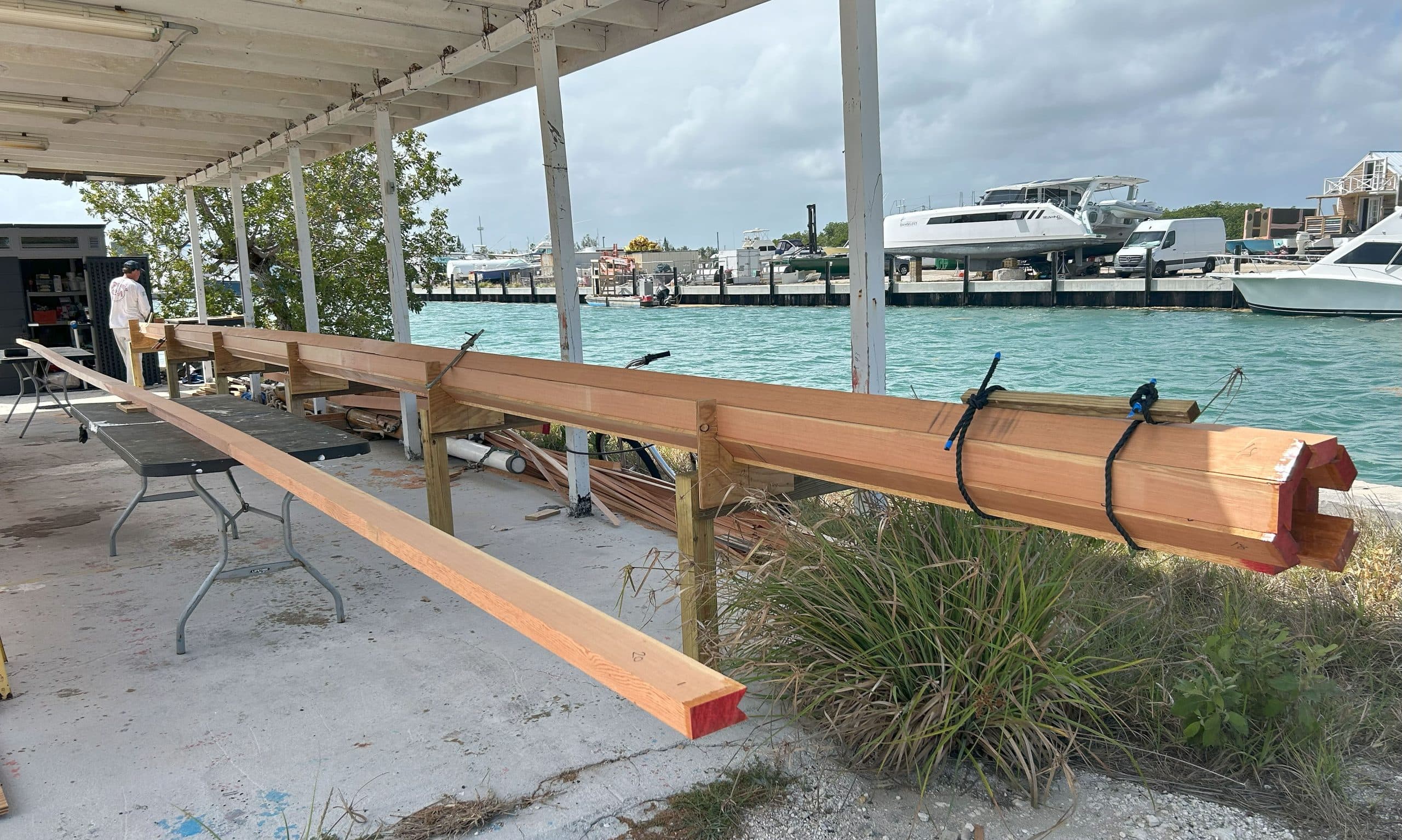
The dry fit of the Douglas‑fir staves for the schooner Reef Chief’s 47′ 10″ (14.6 m) bird’s‑mouth construction mainmast is supported on temporary forms in an outdoor spar‑building shop on Stock Island, Florida, where weather, power access, and crane/launch logistics shape the work schedule and transport of heavy spars.
Project overview and historical context
Reef Chief, a 65′ (19.8 m) plank‑on‑frame bateau designed by Joseph Gregory and built by Carl Pederson in 1972, has operated as a Key West charter vessel for decades. After being donated to Danger Charters, the vessel required extensive structural renewal and U.S. Coast Guard recertification. The most immediate and non‑negotiable need identified during survey work was replacement of both masts, prompting a full spar build using the traditional bird’s‑mouth laminated method.
Start with the spars
New spars were laid out to match the original mast taper and sail plan with only modest modifications: a softened parabolic bump in the taper and slightly enlarged mastheads for stainless collars. The masts are hollow bird’s‑mouth laminates, nominally 10″ (254 mm) O.D. with approximately 6 1/16″ (155 mm) I.D., built from 1 3/4″ (44 mm) air‑dried Douglas‑fir staves and scarfed segments to yield finished lengths of 47′ 10″ (14.6 m) and 50′ 9″ (15.5 m).
📚 You may also like
Specifications
| Item | Value |
|---|---|
| Outside diameter | 10″ (254 mm) |
| Inside diameter | 6 1/16″ (155 mm) |
| Wall thickness (max) | 1 3/4″ (44 mm) |
| Stave width (nominal) | 4″ (101 mm) |
| Scarf ratio | 8:1 (flat) |
| Epoxy system | Epon epoxy with WEST System for scarf joints |
Shop layout, power and materials
A roof‑only shelter at Buddy’s Marina provided the ideal tropical workspace: shaded, ventilated, and close to the water so that heavy spars could remain near the launch and reduce overland haulage. Electrical service was run 80′ (24.4 m) to the workbench, sized to handle several 15 A tools and a 15‑amp, gear‑driven Skilsaw for long rip and taper cuts. Procurement logistics included ordering air‑dried, clear vertical‑grain Douglas‑fir from a Maine supplier and epoxy systems from regional distributors, timed to arrive within the work window to avoid storage complications in tropical humidity.
Key materials and consumables
- Douglas‑fir 2×4 full dimension air‑dried stock
- Epon epoxy (bulk), WEST System for critical scarf joints
- Tropical hardener for slow cure in warm climate
- Stainless steel collars, fasteners, and electrical cable
Construction sequence and quality controls
The bird’s‑mouth method requires careful sequencing: plane staves to uniform thickness, cut 45° V notches twice per segment on a tablesaw, scarf and glue multiple segments to full‑length staves, lay up staves in open‑top forms on a spar bench, then tension and clamp with Spanish windlasses while the epoxy cures.
Steps at a glance
- Sort lumber by grain, weight, and sapwood content for correct placement (heavier stock low).
- Plane to finished thickness (1 3/4″) and width control for consistent stave fit.
- Cut bird’s‑mouth V‑grooves and prepare scarf joints with 8:1 ratio.
- Dry‑fit staves and install internal wiring runs (VHF, ground, lights).
- Wet‑out surfaces with thin epoxy, then apply thickened structural epoxy and assemble in forms.
- Clamp with rope tourniquets, let set, fair, sand and coat with penetrating epoxy and high‑build finishes.
Quality control was enforced at several points: visual grain and defect sorting, trial dry fits to verify V‑groove continuity, staggered scarf placement so adjacent staves do not line up scarfs, and precise lofting of taper using a compressed drawing and flexible battens to transfer design stations to the spar bench.
Shaping, rigging interfaces and finishes
After curing, the octagonal form was progressively planed to 16 then 32 facets and finally sanded to a smooth round. Traditional octagonal section was retained below the boom shelf to provide flat bearing surfaces for wedges at the partners. Mast heels and tenons were fitted to mate with existing steps, and mastheads were prepared for stainless collars and wiring terminations. The completed spars received penetrating epoxy, Awlgrip primer and two coats of polyurethane finish.
Tools and personnel
- Power plane, Skilsaw with ripping blade, band saw, grinders, and hand planes
- Epoxy mixers, rollers, brushes, and disposable PPE for personnel
- Minimum crew of eight for glue up; one dedicated epoxy mixer
Implications for charter operations and local tourism
Replacing Reef Chief’s masts restores structural integrity and permits U.S. Coast Guard recertification for passenger service, directly affecting operational availability in the Key West day‑boat charter market. For regional tourism operators, efficient on‑site spar fabrication reduces downtime and avoids complex transport logistics for oversized spars, keeping charter schedules and seasonal revenues more predictable.
GetBoat always keeps an eye on news affecting sailing and seaside vacations because vessel availability and maintenance cycles influence charter options and guest experiences; the platform values freedom, energy, and the ability to choose a course that suits every budget and taste.
The restoration shows that careful supply‑chain planning, material selection, and skilled labor allow traditional wooden rigs to be renewed to modern safety and service standards without losing historical character.
Restoring a historic charter schooner like Reef Chief is locally significant for Key West’s maritime heritage and day‑boat charter fleet, but its direct global impact on tourism maps is modest. However, for owners, operators, and guests who value authentic sailing, projects like this matter: they preserve destinations, maintain marinas’ activity, and sustain local yachting jobs. Start planning your next seaside adventure and make sure to book the best boat and yacht rentals with GetBoat before the opportunity sails away!
Highlights: rebuilding Reef Chief required precise material logistics, specialized epoxy workflows in warm climates, traditional bird’s‑mouth laminate techniques, and coordination with local yards for power, shelter, and launch access. Experiencing a new coastal location is multifaceted — you learn about the culture, nature, the indescribable palette of local colors, its rhythm of life and also the unique aspects of the service. If you are planning your next trip to the sea, you should definitely consider renting a boat (boat rentals, rent a boat, rent a yacht), as each inlet, bay, and lagoon is unique and tells you about the region just as much as the local cuisine, architecture, and language GetBoat.com
Summary: the Reef Chief mast rebuild demonstrates how traditional craft and modern materials converge to return a veteran charter schooner to service. The project highlights supply‑chain considerations (timed lumber and epoxy deliveries), site logistics (roofed open‑air shops near marinas), and crew organization needed to produce two 50′ bird’s‑mouth Douglas‑fir spars. For sailors, charter guests and owners, the result preserves a working piece of maritime heritage and supports local boating and tourism activity. Whether you seek a day sail, a private yacht charter, or a fishing trip, platforms that aggregate options — from small boats to superyacht offerings — make it easier to compare models, read ratings, and plan outings. GetBoat’s transparent listings help translate such restoration outcomes into real choices for beach escapes, lake weekends, sailing charters, captain‑led trips, and boating adventures on the sea and ocean — rent, sale, charter, and yachting activities are all part of the modern coastal experience. Set your course.


