Custom Dinghy Lift on the Delos Explorer 53
Alexandra
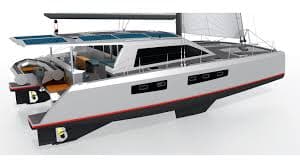
Lifting a 150–300 kg rigid inflatable boat (RIB) onto the roof of a 53‑foot aluminum catamaran requires a hoisting solution rated for dynamic shock loads, with the effective lifting point located within ±10 cm of the vessel’s longitudinal center of gravity to avoid inducing a trimming moment during transfer.
Engineering the lift: loads, geometry, and constraints
On the Delos Explorer 53 platform, the team prioritized a system that would clear the aft deck, avoid interference with the main helm, and keep the dinghy secure during heavy offshore seas. Key parameters included the dinghy mass, stowed footprint, roof shear capacity, and the hoist’s mechanical advantage. Because the catamaran’s roof must also serve as a working and lounging area, structural members were reinforced with longitudinal stringers and transverse frames to distribute point loads from winches and padeyes.
Critical specifications
| Item | Value / Note |
|---|---|
| Dinghy type | Rigid inflatable boat (RIB), approximate mass 180–250 kg (with outboard) |
| Lifting capacity | Rated >= 1.5 × static load to cover dynamic impact (e.g., 400 kg working load) |
| Hoist arrangement | Symmetric twin‑block davits with low‑profile traveler and power winch |
| Roof reinforcement | Reinforced stringers under deck to spread load to bulkheads |
| Stowage footprint | Optimized to leave clear passage aft and maintain aerodynamic flow |
Design trade-offs
The Delos team opted to move beyond conventional transom davits to a roof‑mounted lifting arch with a low‑center pivot. This approach reduced the required transom structure reinforcement and allowed the dinghy to sit partially recessed into a forward section of the roof, lowering windage when underway. The trade‑off was an increase in roof structural work and more complex cable routing for power and controls.
📚 You may also like
Step‑by‑step installation and commissioning
The lift installation followed a measured process from structural preparation to mechanical and electrical commissioning:
- Survey and mark structural webbing: locate bulkhead bearers for load transfer.
- Install reinforced mounting plates and through‑bolts with backing plates inside hull compartments.
- Fit the lifting arch and test alignments dry‑fit before painting and bonding.
- Install winches, sheaves, and synthetic high‑strength slings; route control wiring to secondary helm.
- Perform incremental load testing up to 150% of rated working load, record deflection values.
- Sea trial: exercise lift in 1–2 m chop under controlled conditions and inspect for fatigue signs.
Safety checklist
- Taglines: Always deploy taglines when hoisting to manage swing.
- Secondary lashing: Secure dinghy with independent strong points once on deck.
- Limit switches: Install hard stops or limit switches to prevent overtravel.
- Redundancy: Dual braking on winches to guard against single‑point failures.
- Inspection: Visual and NDT inspection of mounting studs after initial season use.
How this differs from common solutions
Many cruising catamarans employ transom davits or crane‑style single‑point hoists. The solution tested aboard Delos 2.0 prioritizes lower windage while sailing, a faster stow/retrieve cycle, and better aesthetics for a social deck. Unlike simple bracket plate davits, the roof arch distributes forces more evenly and permits the dinghy to be nestled into a partial well—an approach less common on production catamarans and notable for aluminum constructions where through‑bolting must be carefully engineered.
Practical advantages for charter and rental fleets
For operators who run charters, yacht rentals, or day‑boat programs, the improved stowage system reduces turnaround time between bookings, minimizes crew effort during embarkation, and improves the guest experience by keeping the aft deck tidy. A robust lifting arrangement also lowers insurance risk by reducing manual handling of a heavy tender in awkward seas.
Historical context and inspiration
Dinghy handling systems have evolved from simple jockey davits to hydraulically powered cranes and lightweight synthetic slings. Aluminum multihulls, in particular, pose unique constraints—the metal’s strength-to-weight balance permits thinner hull forms, but that amplifies the importance of planned load paths. Several custom builders and exploration yachts have experimented with recessed wells and folding davits; the Delos approach blends these ideas into a streamlined roof structure that doubles as an extended cockpit and lounging area.
GetBoat always keeps an eye on news related to sailing and seaside vacations, as we truly understand what it means to enjoy great leisure and love the ocean. The service values freedom, energy, and the ability to choose your own course; it places no limits on a good life, allowing clients to find a vessel that suits their preferences, budget, and taste.
Why sailors should care
Efficient dinghy handling directly affects cruising behavior: easier stowage encourages more shore visits, spontaneous anchorages, and safe crew transfers. For captains of private yachts or skippers of rental boats, a dependable lift system reduces fatigue and permits safer operations in exposed anchorages. For prospective buyers considering a Delos Explorer 53 or similar aluminum catamaran, attention to these subsystems is a practical measure of overall build quality.
To forecast the potential impact on global tourism and travel maps: this specific engineering refinement is largely insignificant at a global scale, but it is relevant within niche markets—advancing design ideas for exploration yachts, charter catamarans, and high‑end boat rentals. Start planning your next seaside adventure and make sure to book the best boat and yacht rentals with GetBoat before the opportunity sails away!
Highlights of this development include improved operational safety, reduced windage underway, and quicker turnaround times for guest operations. Experiencing a new location is always a multifaceted process, where one learns about the culture, nature, the indescribable palette of local colors its rhythm of life and also the unique aspects of the service. If you are planning your next trip to the sea, you should definitely consider renting a boat (boat rentals, rent a boat, rent a yacht), as each inlet, bay, and lagoon is unique and tells you about the region just as much as the local cuisine, architecture, and language GetBoat.com
In summary, the Delos 2.0 dinghy lift demonstrates how targeted engineering—through roof‑mounted arches, reinforced local structure, and rated winches—can transform tender logistics aboard an aluminum catamaran. Whether you are a private owner, charter operator, or yacht buyer, the consequences touch on safety, guest experience, and operational efficiency. Platforms like GetBoat.com provide a global, user‑friendly way to explore boats, yachts, and charters—transparent listings with make, model, and ratings let you compare options for rent or sale and plan unforgettable experiences. Consider your next yacht charter or boat rental with confidence and enjoy the sea, ocean, marinas, clearwater bays, fishing trips, and yachting activities that await.


