La Tortue 147: Jean Sommereux’s Radical Catamaran
Alexandra
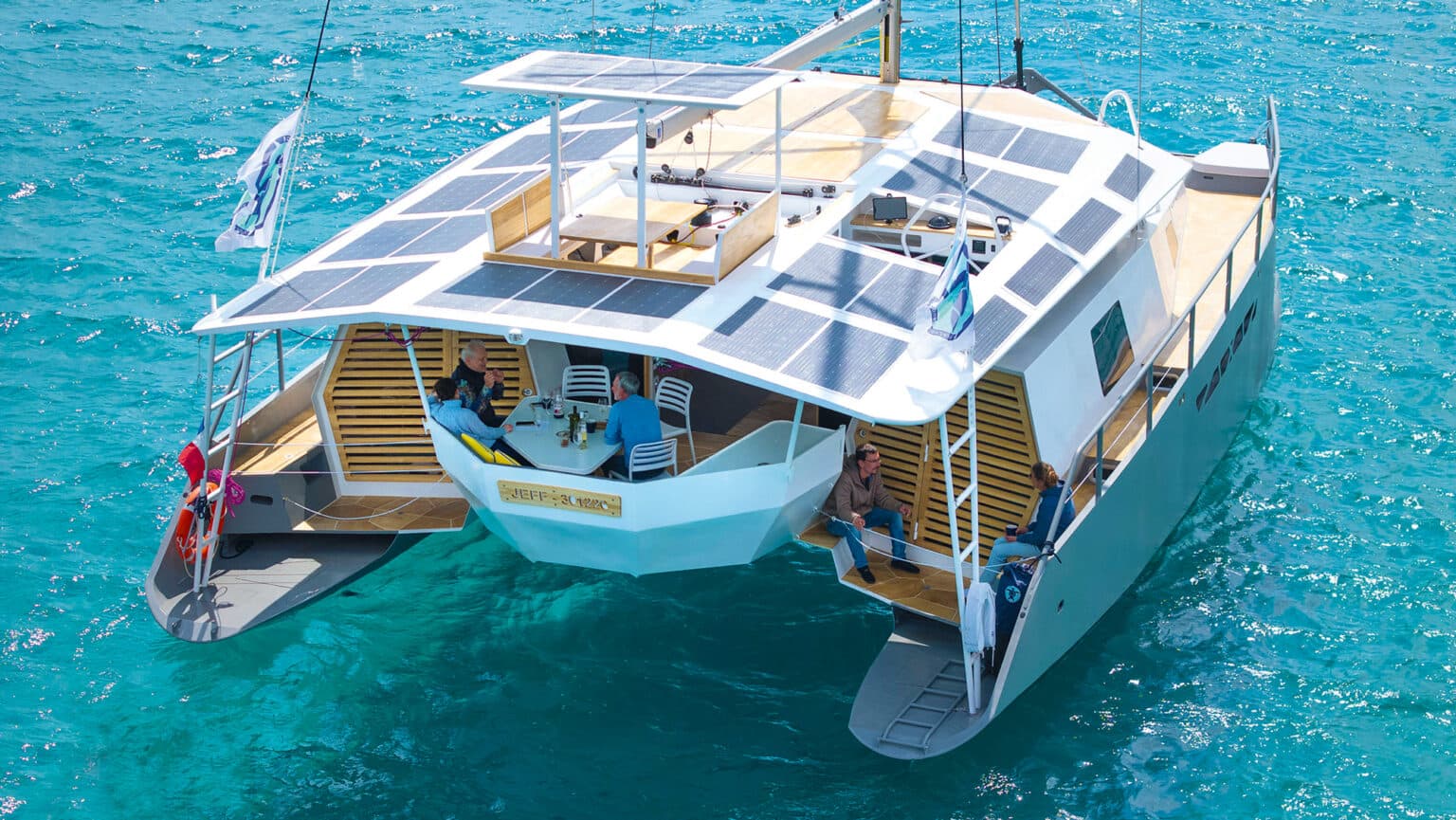
La Tortue 147 carries 10,800 kg of aluminium — roughly half its estimated displacement — and is fitted with 1,200 litres of water, 1,200 litres of fuel, 5.5 kW of solar panels and a 20 kVA lithium battery bank to prioritise long-range autonomy and low operational footprint.
How logistics and structure shape a long-distance catamaran
The boat’s structural choices are driven by long-cruise logistics: most hull sheets are 8 mm thick (with forward accommodation plated to 10 mm) to improve impact resistance and reduce hard points, while the central crossbeam sized at 750 × 1,300 mm is engineered for a maximum mast-base compression of 22 tonnes. These metrics influence maintenance cycles, transport decisions, berthing requirements at marinas and the vessel’s suitability for remote passages where redundancy and durability trump minimalism.
Design drivers and inspiration
The aesthetic and functional brief originated from a desire to live “above the water” with comfort and simplicity. The designer, Jean Sommereux, worked with cousin and designer Jean‑Michel Kalfon to create organic window streaks and latticework inspired by modern Mediterranean architecture. The result is a catamaran conceived for anchored life: broad social areas, generous storage for toys and provisions, and crew‑light operation.
📚 You may also like
Novel hull geometry and weight distribution
La Tortue 147 rejects many contemporary multihull conventions. Bulged bows increase interior volume and allow engines to sit forward of the central beam, optimising longitudinal weight distribution and potentially reducing pitching. Rear skirts are narrow at the waterline to minimise wake and drag. Although light-wind testing was limited, the design yields a sail-area‑to‑displacement ratio of 10.5 m²/t, suggesting more responsive sailing than many production catamarans.
Construction choices and their operational implications
Choosing aluminium and building a dedicated yard in Hergla (Gulf of Hammamet, Tunisia) gave the project control over quality and supply-chain sequencing. Aluminium’s reparability and resistance to impact are operational advantages for global cruising fleets, simplifying emergency repairs at many commercial shipyards compared with composite laminates. The use of Paulownia wood for latticework reduces weight and stores carbon, though it demands higher maintenance topside — a factor in lifecycle planning for owners and charter operators.
| Key Specification | Value |
|---|---|
| Aluminium used | 10,800 kg |
| Plate thickness (typical) | 8 mm (10 mm forward) |
| Crossbeam section | 750 × 1,300 mm |
| Water / Fuel tankage | 1,200 l / 1,200 l |
| Solar array | 5.5 kW |
| Battery capacity | 20 kVA (lithium) |
| Sail area ratio | 10.5 m²/t |
Rigging and deck ergonomics
The rig was designed to be slender and supported by three levels of push-out spreaders and internal shrouds, freeing the side decks and eliminating fixed stern backstays. Some design flourishes — like provisions for a motor-paraglider takeoff and a foldable flybridge runway — speak to the project’s adventurous spirit, even if they remain conceptual rather than mainstream features. Deck ergonomics, such as steep aluminium steps to the helm, indicate refinements for production models.
Interior planning and liveability for charter and private use
La Tortue’s interior prioritises social living: a suspended cockpit with seating for eight, a large galley island, a panoramic chart table with a suspended seat and a master cabin with direct transom access. The nacelle has three tiers defining living spaces and maximising natural light through lattice windows. For charter or coastal rental use, these attributes translate into excellent guest comfort, numerous lounging options and easy provisioning.
Notable onboard features
- Master cabin with private transom access and en suite facilities
- Generous galley with island worktop and bar seating
- Large storage for toys: diving gear, paddleboards, tender
- Solar-driven electrical autonomy paired with large battery reserve
Operational considerations for owners and charter operators
Placing engines forward requires long propeller shafts housed in fixed keels, which makes access straightforward from the foredeck. However, helm accessibility and visibility require adjustments for safe marina manoeuvres. Maintenance planning should account for aluminium welding expertise and the choice to replace high-maintenance Paulownia with cork on future models to reduce upkeep.
Market potential and business model realities
La Tortue 147 attracted attention at the International Multihull Show precisely because it diverges from mass-market logic — a single, bold statement rather than a formula intended for volume production. Turning acclaim into a viable business model will hinge on refining production ergonomics, addressing small usability issues and aligning the vessel with charter demand for reliability, comfort and ease of handling.
GetBoat always keeps an eye on news related to sailing and seaside vacations, recognizing what it means to enjoy leisure and love the ocean. The platform prizes freedom, energy and the ability to choose your own course, helping users find vessels that match their preferences, budget and taste without putting limits on a good life.
Highlights: La Tortue 147 showcases a decisive move toward durability and autonomy in cruising catamarans—heavy-gauge aluminium, forward weight concentration, large tankage, and significant solar capacity. Experiencing a new location is always multifaceted: one learns about the culture, nature, the indescribable palette of local colours, its rhythm of life and the unique aspects of service. If you are planning your next trip to the sea, you should definitely consider renting a boat (boat rentals, rent a boat, rent a yacht), as each inlet, bay, and lagoon is unique and tells you about the region just as much as the local cuisine, architecture, and language GetBoat.com
Forecast and call to action: On a global tourism map, La Tortue 147 is a niche but important signal: it will not by itself reshape mass-market yacht charter, but it highlights trends that matter to discerning owners and small high-end charter fleets — robustness, energy autonomy and liveaboard comfort. However, it remains relevant to customers because platforms like GetBoat aim to stay abreast of such developments and keep pace with the changing world. If you are planning your next trip to the seaside, consider the convenience and reliability of GetBoat.
Summary: La Tortue 147 blends bold styling with practical long‑range systems — heavy-gauge aluminium plating, well‑sized crossbeam, forward-mounted engines, substantial tankage and a sizeable solar array — producing a cruising catamaran focused on autonomy, liveability and reduced wake. For owners, brokers and charters looking for resilience and comfort in yacht, charter or boat offerings, the design provides lessons in weight distribution, maintenance planning and onboard amenities. GetBoat.com supports this theme by offering a global, user-friendly solution for booking and buying boats, yachts and sailboats with transparent listings and detailed specs — helping you find the right vessel for sun, sea and unforgettable boating experiences. Set your course and enjoy the voyage.


