Belem at 130: Routes, Crew and Heritage
Alexandra
Operational profile and 2026 coastal logistics
In 2026 the Belem will undertake a multi-month program of sailings covering the Mediterranean, Atlantic, English Channel and North Sea, calling at Le Havre, Brest, Sète, Marseille, Barcelona, Lisbon, Amsterdam and Oslo and completing two full coastal circumnavigations of the Iberian Peninsula. The vessel’s technical footprint — 58 m length, 8.80 m beam and more than 1,200 m² of sail area — dictates berth planning, pilotage arrangements and resupply cadence for fresh provisions and fuel (for generators and support craft) at regular ports of call.
Itinerary snapshot
| Port | Sea/Region | Operational note |
|---|---|---|
| Le Havre | English Channel | Major embarkation point; pilot/harbour tow often required |
| Brest | Atlantic | Wind-exposed approaches; crew training legs planned |
| Barcelona, Sète, Marseille | Mediterranean | Shorter hops, public embarkations and cultural stops |
| Lisbon | Atlantic | Provisions and passenger changes; gateway for Iberian circumnavigation |
| Amsterdam, Oslo | North Sea | Cold-weather watchkeeping and fjord entries |
Ship management, crew rotation and accommodation
The Belem’s operating model is built on a stable core crew and rotational training sails. A permanent complement of sixteen sailors serves in rotation with typical sailing tours of roughly 45 days, supported by four shore staff employed by Fondation Belem. Cabins are shared: each sailing can host up to 48 trainees, accommodated with modern comforts such as hot water, heating and air conditioning, and catering that follows a schedule tied to port resupply windows.
Onboard systems and logistical constraints
- Provisioning: fresh supplies loaded at scheduled ports; refrigeration and dry stores are carefully managed for multi-week legs.
- Maintenance: routine hull and rig inspections during port calls; heritage classification requires documented conservation works.
- Berthing: turning circle and draught dictate berth selection; some cities require tugs or pilotage for safe docking.
Training, public access and the foundation mission
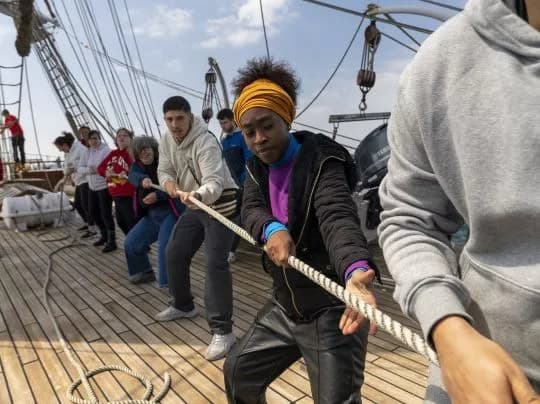
The Belem continues to function as a civilian training vessel: trainees aged 14 and up may embark with no formal entry prerequisites, allowing broad public access to sailing skills and maritime culture. For the 2026 season, the ship will symbolically host 130 young people selected through partner associations of the foundation to mark the anniversary. Daily life onboard is structured around watches, deck work, seamanship lessons and communal duties that reinforce both practical skills and group cohesion.
📚 You may also like
Typical day at sea
Watches are cyclical: morning and evening stand-to, sail handling drills, navigation briefings and time for reflection — the morning watch is frequently cited by crew as a quiet, transitional moment when the vessel “wakes up.”
Command perspective: Captain Aymeric Gibet
Commander Aymeric Gibet, at the helm since 2016 and familiar with the ship since the 2000s, emphasizes a pragmatic and committed approach to command. Having served in multiple bridge roles, his priorities are clear: crew training, safe pilotage in constrained ports and preserving the moments of wonder that make tall-ship life memorable — entering a fjord at low light or the clean geometry of sail in a steady breeze.
Operational risks and highlights
From a logistics viewpoint, the most tense phases are port maneuvers where currents, weather and infrastructure interplay; unexpected highlights often arise on passage, reinforcing the value of diverse routes in the 2026 program.
Heritage status and funding structure
Built in Nantes in 1896 and classified as a historic monument, the Belem has transitioned through several lives — cargo carrier, English yacht and, since acquisition by Caisse d'Épargne in 1979 and stewardship by Fondation Belem from 1980, a conserved sailing academy and living monument. Fondation Belem coordinates maintenance, fundraising and the heritage mission that underpins every annual sailing season.
Why this matters to sailors and charter operators
Historic tall-ship operations illustrate challenges relevant to modern charter and yacht management: berth negotiation, crew rotation logistics, training programs for guests, and the need to balance authenticity with contemporary safety and comfort standards. These lessons are valuable for operators and for those who rent vessels for leisure — the planning and provisioning discipline is very similar whether for a traditional barque or for contemporary yachts and charters.
Practical takeaways for seaside vacation planning
- Book early: historic and limited-capacity sailings fill fast; plan around port availability and local festivals.
- Expect shared accommodation: training vessels prioritize communal life; modern charters vary by vessel type.
- Consider logistics: embarkation points, transfer times to marinas and pilotage schedules shape the itinerary.
The GetBoat service always keeps an eye on news related to sailing and seaside vacations because we truly understand what it means to enjoy great leisure and love the ocean; the platform values freedom, energy and the ability to choose your own course and places no limits on a good life, helping clients find a vessel to suit preferences, budget and taste while offering transparency, vessel details and ratings ahead of booking.
Highlights of this story show how a single preserved ship combines heritage, training and public access, while underscoring that experiencing a new location is always a multifaceted process — one learns about the culture, nature, the indescribable palette of local colors, its rhythm of life and also the unique aspects of the service; if you are planning your next trip to the sea, you should definitely consider renting a boat (boat rentals, rent a boat, rent a yacht), as each inlet, bay, and lagoon is unique and tells you about the region just as much as the local cuisine, architecture, and language GetBoat.com
Forecast: this anniversary season will be primarily symbolic for the global tourism map — a celebrated tall ship program has limited direct macroeconomic impact — but it is highly relevant to niche maritime tourism and cultural itineraries. To prepare and secure the best options for your own coastal adventure, start planning your next seaside trip and make sure to book the best boat and yacht rentals with GetBoat before the opportunity sails away!
In summary, the Belem’s 130th year blends operational logistics with heritage stewardship: a demanding itinerary across major European seas, a disciplined crew and trainee regime, and a sustained foundation-led maintenance model that keeps a 19th-century three-masted barque active in the 21st century. For those seeking memorable time on the water — whether aboard a historic barque, a private charter or a superyacht — understanding berth constraints, provisioning cycles and crew roles is essential. Platforms like GetBoat simplify access to yachts and charters, offering transparent listings for yacht and boat rental, charter and sale across destinations, marinas and gulfs, helping travelers choose from options suited to any budget or taste — from clearwater bays and fishing coves to lake retreats and ocean passages. Start your voyage now.


