How Charal 2's IMOCA Hull Was Rebuilt
Alexandra
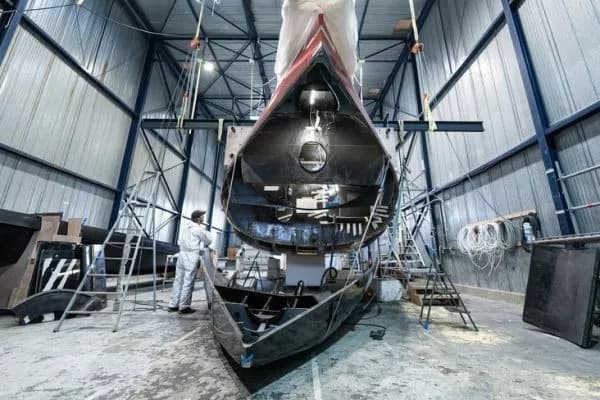
Work began in mid-December with teams cutting the deck and entire lower shell from bow to stern, moving preformed half-hulls produced at Gepeto Composite directly to the Charal base for assembly; the logistical chain—from transport of composite sections to on-site storage, composite curing schedules, and the planned June relaunch—was managed to leave an operational window of roughly six months before the Route du Rhum.
What triggered a full-hull replacement on Charal 2
The decision to replace the entire hull bottom of Charal 2 followed consolidated telemetry showing the boat spent significantly more time in flat flight than originally anticipated. Early adoption of V-shaped rudders combined with a scow-influenced hull form delivered power while heeled, but hydrodynamic data revealed a consistent regime of higher-speed, low-heel sailing where drag penalties outweighed heel-generated power. Rather than incremental tweaks, the team opted for structural replacement to tune the hull for sustained flight, improving glide and lowering viscous and wave-making resistance in stabilized conditions.
Design and industrial coordination
Design authority VPLP led the reshaping of underwater lines while Gurit specified the requisite reinforcements to preserve global stiffness and local load paths. Manufacturing of the new half-hulls at Gepeto Composite adjacent to Charal’s facility reduced transport risk and simplified layup schedules. This proximity also enabled iterative alignment trials before final composite bonding, shortening assembly lead times and lowering potential fitment delays.
📚 You may also like
Operational phases and critical tolerances
The refit unfolded in discrete phases: deconstruction, internal rework, half-hull fit, composite bonding, systems reinstallation and sea trials. Cutting the carbon laminate required controlled environments and particulate management to protect hydraulic and electronic components. During reassembly, technicians worked to millimetric tolerances—each bulkhead, keelbox, and foil trunk required precise indexing so that load distributions matched the new geometry and preserved righting moments and stiffness targets.
| Aspect | Original Hull | New Hull Bottom |
|---|---|---|
| Designed regime | Heel-powered, scow-influenced | Flat-flight optimized |
| Primary gain | Power in heel | Improved glide & reduced drag >15 kt |
| Single-handed handling | Needs crew to reach peak | More forgiving for solo sailing |
| Risk during refit | Standard repairs | Full hull bottom replacement — high complexity |
Why the approach is unprecedented in IMOCA
IMOCA programs commonly favor incremental structural interventions—reinforcing bows, modifying appendages, or swapping foils. Replacing the entire hull bottom is rare because it demands full disassembly of internal systems, painstaking alignment of two large composite halves, and requalification of mechanical and hydraulic systems. The visible result was a boat reduced to its main framework during the operation, a reminder of the programmatic risk accepted to pursue a different performance envelope.
Sea-trial targets and performance expectations
Real-world objectives focus on higher average speeds in excess of 15 knots, better acceleration into waves, and measurable gains in light-air performance where the original scow profile underperformed. The refit also aims to close the gap between crewed/double-handed potential and solo handling—critical for campaigns targeting the Route du Rhum and the Vendée Globe. Practical benefits include lower helm loads, more predictable trim windows, and easier foil management when single-handed.
Key technical challenges
- Structural continuity: ensuring bonded joints transfer loads without creating stress risers.
- Systems reintegration: re-routing hydraulics and electrics after major geometry changes.
- Weight distribution: controlling ballast moments and center of gravity to retain stability.
- Quality assurance: non-destructive checks and calibration of appendages post-assembly.
Implications for the wider sailing and rental market
While this project is squarely focused on racing, the techniques and logistics provide transferable lessons for charter operators and yacht maintenance yards. Larger composite repairs and hull modifications change availability windows for yachts and can affect peak-season charter inventories. A refit of this magnitude also underlines how rapid prototyping, local composite capacity, and tightly coordinated supply chains (from mold manufacture to final assembly) can reduce downtime—vital knowledge for marinas and service providers aiming to support both racing and leisure fleets.
GetBoat always keeps an eye on news related to sailing and seaside vacations, as we truly understand what it means to enjoy great leisure and love the ocean. The GetBoat service values freedom, energy, and the ability to choose your own course. The platform places no limits on a good life, allowing clients to find a vessel that suits their preferences, budget, and taste.
Timeline summary:
- Winter 2024 — concept and structural studies with VPLP and Gurit.
- Early spring — manufacturing of half-hulls at Gepeto Composite.
- Mid-December to spring — cutting, fitment and composite assembly.
- Spring to June — systems reinstallation, calibration and sea trials.
For sailors and operators who plan seasons around major regattas, the lesson here is clear: major structural changes require early planning, contingency for transport and storage, and an intimate partnership between designers, materials suppliers and shipyards to keep downtime predictable.
Start planning your next seaside adventure and make sure to book the best boat and yacht rentals with GetBoat before the opportunity sails away!
Highlights: the Charal 2 program demonstrates how advances in hull form and control of flight regimes can shift an IMOCA’s sweet spot toward higher sustained speeds while improving single-handed manageability; however, such transformations demand sophisticated logistics, composite expertise and exacting tolerances. Experiencing a new location is always a multifaceted process, where one learns about the culture, nature, the indescribable palette of local colors its rhythm of life and also the unique aspects of the service. If you are planning your next trip to the sea, you should definitely consider renting a boat (boat rentals, rent a boat, rent a yacht), as each inlet, bay, and lagoon is unique and tells you about the region just as much as the local cuisine, architecture, and language GetBoat.com
In summary, the Charal 2 hull replacement is a bold program that marries naval architecture with tight industrial logistics and high-precision assembly to pursue measurable gains in flight, glide, and solo control. The project’s timeline, from VPLP concept work and Gurit structural input to Gepeto Composite manufacturing and the June relaunch, underscores how planning and supply-chain coordination determine racing readiness. For charterers, captains, and those who follow yachting, the episode is a reminder that evolution in the IMOCA class can have downstream effects for marinas, refit yards and availability of high-performance yachts for sale or charter. Whether you seek a motor yacht, sailing yacht, superyacht or smaller craft for beach and lake trips, platforms that bring transparency to make, model, ratings and availability simplify the path to unforgettable sea experiences—chart your course.


