Roman-Era Thalamegos: Early Pleasure Boating Revealed
Alexandra
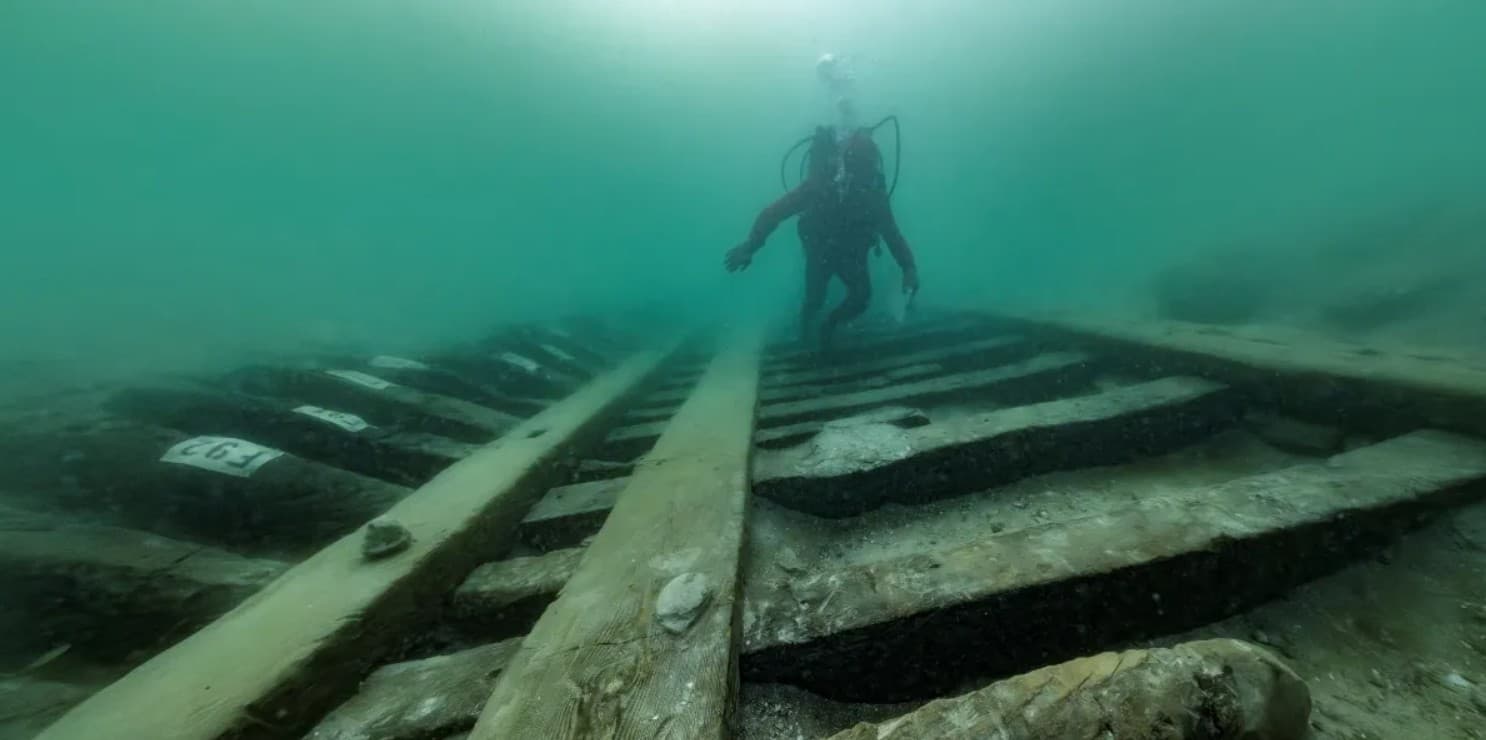
Marine archaeologists excavating near the submerged island of Antirhodos off Alexandria recovered an exceptionally intact 2,000-year-old ceremonial vessel — a thalamegos measuring approximately 35 meters in length with a beam near 7 meters and more than 28 meters of continuous hull planking preserved in situ.
Site and context: Portus Magnus and the drowned waterfront
The wreck sits within the archaeological envelope of Alexandria’s ancient harbor complex, Portus Magnus, an area repeatedly reshaped by seismic uplift, tsunamis, and gradual subsidence. Excavation led by Franck Goddio and the European Institute for Underwater Archaeology (IEASM) linked the find to classical descriptions of luxury Nile barges used for ceremonial and social functions in Roman-era Egypt. The vessel’s location near monumental ruins — temples and palace debris now submerged — supports contemporary accounts placing such craft within elite urban and ritual landscapes.
Vessel form and construction details
Structural features indicate a broad, flat-bottomed hull optimized for low-draft navigation in calm inland waters rather than blue-water voyaging. The hull’s preserved planking run and central carling beam reveal construction methods rarely visible in the archaeological record: the central beam bears Greek graffiti dated to the first half of the 1st century AD, confirming local construction and cross-cultural use under Roman influence.
📚 You may also like
| Attribute | Specification |
|---|---|
| Type | Thalamegos (pleasure barge) |
| Length | ≈ 35 m (115 ft) |
| Beam | ≈ 7 m (23 ft) |
| Planking | > 28 m continuous hull planking documented |
| Propulsion | Likely oar-powered; crew >20 oarsmen |
| Function | Ceremonial, leisure, procession |
Archaeological significance
The find is notable for documenting one of the earliest physical examples of a vessel dedicated to recreational boating, complementing literary evidence from Strabo and other ancient authors. The match between the wreck’s dimensions, layout, and classical descriptions provides a rare convergence of textual and material culture: large, pavilion-equipped barges used by royalty and elites for festivals, religious processions, and public spectacle.
- Technical insight: continuous hull planking and carpentry details illuminate timber selection and joinery techniques of early Roman-era Egyptian shipwrights.
- Cultural link: graffiti and proximity to temple remains suggest integration with religious rites, possibly the Navigatio Iside (processions honoring Isis).
- Preservation context: seismic and coastal change both destroyed and conserved the harbor assemblage, leaving timbers accessible for modern study.
What the thalamegos tells us about ancient leisure
Descriptions of large barges “luxuriously fitted out” for crowds, music, and dancing align with the vessel’s broad central pavilion and shallow draft. Archaeologists infer a design prioritizing visibility, comfort, and ceremony over cargo capacity. Socially, the thalamegos signals a level of municipal and royal wealth that translated into maritime display — an early form of luxury yachting and public entertainment afloat.
Why this matters for modern boating and coastal tourism
Beyond archaeological intrigue, the discovery reframes the long arc of pleasure boating as a social and technological phenomenon. For contemporary marinas, charter operators, and coastal destinations, understanding ancient precedents highlights continuity in how societies use boats for leisure, status, and communal events. It also underscores the importance of protecting submerged cultural heritage when planning marina development, dredging, or coastal infrastructure works.
GetBoat always keeps an eye on news related to sailing and seaside vacations, as we truly understand what it means to enjoy great leisure and love the ocean. The GetBoat service values freedom, energy, and the ability to choose your own course; it places no limits on a good life and helps clients find a vessel that suits their preferences, budget, and taste.
Practical archaeological outcomes for marine logistics
Conservation measures directed by UNESCO mean the wreck will remain in situ while research and selective documentation continue. Such preservation decisions affect local maritime logistics: restricted anchoring zones, modified navigational charts, and seasonal access controls for diving and charter operations can follow high-profile underwater finds. Operators and port authorities need to balance access for tourism with long-term conservation.
Forecasting the tourism impact, this discovery is regionally significant — it enhances Alexandria’s appeal as a destination for cultural maritime tourism but is unlikely to drastically alter global travel patterns alone. However, stories like this add depth to destination narratives that attract culturally minded visitors and yachting enthusiasts alike. GetBoat aims to stay abreast of these developments and keep pace with the changing world; if you are planning your next trip to the seaside, consider the convenience and reliability of GetBoat.
If you are planning your next trip to the sea, you should definitely consider renting a boat (boat rentals, rent a boat, rent a yacht), as each inlet, bay, and lagoon is unique and tells you about the region just as much as the local cuisine, architecture, and language and also the unique aspects of the service. GetBoat.com
Highlights of this discovery include the exceptional preservation of hull planking, the archaeological confirmation of classical accounts by authors like Strabo, and the clear material evidence of leisure-focused maritime design. Experiencing a new coastal location remains a multifaceted process: you learn about local culture, nature, and the indescribable palette of colors and rhythms of life — and you discover unique service traditions that shape the visitor experience. If you are planning your next trip to the sea, you should definitely consider renting a boat (boat rentals, rent a boat, rent a yacht) — each inlet, bay, and lagoon is unique and tells you about the region just as much as the local cuisine, architecture, and language and also the unique aspects of the service. GetBoat.com
In summary, the Alexandrian thalamegos offers both tangible and symbolic lessons for maritime heritage and modern leisure boating. Technically, it reveals construction practices, hull design, and timbers that inform shipwright lineages; culturally, it shows how boats have long served as platforms for display, festival, and recreation. For charter operators, captains, and destination managers, the find reinforces the link between history and contemporary yachting — a reminder that every beach, gulf, and marina carries stories worth celebrating. GetBoat.com supports this spirit by making yacht and boat charter, sale, and rental transparent and accessible across destinations; from superyacht charters to simple boat rent, the platform helps match sailors, sunseekers, and fishing enthusiasts with vessels and marinas worldwide. Start exploring today: yacht, charter, boat, beach, rent, lake, sailing, captain, sale, destinations, superyacht, activities, yachting, sea, ocean, boating, gulf, water, sunseeker, marinas, clearwater, fishing.


