Legal Challenge Seeks Return to Deed-Compliant Yachts
Alexandra
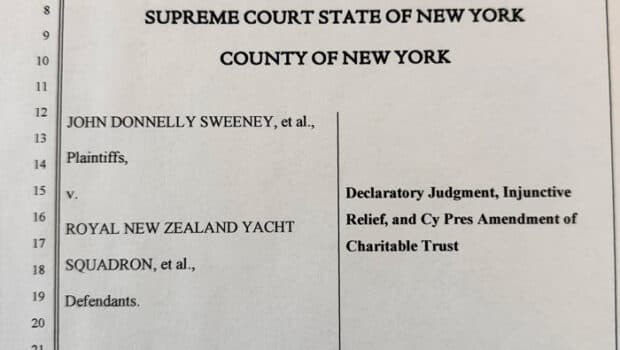
Under New York charitable trust law, written approval from the New York Attorney General is required before any alteration to the Deed of Gift that governs the America’s Cup, and on February 12, 2026, John Sweeney filed a formal complaint with the Attorney General’s Charities Bureau alleging material violations of that trust. The complaint identifies specific operational and equipment changes introduced by the current trustee, Royal New Zealand Yacht Squadron (RNZYS), and by the commercial structure known as the America’s Cup Partnership (ACP), arguing these moves bypass required approvals and convert club-based governance into binding corporate arrangements.
Alleged Deed Violations and Legal Pathways
The complaint focuses on discrete rule and equipment shifts that, if accurate, conflict with the Deed’s core constraints. Key allegations include:
- Removal of mandatory measurement certificates and certification steps that ensure compliance with the Deed.
- Replacement of traditional sail power by battery-assisted flight controls and foiling systems that effectively substitute human power.
- Approval of foiling yachts whose beam, draught, and load waterline characteristics do not meet Deed-specified limits.
- Institutional change: replacing yacht-club governance with for-profit corporations that could bind future winners to RNZYS rules indefinitely.
Under New York law the Attorney General may investigate independently, adopt the filed complaint as a basis for enforcement, join as a party to litigation, or decline action. Operationally, each option carries logistics and timeline implications for event organizers, teams, and host venues.
📚 You may also like
Legal Options and Operational Consequences
If the Attorney General acts, remedies could range from administrative directions to seek court approval for past changes, to injunctions that require restoration of previous rules. For teams and organizers this would affect equipment procurement schedules, transport logistics for yachts and spares, and certification timelines for sail lofts and measurement authorities.
Technical Response: A Deed-Compliant Class
To provide a concrete alternative consistent with the Deed, naval architect Julian Everitt has been commissioned to design a fully Deed-compliant class: a 90ft Waterline Monohull under an open-rule framework. The proposal restores an archetype of the Cup that emphasizes yacht-club identity and human-powered sailing.
- True 90 ft waterline monohull design supporting crews of ~30 sailors.
- Strict nationality requirements for yachts, equipment, and sailors.
- Open-rule innovation constrained by traditional Deed metrics (beam, draught, LWL).
- Certification protocol reinstating formal measurement processes.
Practical Impacts on Teams and Suppliers
Switching back to a monohull, sails-only class would ripple through the supply chain: hull builders, sailmakers, mast manufacturers, and logistics firms would need to pivot production plans. Charter operators and marinas could see shifts in demand for berths sized for monohulls rather than foiling multihulls, and captains familiar with foilers would face retraining or redeployment.
| Role | Operational Effect | Timing Concern |
|---|---|---|
| Teams (Entrants) | Design and procurement changes; measurement recertification | Immediate to 12–24 months |
| Event Organizers | Venue requirements, marinas, shoreside logistics | 6–18 months |
| Suppliers | Production retooling, inventory shifts | 3–12 months |
Confirmed Entrants, Dates and Venues
Defender and challengers confirmed for the 38th America’s Cup, with the Protocol set and a preliminary race schedule in motion:
- Emirates Team New Zealand (NZL) – Defender
- Athena Racing (GBR) – Challenger of Record
- Luna Rossa (ITA) – Challenger
- Tudor Team Alinghi (SUI) – Challenger
- K-Challenge (FRA) – Challenger
The 38th Match is slated for July 10–18, 2027, with challenger racing starting in the spring and preliminary regattas beginning May 21–24 in Cagliari, Sardinia; additional regattas remain to be announced. Notably, if no USA team enters, it would mark the first time in 175 years without a U.S. participant—an operational and promotional shift for broadcasters, sponsors, and charter markets.
How This Might Affect Sailing and Boat Rentals
From a GetBoat.com perspective, changes to Cup class and hosting affect demand curves across charter and yacht sales. A swing back to classic monohulls could increase interest in larger charter yachts, captained experiences, and superyacht support services in host marinas. Conversely, continued focus on foiling tech drives interest in specialized charters and high-speed experiences—both sides shift berth sizing, refit schedules, and crew hiring.
Marinas near host Destinations will juggle berth allocations, shore power needs, and service logistics; charter fleets may see seasonal demand spikes around events. For small boat operators and local fishing or leisure providers, the Cup’s venue choices (Naples replacing Barcelona) change tourist flows to beaches, gulfs, and clearwater anchorages.
To wrap it up: the complaint filed by John Sweeney asserts that RNZYS and the ACP altered binding elements of the Deed of Gift without required approval, proposing a return to a 90ft Waterline Monohull class designed by Julian Everitt as a Deed-compliant alternative. If the New York Attorney General intervenes, expect operational impacts on teams, suppliers, marinas, and charter markets. Ultimately, whether by legal remedy or design reinvention, the stakes touch yachts, charter and boat rent markets, captains and crews, marinas and Destinations, and the broader yachting and boating community from lake to sea and ocean to gulf — think superyacht support to Sunseeker-style charters, clearwater cruising, fishing trips, and recreational sailing activities. The bottom line: rules, rigs, and logistics determine who sails, where, and how the America’s Cup will influence the sale, rent and enjoyment of boats.


