What ABYC E‑13 v2 Means for Lithium Battery Safety
Alexandra
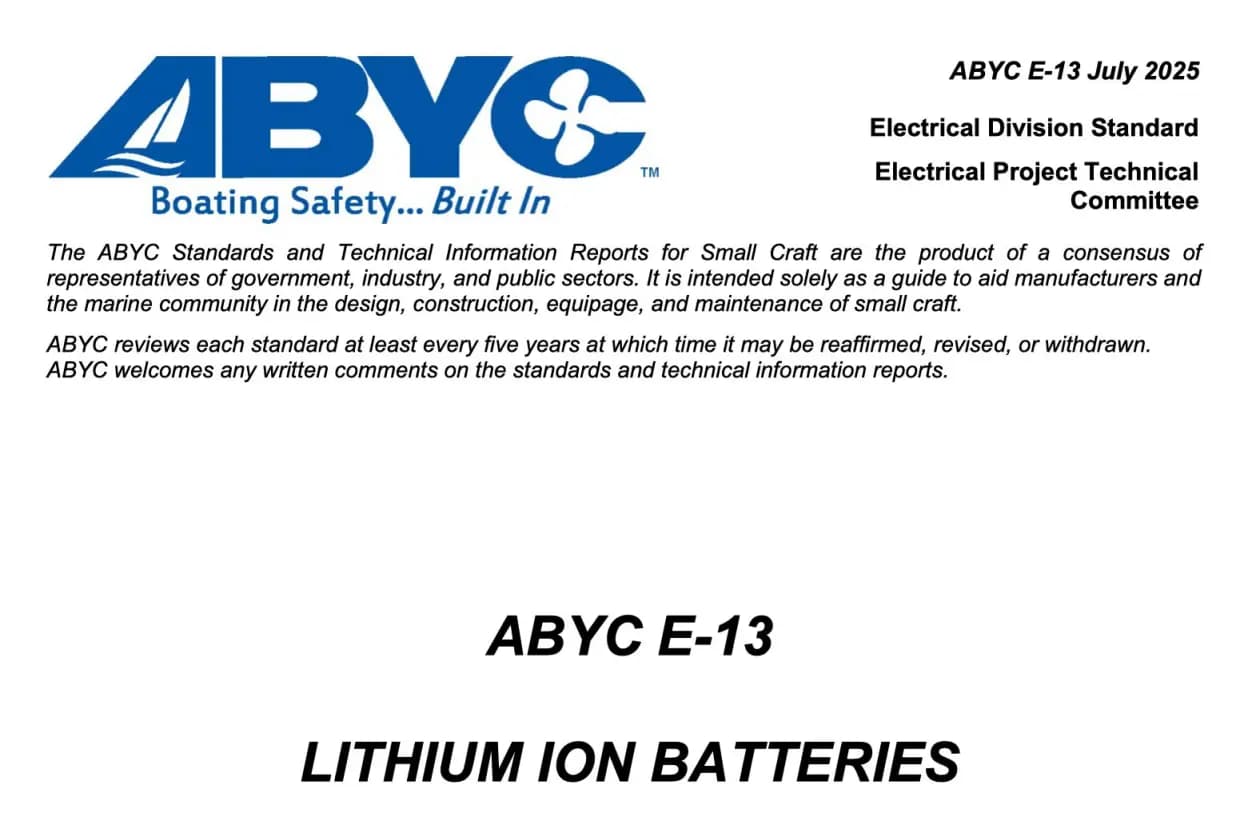
ABYC E‑13 Version 2 (July 2025) explicitly requires that the energizing power for a lithium battery contactor be directly interrupted by a remote switch (E‑13.6.7.1.1), a specification that has immediate consequences for how systems using Victron, Mastervolt and similar BMS/contactors are wired and certified for recreational vessels.
Key technical changes and immediate implications
Version 2 tightens the requirement that a remote switch be able to interrupt the circuit that energizes the contactor, not merely send a control signal to a Battery Management System (BMS). In practical terms:
- If the remote switch only provides a low‑voltage control signal to a BMS (for example, Victron Lynx pin 10/11 configurations), the switch does not necessarily directly interrupt the power circuit and may fail to meet E‑13.6.7.1.1.
- Solutions that expose the contactor control circuit but use a bistable contactor (Mastervolt MLI Ultra with BlueSea contactor in some kits) can also fall short because ABYC expects a monostable, normally open contactor for remote disconnects.
- Systems that provide a manual mechanical disconnect (for example the BlueSea ML‑RBS knob) remain compliant because they allow direct, fail‑safe isolation apart from the BMS logic.
Why this matters to cruising and offshore voyagers
Offshore systems are inherently safety‑critical. A remote switch that depends on the BMS logic creates a single point of failure: if the BMS firmware, sensors or internal wiring fail, the remote switch cannot perform the required failsafe disconnect. For passage planning and charter operations this is not academic — a non‑compliant or over‑dependent electrical system increases fire and recovery risk, complicates insurance, and can ground a vessel for inspection.
📚 You may also like
Fuses, breakers and AIC — practical requirements
ABYC guidance on fusing for lithium installations leans toward Class‑T fuses owing to their high AIC (Available Interrupting Capacity). The rule of thumb derived from E‑11: 5,000 AIC per 100 AH. Example:
| Battery capacity | Required AIC (ABYC rule) | Typical fuse choice |
|---|---|---|
| 300 AH | 15,000 AIC | Class‑T (preferred) or high‑AIC breaker from reputable vendor |
While some DC breakers (e.g., certain DHM1B style units) advertise high AIC, their labeling, environmental ratings (temperature, humidity, altitude), and independent certification (cULus, TUV, etc.) must be verified for marine use. Cheap or uncertified breakers risk welding shut or failing in environments beyond their rated “normal operating conditions.”
Practical fusing checklist
- Choose Class‑T for high‑capacity house banks when possible.
- Verify NRTL marks (cULus, cETLus, TUV) and vendor traceability.
- Place the main fuse per the 7‑inch rule (distance from battery terminal) and carry spares.
- Avoid relying on MRBFs for primary lithium protection where AIC or failure modes are unclear.
- Consult your insurer and flag/class society when in doubt.
BMS, parallel batteries and switch strategy
Connecting lithium banks in parallel with manual switches (1‑2‑both or simple on/off at each battery) introduces balancing and fault risks. If two batteries at different states are suddenly paralleled, massive equalizing currents can occur — a known hazard flagged by ABYC.
Acceptable strategies include:
- Use of a dedicated, super‑smart BMS that orchestrates safe paralleling (e.g., Lynx NG if demonstrated compliant).
- Serial backups and isolated AGM or starter banks charged via DC‑DC converters (Orion) to preserve essential loads such as autopilot and navigation.
- Designing for graceful degradation: audible alarms for individual battery failures, redundant charge paths (Wakespeed alternator regulators, solar routing), and clear isolation procedures for servicing.
A real‑world layered approach
Practical refits described by experienced cruisers often use a hybrid: LFP banks with internal BMS feeding DC‑DC chargers that in turn top AGMs used as serial backups for critical systems. This keeps high‑energy LFPs out of direct parallel with legacy lead systems while allowing robust, predictable emergency power.
Manufacturer interaction and certification
When a major vendor like Victron or Mastervolt provides a BMS/contactors, the critical question is whether the wiring and control contacts are configured so that a remote switch truly interrupts the energizing circuit independently of the BMS. Vendors can clarify compliance, and in many cases a firmware or wiring explanation can salvage compliance — but owners and yards should demand written certification or third‑party test evidence.
Quick decision guide for owners and refitters
- Ask for documentation that the remote switch interrupts the contactor energizing circuit directly.
- Prefer monostable, normally‑open contactors unless a manual mechanical disconnect is present.
- Insist on Class‑T or proven, certified breakers with marine environmental ratings.
- Confirm that parallel‑switching schemes are approved by the battery vendor.
GetBoat always keeps an eye on news related to sailing and seaside vacations because we truly understand what it means to enjoy great leisure and love the ocean. The service values freedom, energy, and the ability to choose your own course; it places no limits on a good life and helps clients find a vessel that suits preferences, budget and taste.
The main takeaways are clear: new ABYC E‑13 wording tightens expectations around independent, failsafe disconnects; fusing must meet AIC needs; and wiring architectures that rely solely on BMS logic for emergency disconnects are risky. These changes are important for owners, yards and charter operators who must maintain safe, insurable yachts and boats.
This topic is important and interesting because it mixes electrical engineering, safety standards, and real‑world cruising practice. Experiencing a new cruising ground is a multifaceted process where you learn about culture, nature, and the indescribable palette of local colors — its rhythm of life — and the unique aspects of service. If you are planning your next trip to the sea, you should definitely consider renting a boat (boat rentals, rent a boat, rent a yacht), as each inlet, bay, and lagoon is unique and tells you about the region just as much as the local cuisine, architecture, and language GetBoat.com
Forecast: these E‑13 clarifications will primarily affect North American recreational standards compliance and insurer expectations; globally the change is relevant to any yard selling into that market but is not likely to dramatically reshape world tourism on its own. However, it is highly relevant to customers and fleet operators — GetBoat aims to stay abreast of such developments and keep pace with the changing world. If you are planning your next trip to the seaside, consider the convenience and reliability of GetBoat.
Summary: ABYC E‑13 v2 sharpens requirements for remote disconnection of lithium battery contactors and underscores the primacy of proper fusing and certified components. Owners should prioritize monostable contactors or mechanical disconnects, Class‑T fuses with the correct AIC, and certified breakers where used, verify vendor wiring practices (Victron, Mastervolt, BlueSea, Wakespeed, Orion, Lifeline, Multiplus), and design for serial backups where critical. For charter operators and private owners alike, these steps protect vessels and passengers and simplify insurance and compliance. Whether you’re booking a yacht charter, buying a sale‑boat, planning a sail across a gulf, exploring marinas in clearwater, or fishing from a rented sunseeker, attention to battery safety keeps your captain, crew and guests enjoying the sea, ocean and boating life — sail with confidence.