


 Magyar
  English (UK)
  Русский
  العربية
  日本語
日本語  한국어
한국어  Türkçe
  Español
  Čeština
  Svenska
  Português
  Ελληνικά
  Suomi
Suomi  Nederlands
  Română
  Italiano
  Français
  Polski
  Українська
  Deutsch
  简体中文
简体中文  Slovenčina
 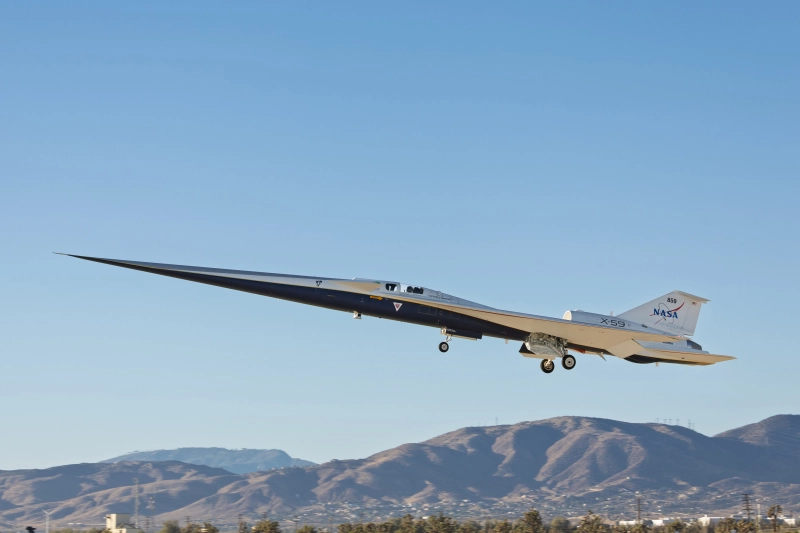 The X-59 Achieves First Supersonic Flight with Sonic Boom Reduction">

Introduction to the X-59 Supersonic Milestone
The X-59 supersonic aircraft has successfully completed its inaugural flight, marking a major achievement in aerospace innovation. Developed jointly by Lockheed Martin and NASA, this aircraft aims to pioneer quieter supersonic travel by minimizing the sonic boom traditionally associated with breaking the sound barrier.
The Flight and Technical Achievements
The first flight of the X-59 took place at the U.S. Air Force Plant 42 in Palmdale, California, finishing at NASA’s Armstrong Flight Research Center in Edwards, California. This test flight primarily aimed to assess the aircraft’s flight characteristics and air data performance under subsonic conditions before advancing to supersonic speeds.
The centerpiece of the X-59’s technology is its innovative design, crafted to dramatically reduce the intensity of sonic booms. Conventional supersonic aircraft create loud shock waves that can severely disturb communities beneath flight paths, limiting routes and commercially viable supersonic travel over land. The X-59’s shape and engineering are optimized to transform this disruptive noise into a gentler sound, often described as a soft “thump,” greatly reducing noise pollution concerns.
Future flight tests will push the X-59 to supersonic speeds under various conditions and altitudes to collect detailed data on its sound signature. These measurements are crucial for NASA’s community acceptance testing, which will identify how local populations perceive the reduced sonic boom and help shape regulatory frameworks for future supersonic commercial flights.
The Road to Quiet Supersonic Flight
The drive to achieve quieter supersonic flight responds to decades of challenges with traditional supersonic travel, where loud sonic booms restricted aircraft to routes over oceans and unpopulated areas. The X-59 represents a leap forward, supported by advances in aerodynamics, materials, and propulsion, reflecting the collaboration between Lockheed Martin’s Skunk Works and NASA’s aeronautics experts.
This partnership leans on modern technology to revisit the concept of supersonic travel, with the goal of opening new commercial possibilities that could drastically reduce flight durations while respecting terrestrial noise regulations and environmental concerns.
Brief History of Supersonic Flight
The quest for supersonic flight dates back to military testing in the mid-20th century, notably with the Bell X-1 breaking the sound barrier in 1947. Since then, efforts moved from experimental jets to commercial supersonic transport (SST), highlighted by remarkable aircraft like the British-French Concorde and the Soviet Tupolev Tu-144 in the 1960s and 1970s.
The Concorde famously cut transatlantic flight times by half, cruising at roughly twice the speed of sound (Mach 2). However, noise pollution from sonic booms and environmental factors led to its retirement and halted wider adoption of SST aircraft. In the U.S., projects such as Boeing’s 2707 were canceled due to high costs and sonic boom concerns.
Advances in materials, engine efficiency, and aerodynamic design have gradually nudged the industry back toward supersonic possibilities. The X-59’s objective to tame sonic booms revitalizes this historical vision with modern solutions, potentially ushering in a new era of sustainable and community-friendly supersonic travel.
Supersonic Flight: Impact on Travel and Tourism
The return of quieter supersonic aircraft could significantly reshape long-distance travel, providing faster connections between key international destinations. This increase in travel speed can influence tourism patterns, opening up new markets and boosting economic activity in remote regions.
For marine and coastal regions popular among yacht and sailing enthusiasts, faster air travel can mean increased accessibility for travelers, potentially enriching boating activities and yacht charters. Improved connectivity might also encourage more frequent visits, extending high season periods and introducing diverse international guests to scenic seaside marinas and clearwater beaches.
Key Features and Design Highlights of the X-59
| Feature | Description |
|---|---|
| Tervezés | Long, slender fuselage with a sharp nose to shape shock waves |
| Sebesség | Capable of reaching supersonic speeds while minimizing noise |
| Sonic Boom | Transforms the traditional loud sonic boom into a soft, quiet thump |
| Testing Sites | First flight at Plant 42, comprehensive testing at Armstrong Flight Center |
| Partners | Lockheed Martin Skunk Works and NASA collaboration |
Anticipated Future Developments
Upcoming phases of testing will extend to supersonic flight regimes, measuring flight dynamics, noise emissions, and community feedback. The expectation is that findings will influence regulatory agencies worldwide, adapting noise standards to permit commercial supersonic jets to operate over populated areas.
This progress could stimulate new markets in high-speed travel, creating a bridge between aviation technology and emerging trends in global tourism and international cargo transit.
Conclusion: The X-59 and Its Role in Future Travel
The first flight of the X-59 marks an exciting chapter in aeronautical engineering, promising a future where high-speed supersonic travel can coexist with community comfort and environmental responsibility. For maritime and coastal regions often visited by yachts and sailing boats, enhanced global connectivity could translate into greater tourism inflow and expanded boating activities.
As the aviation world moves toward these quieter, faster aircraft, travelers and adventurers might find new opportunities to explore destinations by sea and air alike. For those who enjoy yachting and related activities, the synergy between improved supersonic travel and accessible marine resorts could present a fresh wave of growth in chartering, boating, and seaside vacations.
To explore more about boating, yacht charter, and other water-based adventures, visit GetBoat.com, an international marketplace for renting sailing boats and yachts. GetBoat offers a wide selection of vessels to rent for every taste and budget, ensuring your sea experiences complement the future of travel.