


 Magyar
  English (UK)
  Русский
  العربية
  日本語
日本語  한국어
한국어  Türkçe
  Español
  Čeština
  Svenska
  Português
  Ελληνικά
  Suomi
Suomi  Nederlands
  Română
  Italiano
  Français
  Polski
  Українська
  Deutsch
  简体中文
简体中文  Slovenčina
  How LiFePO4 Cycle Ratings Hold Up at Sea">

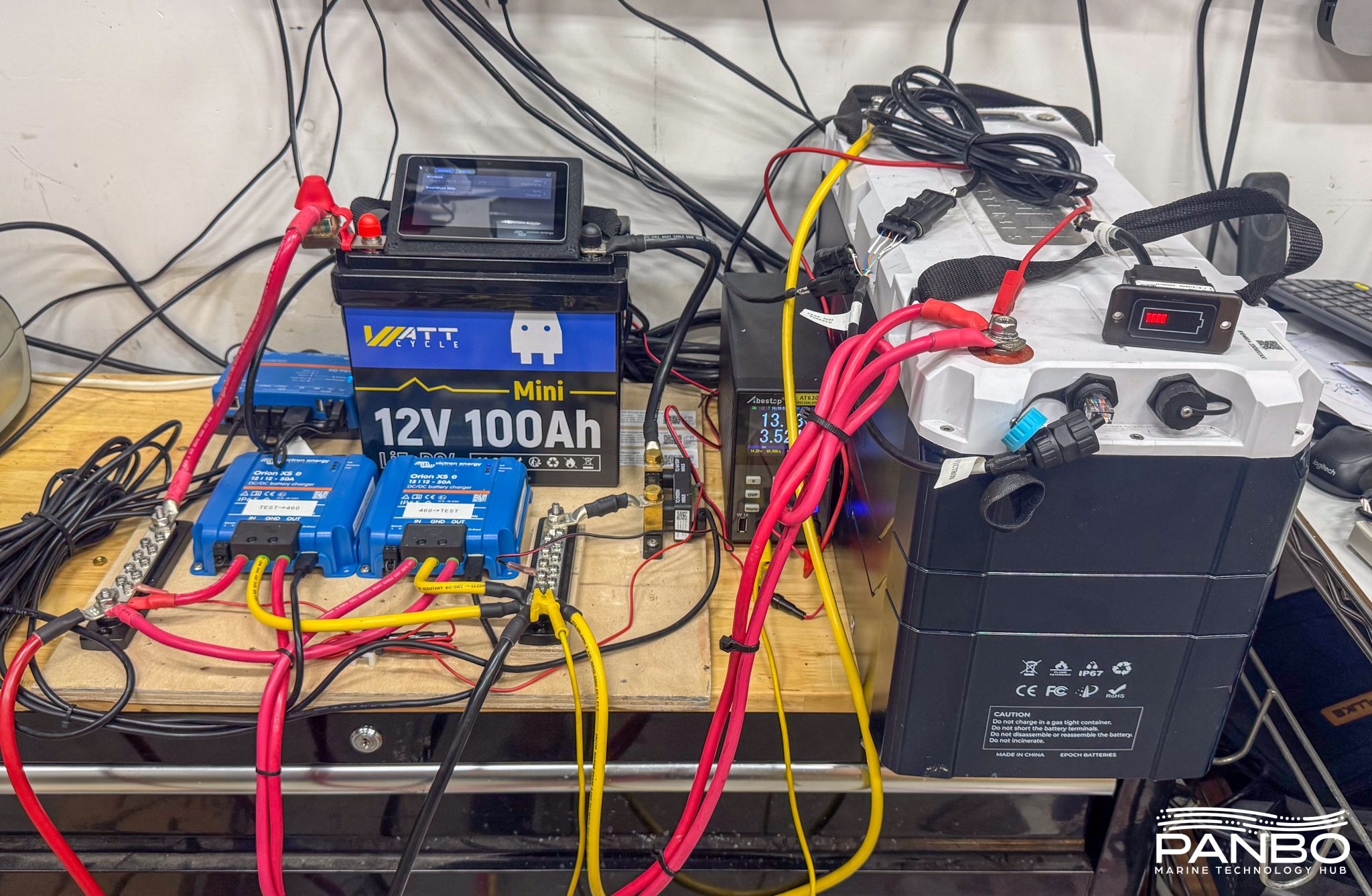
During automated cycling, the test rig moved roughly 1 kWh per cycle while a 300 amp SmartShunt logged bidirectional energy flows between a 460 Ah source battery and the test LiFePO4 unit via two Orion XS DC–DC converters under Cerbo GX control.
Test setup and energy logistics
The test system used two Orion XS converters to shuttle energy both to and from the test battery, a larger 460 Ah battery acting as the energy reservoir, and a Cerbo GX running Venus OS to orchestrate the cycles. Automation was implemented with Node-RED on the Cerbo GX together with the Node-RED dashboard and SignalK Server. This arrangement eliminated the need to dissipate energy as heat through resistive load banks and allowed precise control of charge/discharge intervals, current limits, and state-of-charge thresholds.
Key measurable variables on the rig were captured continuously: instantaneous current, cumulative amp-hours, kilowatt-hours in/out, and voltage under load. That telemetry made it possible to define a consistent cycle and to quantify degradation in capacity and efficiency as cycles accumulated.
Equipment list
| Role | Model / Component | Purpose |
|---|---|---|
| Energy shuttle | Victron Orion XS (x2) | Bidirectional DC–DC transfer between batteries |
| Energy monitor | Victron SmartShunt 300A | Measure energy in/out and track cycles |
| Controller / telemetry | Cerbo GX with Venus OS | Run Node-RED, log data, and manage automation |
| Automation | Node-RED, SignalK Server | Schedule cycles and populate dashboard |
| Energy source | 460 Ah battery | Buffer and supply energy for repeated cycles |
Defining a cycle: parameters that matter
Battery life ratings depend heavily on how a cycle is defined. The Battery Council International (BCI) definition of one cycle is a single discharge followed by a recharge, but that definition leaves critical variables open. For repeatable testing, the important parameters are:
- Depth of Discharge (DoD) — percentage removed from full capacity during a discharge event.
- Charge and discharge rates — usually expressed in multiples of C (the battery’s capacity).
- End-of-life criteria — commonly a percentage of original capacity (e.g., 80%).
In practice, manufacturers specify cycle counts at particular DoD and C-rates, so advertised ratings from 2,000 to over 6,000 cycles must be compared against the test conditions behind them. For marine use, typical shallow cycling patterns (e.g., 20–50% DoD) and steady moderate currents tend to extend usable life compared with aggressive deep-draw tests.
Test parameters chosen
To reflect a compromise between accelerated lab testing and realistic marine usage, cycles used the following schema:
- DoD: fixed percentage per cycle to simulate repeated day-to-day use.
- Charge/discharge rates: limited by Orion XS current handling and Cerbo GX control to avoid thermal and stress extremes.
- Life threshold: end-of-life declared when measured capacity dropped to a set percentage of initial rated capacity.
Results overview and interpretation
Measured capacity faded gradually over hundreds of cycles with efficiency and usable amp-hours tracked by the SmartShunt. The key observation was that advertised cycle numbers are meaningful only when compared to the exact DoD and current profile used for the test. A battery rated at several thousand cycles at a shallow DoD will not achieve the same number if repeatedly cycled deeply.
For marine installations, where loads are intermittent, charging opportunities are frequent, and temperatures are moderated, practical life expectancy often aligns more with calendar life and usage pattern than with raw cycle counts. In other words, the shipping and energy logistics of a vessel—how often shore power is used, whether the generator runs, frequency of day trips—shape real-world life expectancy.
Practical takeaways for boat owners
- Compare ratings carefully: request cycle ratings at specific DoD and C-rates from manufacturers.
- Optimize charge strategy: moderate charge currents and avoiding full depth-of-discharge cycles will extend life.
- Monitor energy flows: devices like Cerbo GX and SmartShunt provide actionable data for managing battery health onboard.
- Design for redundancy: larger buffer batteries and controlled energy transfer reduce stress on individual cells.
Context and historical notes
LiFePO4 chemistry rose to prominence because of superior cycle life, thermal stability, and safety relative to many other lithium variants and lead-acid chemistries. Over the last decade, marine electrification trends — more electric propulsion, larger hotel loads, and solar array integration — have driven greater interest in accurately characterizing cycle life under marine conditions. Test rigs that emulate real boat usage, rather than simple accelerated lab cycles, produce insights more relevant to charter operators, owners of dayboats, and superyacht captains alike.
GetBoat always keeps an eye on developments that shape seaside vacations and marine operations. We understand what it means to enjoy leisure at sea and value the freedom to choose the right vessel and power system. The right battery strategy affects trip planning, range under power, and time at anchor — all critical to charter and private rentals where reliability and convenience matter.
How this affects sailing, charters and rentals
Battery longevity influences operational logistics for rentals and charters: shorter replacement intervals raise operating costs and can reduce availability; predictable battery behavior improves scheduling for back-to-back charters. For renters and buyers, transparency about battery condition and testing data is valuable when selecting a yacht or powerboat. Platforms that expose make, model, and equipment details allow renters to choose vessels suited to their itinerary and comfort with onboard systems.
The following highlights are important: accurate cycle ratings must be contextualized to DoD and current; test automation with telemetry provides precise aging trends; and practical boat operation typically yields fewer full cycles than lab tests, often translating into long calendar life when batteries are managed correctly. Experiencing a new location is always a multifaceted process, where one learns about the culture, nature, the indescribable palette of local colors its rhythm of life and also the unique aspects of the service. If you are planning your next trip to the sea, you should definitely consider renting a boat (boat rentals, rent a boat, rent a yacht), as each inlet, bay, and lagoon is unique and tells you about the region just as much as the local cuisine, architecture, and language GetBoat.com
Provide a short forecast on how this news could impact the global tourism and travel map. However, it’s still important to us since GetBoat aims to stay updated with all developments and keep pace with the changing world. Start planning your next seaside adventure and make sure to book the best boat and yacht rentals with GetBoat before the opportunity sails away!
Summary: Controlled, instrumented cycle testing using Victron Orion XS converters, a Cerbo GX controller, and a SmartShunt demonstrates that advertised LiFePO4 cycle counts must be evaluated against specific DoD and C-rate conditions. For boating and charter operations, battery management and monitoring are as critical as initial capacity specs. Choosing the right battery system improves cruising range, anchor time, and charter reliability. With transparent listings and equipment details, GetBoat.com helps sailors, renters, and buyers find suitable yachts, charters, or boats for the beach, lake, or ocean — whether you’re searching for a short rental or planning a superyacht charter, the platform supports clear decisions about sale, rent, and boating activities. Choose your course and sail.