O'Day 40: Design, Performance and Ownership Guide
Alexandra
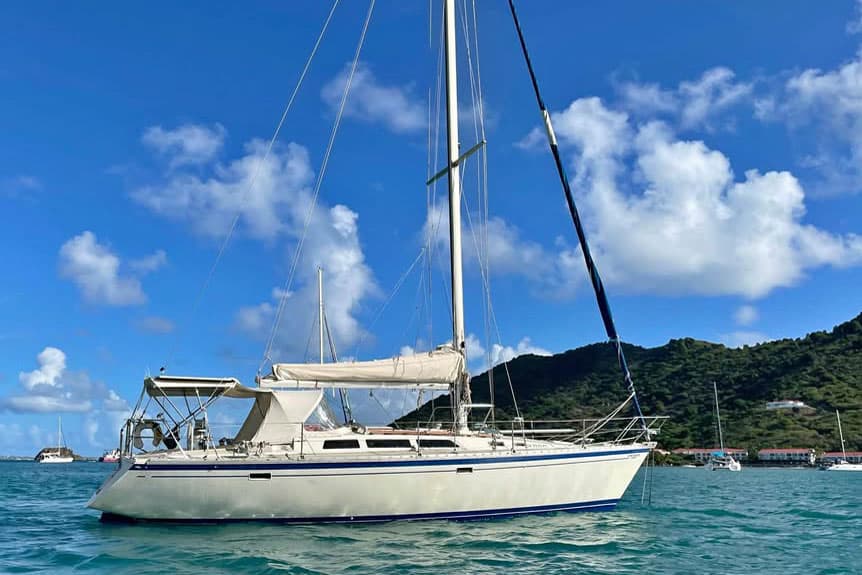
With an LOA of 39'7", a beam of 12'7" and masthead rig standing roughly 51'6" above the deck, the O’Day 40 requires careful berth planning: marinas must offer sufficient LOA and mast clearance, channel depths must accommodate either the 6'8" fin keel or the 4'11" wing keel, and haul-out logistics demand crane capacity for a near 18,000 lb displacement hull. Tankage—about 100 gallons of water and 40 gallons of fuel—means provisioning and waste handling aboard affect turnaround time for coastal charters or long-distance passages.
Design & Construction
The O’Day 40 was produced by the O’Day Corporation from 1985 to 1989 and represents a deliberate shift toward contemporary performance styling. French naval architect Philippe Briand introduced a flatter underbody and finer entry compared with earlier American production cruisers, improving off-wind speed and average passage-making velocity. The hull is solid fibreglass (GRP) while the deck employs a balsa core to balance stiffness against weight.
The Briand Hull
Briand’s hull form gives the O’Day 40 a more performance-oriented character: reduced wetted surface, quicker acceleration in puffs, and a hull shape that carries form stability aft. For owners and charter operators this translates into a boat that feels responsive when sailing short-handed, maintains cruising speeds between destinations, and requires less engine motoring time in light airs.
📚 Vous aimerez peut-être aussi
Variants & Layouts
Most O’Day 40s were sold as masthead sloops with an aft cockpit and a standard two-cabin, two-head interior—comfortable for two couples or a small charter party.
- Fin Keel: 6'8" (2.03 m) draft—better pointing and upwind performance.
- Wing Keel: 4'11" (1.50 m) draft—favoured for shallow cruising grounds such as the Bahamas and sheltered bays along the US East Coast.
Published Specification
| Specification Item | Measurement / Detail |
| LOA | 39'7" (12.07 m) |
| LWL | 33'6" (10.21 m) |
| Beam | 12'7" (3.84 m) |
| Draft (Wing Keel) | 4'11" (1.50 m) |
| Draft (Fin Keel) | 6'8" (2.03 m) |
| Displacement | 18,000 lbs (8,165 kg) |
| Ballast | 7,200 lbs (3,266 kg) |
| Rig Type | Masthead Sloop |
| Hull Material | GRP (Glass Reinforced Plastic) |
| Production Dates | 1985 – 1989 |
Rig, Sail Plan & Sail Areas
The O’Day 40 carries a relatively generous sail area for its displacement, which helps in light conditions and improves charter appeal where motoring is undesirable.
- I (Forestay Height): 51'6" (15.70 m)
- J (Foretriangle Base): 15'3" (4.65 m)
- P (Mainsail Luff): 45'5" (13.84 m)
- E (Mainsail Foot): 14'6" (4.42 m)
- Mainsail Area: 329.28 ft² (30.59 m²)
- 100% Foretriangle: 392.69 ft² (36.48 m²)
- Total Sail Area (100%): 721.97 ft² (67.07 m²)
Performance Analysis
Key design ratios show a cruiser that balances comfort and performance—important for owners planning long hops between ports or charter operators needing reliable sea-keeping and speed.
| Ratio Type | Value | Interpretation |
| SA/D | 16.9 | Moderate: enough power in light airs without excessive weather helm at moderate wind. |
| D/L | 214 | Medium displacement: good load-carrying for cruising stores and equipment. |
| B/D | 40% | Healthy ballast ratio for stiffness and sail-carrying capacity. |
| CSF | 1.94 | Under 2.0, indicating acceptable offshore capability for passagemaking. |
| Comfort Ratio | 27.8 | Predictable motion favorable for liveaboard use and longer passages. |
Structural Integrity & Common Maintenance Concerns
The O’Day 40 uses a structural grid to spread rig loads and a solid GRP hull, but boats of this era require careful inspection before purchase or entry into a rental fleet.
Buyer / Survey Checklist
- Balsa Core Moisture: Inspect around stanchions and mast step for signs of water ingress and delamination.
- Chainplates & Seals: Check for deck seal deterioration and internal staining near bulkheads.
- Keel-to-Hull Joint: On fin keel models look for hairline cracks at the keel root and assess keel-bolt condition.
- Mast Step & Compression Post: For deck-stepped masts confirm there is no compression or deck sag.
- Through-hulls: Replace original plastic valves with bronze or modern composite fittings where necessary.
How the O'Day 40 Stacks Up
Against contemporaries such as the Catalina 42, Hunter 40 and the Beneteau First 405, the O’Day 40 sits between comfort and performance. It often feels more substantial than the Catalina, less radical inside than many Hunters, and trades a touch of the First 405’s speed for livability—an appealing compromise for private owners and smaller charter operations.
Accommodation & Cruising Characteristics
The interior layout favours practical cruising: a U-shaped galley to starboard for secure meal prep underway, two private cabins and two heads to support couples or small charter groups. A deep cockpit offers protection, while a transom platform eases dinghy handling and boarding—features that increase the boat’s utility as both a liveaboard and a rental yacht.
Brief Historical Context
O’Day Corporation’s move in the 1980s to commission designers like Philippe Briand reflected a wider industry shift: American builders were integrating European hull concepts to produce cruisers with improved performance without sacrificing comfort. The O’Day 40 is a product of that era, embodying a compromise between club-racing agility and coastal/offshore cruising practicality.
As a forecast for the boat’s role in recreational boating and tourism, the O’Day 40’s moderate displacement, comfortable interior and accessible sail plan keep it relevant for second-hand sales, coastal charters and owner-operated cruising. Its draft choices make it adaptable to diverse destinations, from shallow island anchorages to deeper ocean marinas.
In summary, the O’Day 40 blends a performance-minded hull with roomy accommodations and practical systems—making it attractive to private owners and small-scale charter operators who value a balance of speed, comfort and manageability. For anyone seeking options for yacht charter, boat rental or sale, the O’Day 40 offers sensible cruising capability for coastal gulfs, clearwater anchorages and longer sea passages. For listings, comparisons and advice on finding the right charter or purchase—whether you need a skippered boat with a professional captain or a bareboat option ready for family activities—visit GetBoat.com, an international marketplace for renting sailing boats and yachts that can match budgets and tastes across destinations, marinas and yachting needs.


