Practical guide to basic boat electrics and troubleshooting
Alexandra
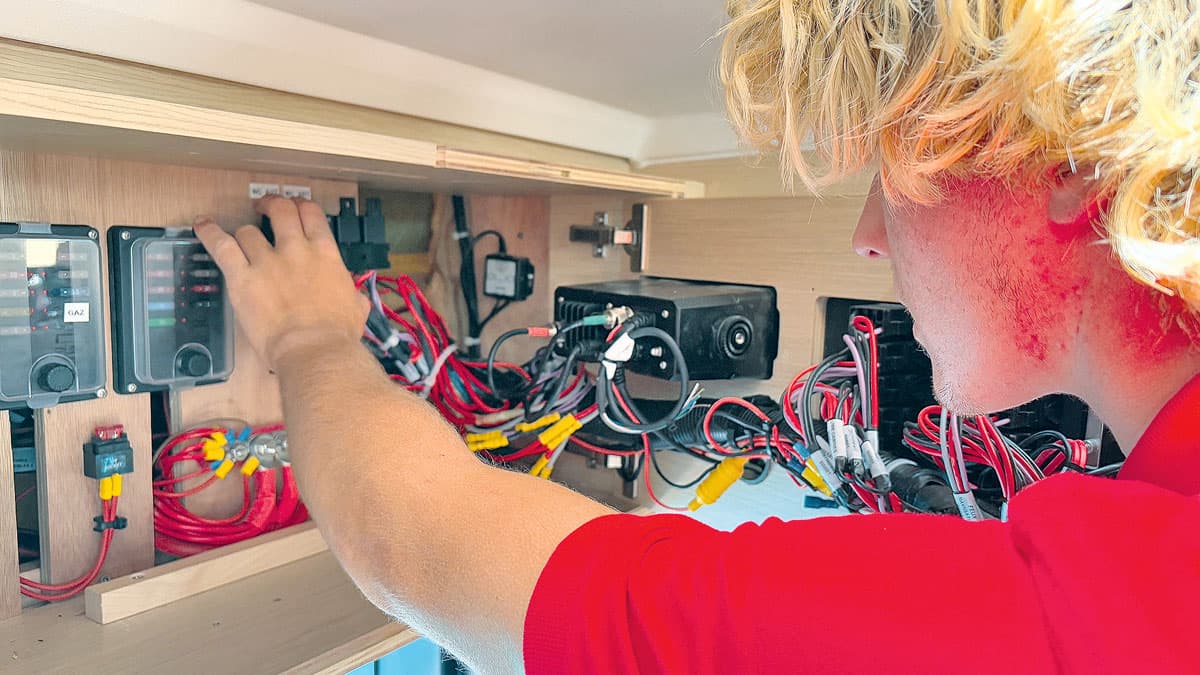
On most coastal charters a failed 12V circuit or a dead start battery often causes the largest operational delay: a typical on-site repair requires a multimeter, replacement fuses, a spare lead-acid battery or a charging source, and usually 30–90 minutes in a marina berth to diagnose and fix. Stocking basic electrical spares and a small tool kit reduces downtime and prevents cancellations on short-term yacht charters.
Essential tools and probe technique
Any practical marine electrician or skipper should keep a reliable multimeter, a set of sharp probes and a pair of crocodile clips aboard. Use the VΩA socket for measuring volts and ohms with the red probe; use the 10A socket when measuring higher currents up to 10A. Clean bare metal before measuring — oxidation and dirt create false resistance readings that mislead diagnostics.
- Sharp probes improve contact and accuracy.
- Crocodile clips free hands during multi-point testing.
- Remove dry cells at season end to prevent leakage damage.
- After cleaning, a thin smear of Vaseline protects terminals from corrosion.
Practical probe tips
When checking voltages, scrape corrosion back to bright metal with a sharp blade or sandpaper. Wipe contacts with a clean cloth and protect them with a thin layer of petroleum jelly to slow future oxidation. For small instruments and battery banks, keep fingers off contacts to avoid transferring oils that attract dirt.
📚 Vous aimerez peut-être aussi
Testing dry cell and lead-acid batteries
For dry cells use the multimeter’s BATT position set to the appropriate range (1.5V or 9V). Place the red probe on the positive pip and the black probe on the negative end. As a general rule for AA/AAA cells, readings above 1.4V are typically usable; below this, consider recycling. For PP3 (9V) batteries, readings below 8V are generally scrap.
| Battery type | Typical new voltage | Usable threshold |
|---|---|---|
| AA / AAA | 1.6V–1.65V | >1.4V |
| PP3 (9V) | 9.5V–9.8V | >8V |
| Lead-acid (12V nominal) | 12.6V–12.8V (resting) | Stand-alone >12.6V indicates reasonable charge |
If a device still fails with good batteries, measure across the battery bank contacts. For example, four 1.5V cells should show roughly 6V across the pack. Lower readings indicate dirty contacts rather than dead cells.
Fuses, bulbs and continuity
To check a fuse or an incandescent bulb, remove it and set the multimeter to the Ω range (200k is suitable). Touch the probes to both ends of the fuse or filament. A reading of 0.00 (or the meter’s continuity tone) indicates a good circuit; a reading of 1 indicates an open (blown) fuse. This method is safe for both DC and AC fuses when removed from their holder.
Continuity and resistance checks
Boat circuits suffer from poor joints and corroded clamps more than from single-component failures. Two common methods to test circuit integrity are:
- Resistance checks between two accessible metal points (battery post to clamp, fuse to fuse holder).
- Voltage-drop tests while the circuit is live, to find where voltage falls across a joint.
When testing resistance, switch the boat’s main battery selector to OFF and measure between the two metal faces. A low-ohm (near zero) reading indicates a good connection. Higher-than-expected resistance signals cleaning or replacement of the terminal/clamp.
Voltage-drop test procedure
To diagnose a failing instrument, perform a voltage-drop test with the circuit live. With the multimeter on DCV 20, place the probes on the battery posts and then on the positive and negative terminals of the device plug (or disconnected feed wires). Any measurable drop between battery and device indicates a dirty or loose joint in that section of cable or connector. Trace the circuit from battery to device, cleaning and reassembling joints until the voltage drop disappears.
Alternator, chargers and solar
Lead-acid batteries indicate charge state poorly when connected to loads. At rest, a fully charged battery measures about 12.8V. When charging, an alternator or mains charger should produce approximately 13.5–14.4V. Check the alternator output by placing the red probe on the BATT+ terminal and the black on a clean engine earth while the engine runs at ~1,500 rpm. Readings under 13V suggest undercharging or belt slip; above 14.6V indicates a regulator fault.
Solar panels measure high open-circuit voltages in bright sun (often ~20V), but actual charging current and watts depend on light intensity and battery voltage. To measure solar current, put the multimeter in the DC 10A mode and insert it in series with the panel output. Use W = V x A to calculate panel watts into the battery.
Load testing and operational checks
Perform an engine cranking load test with an assistant. Measure battery voltage across the start posts while the starter motor cranks: a drop below ~10V during cranking suggests a weak battery. Heavy loads (windlass, bow thruster) can also be used to identify battery weakness; voltage drops greater than ~2V under load indicate replacement is imminent.
- Always remove jewelry and avoid shorting probes across live circuits.
- Check instrument power plugs by probing the plug contacts when disconnected.
- Keep spares: fuses, ring terminals, heat-shrink, and a small stock of battery terminal grease.
Maintenance checklist for charter skippers
| Item | Frequency | Action |
|---|---|---|
| Battery terminals | Monthly | Inspect, clean, apply Vaseline |
| Fuses and spares | Pre-departure | Verify spares on board and test sample fuses |
| Solar/alternator output | Season start & spot checks | Measure charging voltage and current |
Context and historical perspective
Marine electrical systems evolved from basic DC setups to integrated charging arrays combining alternators, shore chargers, solar and wind generators. Early cruising yachts relied almost entirely on shore power and manual battery maintenance; modern charter yachts increasingly use diversified charging sources and monitoring systems to ensure continuous service. This evolution reduces reliance on shore-side infrastructure, enabling longer passages and remote moorings without sacrificing comfort or safety.
The practical know-how described above reflects decades of skipper experience: routine cleaning of terminals, simple multimeter tests and sensible spare parts keep fleets operational. For charter operators and skippers, reliable electrics translate into fewer delays for passengers, lower service costs and improved safety at sea.
In summary, boat owners and charter skippers should prioritise a small suite of tools, a basic stock of spares and regular checks of batteries, fuses and charging systems to maintain uptime. Practiced use of a multimeter for resistance, continuity and voltage-drop tests quickly isolates faults and keeps yachts and small craft ready for sea. For those planning charters, yacht owners or captains seeking boat, yacht or superyacht rental options, an informed equipment check reduces the chance that a battery or charging fault will disrupt Destinations, marinas or beach activities. For further practical solutions and to explore yacht charter, boat rent and boating Destinations, the international marketplace for renting sailing boats and yachts GetBoat.com is a helpful resource — whether you are booking a small sailing boat for fishing and clearwater cruising or a sunseeker-style motorboat for gulf and ocean adventures, knowing how to test and maintain electrics makes every charter, captain-led cruise and boating activity safer and more reliable.


