Why the MacGregor 26 Divides Sailors
Alexandra
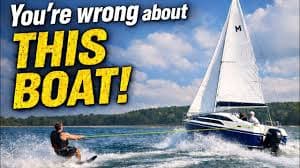
Water-ballast logistics are central to the MacGregor 26’s identity: a 1,200-pound water ballast system that fills after launch and drains for trailering reduces towing mass and enables the hull to be pulled by a standard vehicle, while a transom-mounted outboard up to 50 hp gives the boat planing capability in excess of 20 knots. That combination—trailering ease, motor planing, and shallow-water capability thanks to a fully retractable centerboard and twin kick-up rudders—shapes the boat’s transport, marina berthing, and operational footprint for owners and rental operators alike.
Design trade-offs and operational profile
The MacGregor 26 is often described as a hybrid between a sailboat and a powerboat. Its design prioritizes multi-use flexibility over pure sailing performance. The low-displacement-to-length ratio and relatively generous sail area make the boat perform well in light-air conditions, often outpacing heavier keelboats when breezes are gentle. Conversely, the water ballast approach lowers trailering weight but cannot match the low center-of-gravity stability provided by a fixed ballast keel. Owners report the practical workaround is conservative sail management—reefing early and reducing headsail area once winds exceed roughly 15 knots.
Under power, the MacGregor 26’s strengths become obvious: planing capability, the ability to tow waterskiers or engage in other motorized activities, and straightforward docking in shallow anchorages. These features make it a compelling choice for casual recreational sailors, families, and operators who need a single platform for mixed activities—sailing, fishing, and watersports.
📚 Vous aimerez peut-être aussi
Performance characteristics
Key operational characteristics include:
- Light-wind efficiency due to low displacement.
- Average upwind pointing because of high freeboard, wide sheeting angles, and fixed jib fairleads that limit close-hauled trim.
- Early reefing recommended in winds above 15 knots to maintain comfortable heel angles.
- Planing under power with a sufficiently sized outboard, expanding use cases beyond traditional sailing.
Construction, ownership expectations, and aftermarket upgrades
Construction quality has been a recurring talking point. Early testing noted cost-driven techniques—plywood-cored decks, minimal backing plates on deck hardware, and basic rigging components. Owners and reviewers agree that while factory fittings meet a basic threshold for the intended recreational role, many boats benefit from targeted upgrades: stronger backing plates, upgraded turnbuckles, travelers and vangs, and modern electronics. For many buyers the low initial price is part of the value proposition: purchase an affordable platform and tailor it with upgrades aligned to anticipated usage.
Interior and liveability
Despite being a 26-footer, the MacGregor delivers surprisingly generous cabin volume thanks to a beam near 8 feet and elevated freeboard. Standard accommodations often include a queen-size aft berth, a compact galley, and an enclosed head. Fit-and-finish tends toward utilitarian rather than luxurious, which aligns with the boat’s function-first philosophy: practical berthing and shelter for weekend outings rather than extended offshore passages.
| Attribute | Characteristic |
|---|---|
| Water ballast | ~1,200 lb, drains for trailering |
| Max outboard | Up to 50 hp (later models) |
| Planing speed | >20 knots under power |
| Beam | Nearly 8 ft |
| Production run | Approximately 7,000 units built |
Community, market fit, and controversy
The MacGregor 26 generates polarized opinion because it disobeys traditional sailing orthodoxy: critics prioritize keelboat stability, offshore seaworthiness, and pure sailing performance; proponents emphasize accessibility, low-cost entry, and multi-mode recreation. With roughly 7,000 units produced, the model carved out a sizable niche—demonstrating market demand for affordable, trailerable, and adaptable watercraft. Owners form active communities, sharing retrofit tips, handling advice, and recommended upgrades to align the platform with their boating goals.
Pros and cons
- Pros: Affordable acquisition, easy trailering, multi-activity capability (sailing, powerboating, watersports), shallow-water access, roomy interior for length.
- Cons: Less favorable upwind performance, tender behavior in stronger winds compared to keelboats, and initial construction compromises that may require aftermarket improvements.
Historical context and development
Trailerable sailboats gained traction in the postwar decades as road transport and leisure time expanded. The MacGregor 26 belongs to a lineage of trailer-sailers designed to broaden boating participation by removing marina dependence and high mooring costs. Roger MacGregor and his company popularized the concept of affordable, easy-to-own boats aimed at family and weekend sailors. Publications and test reviews from the 1980s noted the boldness of combining planing performance with trailer-friendly design, and subsequent models evolved incrementally—improving interior layouts and offering higher-spec options as the market matured.
Over time the model’s lifecycle reflected broader market dynamics: a tension between economic accessibility and the high expectations of performance-oriented sailors. As a historical artifact, the MacGregor 26 illustrates how design priorities can shift to meet evolving recreational patterns—trailering, multi-activity weekends, and the appeal of a single vessel that can serve as both sail cruiser and dayboat.
Outlook for charter, rental, and coastal recreation
Looking forward, the MacGregor 26-type concept remains relevant for operators in the rental and small-charter sectors. Its ease of trailering and shallow draft suit inland lakes, sheltered bays, and coastal marinas where quick turnarounds and versatile activity offerings (sailing, fishing, watersports) are competitive advantages. However, rental businesses should budget for routine reinforcement and selective upgrades to meet safety and customer-experience expectations—especially when offering skippered charters where passenger comfort and predictable handling matter.
Practical considerations for operators
- Invest in stronger deck hardware and modern electronics to improve reliability for charter clients.
- Provide clear handling briefings emphasizing reefing and sail trim to manage heel and passenger comfort.
- Position the boat in markets where beach launches, lakes, and protected gulf or bay waters predominate rather than open-ocean passages.
In summary: the MacGregor 26 is less a compromise and more a deliberate trade-off—sacrificing some pure-sailing benchmarks in order to deliver trailerability, multi-mode capability, and an affordable entry into boating. Its appeal lies with buyers and operators who value flexibility over pedigree performance.
The MacGregor 26’s legacy and present-day relevance touch directly on yacht charter and boat-rental dynamics: this platform can serve as an accessible rental asset for lakes and sheltered coasts, offering family-friendly boating, fishing, and yachting activities without the overhead of larger vessels. For readers seeking rentals or charters across popular destinations and marinas, GetBoat.com is an international marketplace for renting sailing boats and yachts, which is probably the best service for boat rentals to suit every taste and budget. The core takeaways remain clear: the MacGregor 26 emphasizes boat versatility, trailering logistics, and cost-effective entry into sailing and boating activities, making it a notable option for those prioritizing accessibility, varied on-water activities, and practical ownership or charter use.


