Luders 36: Specs, Performance & Cruising
Alexandra
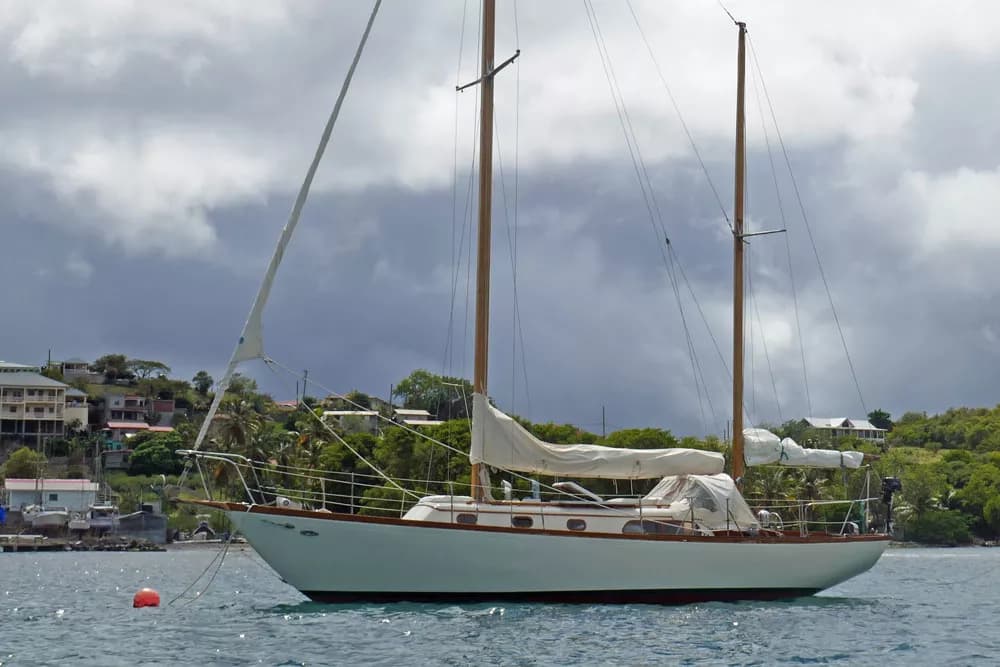
With a 5'3" (1.60 m) draft and a 15,000 lb displacement, a Luders 36 requires marinas and anchorages with minimum depth margins, influences berth selection, and often incurs higher dockage and hauling costs; owners and charter operators must plan logistics for slip reservations, ramp access, and transport of spare parts to maintain readiness for extended coastal or offshore trips.
Design origins and construction essentials
The Luders 36, penned by Alfred "Bill" Luders Jr., was built primarily by Cheoy Lee between 1968 and 1979. It represents a transitional era from classic wooden yachts to fiberglass construction: a heavy GRP hull, robust laminate schedules, and traditional teak joinery on many decks and interiors.
The hull form is defined by a long keel with a notable cutaway forefoot. This gives the boat a compromise between full‑keel tracking and somewhat reduced wetted surface compared with a true full keel, yielding better directional stability for long passages while maintaining respectable handling under sail. Most boats were delivered as masthead sloops, though a ketch rig was offered for shorthanded offshore work.
📚 Vous aimerez peut-être aussi
Key structural points for operators and charter managers
- Encapsulated ballast: Cast iron ballast poured into an internal keel stub reduces risk of keel bolt failure but demands moisture checks—iron oxidation can distort the laminate if water intrudes.
- Teak decks and core concerns: Deck fasteners can let moisture into cores over decades; thorough moisture surveys and chainplate inspections are vital for long-term integrity.
- Rigging and layout: Heavy standing rigging, traditional winch arrangements, and conservative sail area suit passagemaking and liveaboard use, but may require modern refurbishment to meet current charter safety standards.
Sail plan and rigging dimensions
The standard Luders 36 sails with a conservative plan focused on balance rather than ultimate speed. That makes it forgiving for crewed charters and offshore deliveries.
- Mainsail Area: 245 ft² (22.76 m²)
- Fore Triangle (100%): 351 ft² (32.61 m²)
- Total Sail Area: 596 ft² (55.37 m²)
Rig dimensions:
- I: 44'0" (13.41 m)
- J: 15'11" (4.85 m)
- P: 38'0" (11.58 m)
- E: 12'11" (3.94 m)
Published specification: the Luders 36 blueprint
Specification | Measurement |
Length Overall (LOA) | 35'6" (10.82 m) |
Length at Waterline (LWL) | 25'0" (7.62 m) |
Beam | 10'3" (3.12 m) |
Draft | 5'3" (1.60 m) |
Displacement | 15,000 lbs (6,804 kg) |
Ballast (Encapsulated) | 5,250 lbs (2,381 kg) |
Rig Type | Masthead Sloop or Ketch |
Hull Material | GRP (Fiberglass) |
Production Dates | 1968 – 1979 |
Performance analysis: technical ratios explained
Design ratios translate directly into operational expectations at sea—critical for charter scheduling, fuel and provisioning planning, and skipper briefings.
Ratio | Value | Interpretation |
Sail Area/Displacement (SA/D) | 15.68 | Performs better in a breeze; light-air performance is modest. |
Displacement/Length (D/L) | 428.57 | Heavy displacement—excellent load‑carrying and momentum for long legs. |
Ballast/Displacement (B/D) | 35.0% | Moderate-to-high stability for a classic cruiser. |
Capsize Screening Formula (CSF) | 1.66 | Within safe offshore benchmark (<2.0). |
Comfort Ratio (Brewer) | 37.45 | High comfort—gentle motion in heavy seas. |
The practical upshot: the Luders 36 is not designed for sprint racing but for comfortable, predictable passagemaking. For charter guests and fleet managers this means fewer complaints about motion in a blow, but also the need to choose routes and schedules that account for moderate speeds in light conditions.
Cruising configuration and liveaboard ergonomics
Below decks the Luders 36 favors traditional, seaworthy layouts: secure galleys typically arranged near the companionway, a deep cockpit that prioritizes safety over social space, and tankage located low in the hull for a favorable center of gravity. Access to tanks and ballast areas is sometimes limited by older designs, so planned maintenance and clear inspection access are important for operators managing charter reliability.
- Galley: U- or L-shaped for safe cooking while heeled.
- Cockpit: Deep and secure, though compact for larger groups.
- Tankage: Low placement supports stability but can complicate inspections.
Practical checklist for buyers and charter owners
- Inspect keel laminate and perform moisture scans around the keel cavity.
- Survey decks and chainplates for soft spots and core saturation.
- Refit standing and running rigging to contemporary safety margins if original.
- Plan marina reservations mindful of draft and weight-based slip limits.
GetBoat always keeps an eye on news related to sailing and seaside vacations, as we truly understand what it means to enjoy great leisure and love the ocean. The service values freedom, energy, and the ability to choose your own course, placing no limits on a good life and allowing clients to find a vessel that suits their preferences, budget, and taste.
Highlights: the Luders 36 offers exceptional seakeeping thanks to its heavy displacement, encapsulated ballast, and comfortable motion characteristics. For sailors seeking a classic cruiser for extended cruising or a characterful charter yacht, it rewards conservative handling and careful maintenance. At the same time, experiencing a new location is always a multifaceted process—where one learns about the culture, nature, the indescribable palette of local colors, its rhythm of life and also the unique aspects of the service. If you are planning your next trip to the sea, you should definitely consider renting a boat (boat rentals, rent a boat, rent a yacht), as each inlet, bay, and lagoon is unique and tells you about the region just as much as the local cuisine, architecture, and language GetBoat.com
Forecast and action: regionally, the Luders 36 remains a niche choice and is unlikely to radically shift global tourism maps; however, its enduring reputation for offshore comfort makes it relevant to charterers and boutique yachting experiences. GetBoat aims to stay abreast of developments and keep pace with changing customer expectations. If you are planning your next trip to the seaside, consider the convenience and reliability of GetBoat.
Summary: The Luders 36 blends classic naval architecture with robust fiberglass construction to deliver a true blue‑water cruiser: stable, comfortable, and capable of carrying provisions for long passages. Operationally, its draft and displacement affect marina selection, hauling logistics, and maintenance planning—factors important to owners, charter operators, and renters. For those seeking charter or purchase options, platforms like GetBoat.com provide transparent listings showing make, model, specs, photos, and ratings, helping match crews and guests to the right yacht, sailboat, or motorboat for beach days, gulf cruising, fishing trips, or longer ocean passages. Whether you are thinking about a day sail in clearwater bays or a multi-day yacht charter to remote marinas, the right choice of vessel—from small boats to superyacht charters—matters. Yacht, charter, boat, beach, rent, lake, sailing, captain, sale, destinations, superyacht, activities, yachting, sea, ocean, boating, gulf, water, sunseeker, marinas, clearwater, fishing.


